
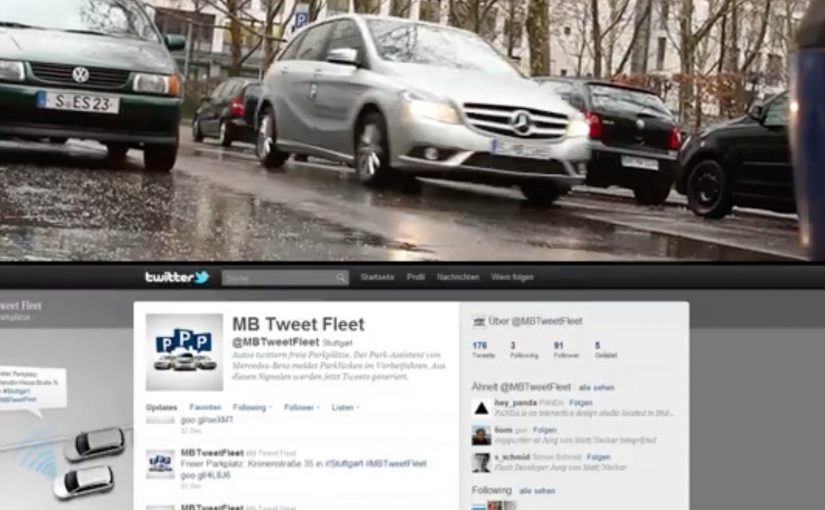
Mercedes-Benz: Tweet Fleet Parking on Twitter

The “Active Parking Assist” from Mercedes-Benz recognizes empty parking spaces by simply passing them. That brought ad agency Jung von Matt/Neckar to the idea that if the car knows where the empty parking spaces are, then everybody could also be informed.

So just before Christmas when parking spaces were hard to find, they launched the Mercedes-Benz Tweet Fleet with its Active Parking Assist that tweeted empty parking spaces in downtown Stuttgart.

The MBTweetFleet cars (the Tweet Fleet vehicles running the setup) automatically generated the tweets with GPS data via Arduino an onboard electronic and a PHP Relay. People could then follow @MBTweetFleet to find empty parking spaces near them on Twitter and be navigated there by the linked Google map.

Why this idea is stronger than it looks

The cleverness is not “tweeting”. The cleverness is turning a capability that already exists inside the car into a public utility. That flips a product feature into a service people can use immediately, without buying anything first. The real question is how you turn a private product signal into a public utility people can act on in seconds.

Extractable takeaway: If you can expose a reliable product signal as a live feed in a channel people already use, you can create immediate utility that beats a feature demo.

  • Signal becomes service. The car detects something useful. The system shares it.
  • Real-time context. Parking availability is only valuable when it is current.
  • Distribution is native. Twitter is a lightweight channel for fast, location-based updates.

The technical stack is simple, but the integration is the point

GPS plus an onboard controller plus a relay layer is not the story. The story is that data moves from sensing to publishing with minimal friction. Because publishing is automatic and immediate, the service stays relevant long enough for someone to navigate to it. That is what makes it feel “live”.

  1. Detect. Active Parking Assist identifies an empty space while driving.
  2. Locate. GPS attaches coordinates.
  3. Publish. An automated tweet shares the spot publicly.
  4. Act. People navigate using the linked map.

In European city centers, connected experiences win when they reduce search friction in the moment, not when they add more messaging.

In urban mobility and smart-city moments, public utility beats brand messaging when the value is immediate, local, and easy to act on.

What to take from this if you build connected experiences

  1. Start with a real pain point. Holiday parking pressure is a perfect use case.
  2. Make the feature externally visible. Utility grows when it helps non-owners too.
  3. Choose a low-friction channel. Where people already are beats “download our app”.
  4. Design for immediacy. Real-time value requires real-time delivery.

A few fast answers before you act

What is Mercedes-Benz Tweet Fleet?

It is a campaign in Stuttgart where Mercedes-Benz used Active Parking Assist to detect empty parking spaces and automatically tweet their locations so people could find and navigate to them.

Why does Active Parking Assist enable this?

Because it can recognize empty parking spaces as the car passes them, creating a reliable signal that can be shared.

How were the tweets generated?

The cars generated tweets automatically using GPS data, an Arduino-based onboard electronic component, and a PHP relay.

How did people use the service?

They followed @MBTweetFleet on Twitter and used the linked map in tweets to navigate to nearby empty spaces.

What is the transferable lesson?

If a product can sense something valuable in the real world, you can turn that sensing into a public utility by publishing it in a channel people already use.
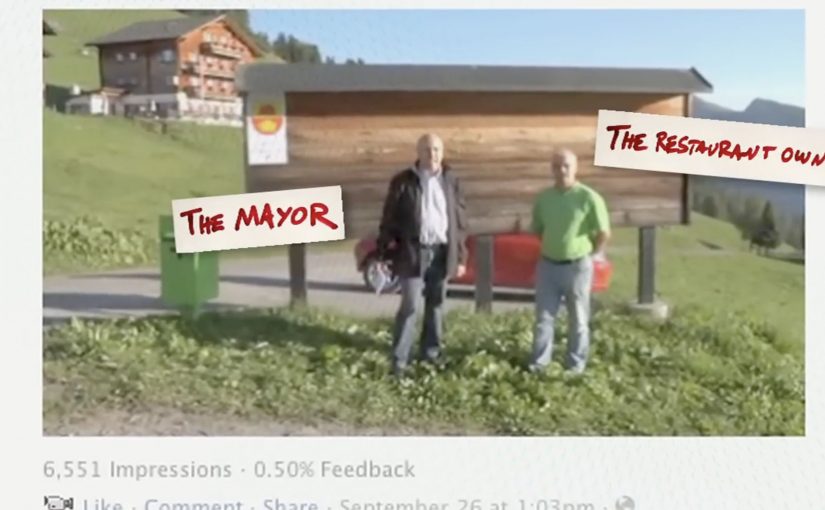
Obermutten: A Little Village Goes Global

Obermutten is a little mountain village in the Canton of Graubünden, Switzerland. It has around seventy eight residents and is known to virtually no one except a few hikers passing through now and then.

Now, millions of people around the world have reportedly either read about or heard of Obermutten, after Jung von Matt/Limmat created a simple Facebook campaign for Graubünden Tourism that put this small village on the world map. Media reports have reportedly appeared across many countries, including mentions on mainstream TV news in South Korea.

How? It began with a newly created village Facebook page where the local mayor made a remarkable promise via video: click “Like,” and your profile picture will be posted on the commune’s official notice board. In no time, the board was completely covered with fans. To deal with the flood of likes, they reportedly started hanging profile pictures on barn walls in the village. The community has reportedly grown to over 14,000 fans.

A promise that turns a “Like” into a physical souvenir

The mechanism is a simple exchange with a visible payoff. A tiny action online triggers a tangible reward offline. Your profile picture is printed and displayed publicly, which makes the relationship feel real, not symbolic. Each new photo also becomes proof for the next person considering whether to join.

In destination marketing for small places, visible social proof, meaning a growing wall of real faces that proves the promise is being kept, and low-friction participation can outperform paid reach when the reward is concrete and inherently shareable.

The real question is how a tiny place turns a one-click action into public belonging people want to share.

Why it lands

This works because it replaces abstract engagement with a human gesture. You are not “following a page.” You are being welcomed by a real village and given a public spot on a real wall. That emotional upgrade is what converts a novelty into a story, and a story into press and sharing. This is a smarter tourism idea than a bigger media buy because the participation itself becomes the attraction.

Extractable takeaway: When you turn a digital action into a physical, publicly visible reward, participation becomes contagious. People join to see themselves included, and the growing display becomes the marketing.

What destination marketers should steal from Obermutten

  • Make the reward tangible: if the payoff can be photographed, it spreads without asking.
  • Keep the promise binary: one action, one guaranteed outcome, no fine print in the core idea.
  • Design for accumulation: the “wall filling up” is the compounding asset that makes the story stronger over time.
  • Use a human voice: a mayor speaking is more believable than a brand slogan.
  • Let the proof do the persuasion: the growing number of displayed faces sells the idea better than any ad copy.

A few fast answers before you act

What did Obermutten do on Facebook?

They invited people to like the village Facebook page, with the promise that each fan’s profile picture would be printed and posted on the village’s official notice board, and later on barn walls as the number grew.

Why did this become global news?

The idea is easy to explain and easy to visualize. A tiny village publicly “welcoming” thousands of strangers creates an inherently newsworthy contrast, and it produces strong images for media coverage.

What is the core mechanic marketers can reuse?

Convert a low-friction digital action into a tangible, visible reward that accumulates over time. The accumulation becomes both proof and content.

Is this a tourism campaign or a social media campaign?

Both. It uses a social platform to generate participation, then translates that participation into offline visibility that functions like a tourism invitation and a PR engine.

What is the biggest risk with this approach?

If the reward is not genuinely delivered, the story collapses. The format depends on the promise being kept consistently, and on the physical display being maintained with care.

#The8N8 Twitter Campaign

A celebrity tweets a question about the new Nokia N8. You spot the clue, follow the celebrity, and race to reply with the correct answer before everyone else. Do it fast enough, and you earn the follow-back. Repeat until you have eight.

The brief. Launching the Nokia N8 on Twitter

Wunderman Buenos Aires is given the task to launch the new Nokia N8 smart phone. They create a Twitter-based activation campaign called #The8N8. Here, “activation” means a participatory game on Twitter, driven by clue tweets and timed replies.

The real question is whether you can turn product features into a race people choose to replay.

This is a strong Twitter launch mechanic because it forces people to learn features under time pressure, while making the reward publicly visible.

How it works. Clues, speed, and follow-backs

  • Nokia enlists top celebrities to tweet questions, clues, and features of the phone.
  • Users find the clues, follow the celebrity, and respond correctly in the fastest time.
  • The reward is the celebrity following the user back.
  • The first eight people to get eight celebrities to follow them back win the new Nokia N8.

In consumer electronics launches on fast-moving social platforms, attention windows are short and social proof is a primary currency.

Why the follow-back works

By making the reward a follow-back from a celebrity, the mechanic converts speed and accuracy into instant social proof, which is why participants keep replaying the hunt.

Extractable takeaway: When you attach a visible status reward to answering product-feature clues fast, you can make launch messaging feel like a game instead of an ad.

Results. Reach and follower growth

The campaign is reported to reach 300,000 Twitter users. It is also reported to increase Nokia’s fan base on Twitter and Facebook by over 100%.

How to reuse the mechanic in a launch

  • Turn features into clues. Write prompts that translate key features into quick, answerable questions.
  • Make speed the differentiator. Keep the rule simple. First correct reply earns the follow-back.
  • Keep the reward visible. A follow-back is public, so the prize doubles as social proof.
  • Use a clear finish line. “Eight follow-backs” makes progress legible and creates urgency.

A few fast answers before you act

What is #The8N8?

A Twitter-based activation by Wunderman Buenos Aires to launch the Nokia N8.

What do participants actually do?

They follow participating celebrities, answer their clue tweets correctly, and do it faster than others to earn follow-backs.

What is the win condition?

Be among the first eight people to get eight celebrities to follow you back.

What are the reported outcomes?

Reported reach of 300,000 Twitter users and reported fan base growth on Twitter and Facebook by over 100%.

What is the transferable mechanic?

Turn product messaging into a speed-based game that rewards social proof. Here, that social proof is the follow-back.