
SAS: Up for Grabs on Facebook

To promote a million-seat fare sale, Scandinavian Airlines (SAS) and Crispin Porter + Bogusky Stockholm ran a Facebook competition where fans could “grab” a free trip. The ask was visual and dead simple, and it turned participation into the media.

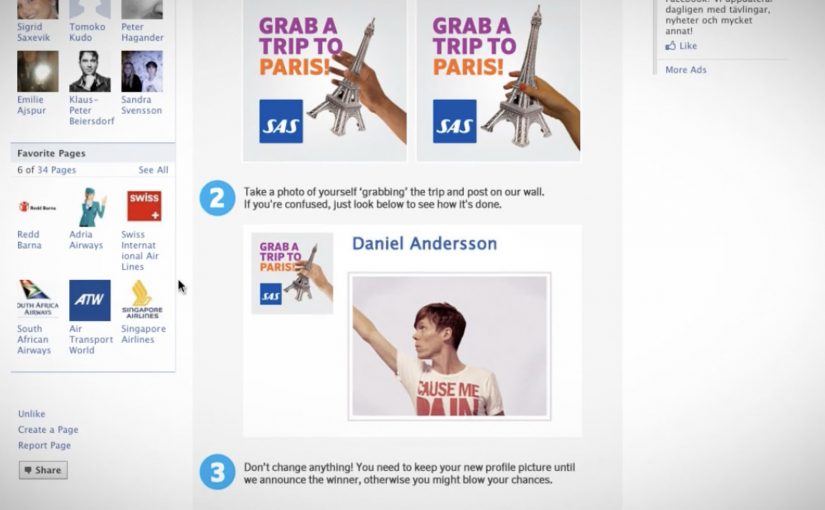
Fans changed their profile picture into a custom “Up For Grabs” image, then posted a matching photo on the SAS Facebook wall where they physically “grabbed” the trip. Every entry looked like an ad, and every ad looked like a friend.

The mechanic that turns fans into distribution

The campaign’s mechanism was a two-step loop. First, replace your profile image with a branded frame that signals you are “in”. Second, publish a playful photo on the brand wall that demonstrates the concept, grabbing the prize. That wall then becomes a live gallery of social proof, with each new post re-selling the fare sale in a more human way than a banner ever could.

In airline marketing, promotions that convert participation into shareable images can outperform price-only fare announcements.

Why it lands

It turns an abstract offer into a physical gesture. “Grab a trip” becomes something you can perform, photograph, and show. The profile-picture switch is a light commitment that broadcasts intent, and the wall post is a public performance that invites imitation. The momentum comes from visibility, because the more entries you see, the more “normal” it feels to join.

Extractable takeaway: When you need scale fast, design one participation artifact that doubles as an ad unit, and make the action easy enough that people will copy it without instructions.

What the shutdown reveals about the strategy

The campaign was reportedly against Facebook promotion terms, and it was shut down. That ending is part of the story, because it highlights the tightrope of social-first promotions. The creative is built on a behavior Facebook historically restricts for contest entry, asking people to publish specific content as a condition of participation, even if the idea is clever and the buzz is real.

The real question is whether the participation mechanic can spread the offer without depending on a platform behavior that can be switched off overnight.

The stronger strategic read is that the creative idea is right, but the distribution mechanic is too dependent on borrowed platform rules.

What to steal for your own launch

  • Make the entry format the message. If the entry itself demonstrates the offer, you get free repetition of the proposition.
  • Use a low-friction first step. Profile-picture frames and templates work because they are fast and socially legible.
  • Design a single visual trope. “Grabbing” is a trope anyone can reproduce, and that consistency creates a recognizable feed.
  • Build compliance in from day one. If the mechanic depends on prohibited platform behaviors, plan a compliant alternative before launch.

A few fast answers before you act

What is the core idea of Up for Grabs?

A Facebook contest where fans change their profile picture to a branded frame and post a “grabbing the trip” photo on the SAS wall to compete for a free flight.

Why does the profile-picture step matter?

It turns participation into persistent visibility. The frame signals “I am in”, and it spreads through everyday browsing without requiring an additional media buy.

What made the campaign travel beyond the SAS page?

Each entry was both participation and promotion. When fans changed their profile picture and posted a matching photo, the fare sale moved into personal networks instead of staying inside brand media.

Why was it shut down?

It was reportedly closed for violating Facebook promotion rules by conditioning entry on specific platform actions, such as posting photos on the wall.

How do you keep the upside without the platform risk?

Keep the visual template and the “grab” trope, but move the submission mechanic to a compliant entry flow, then allow optional sharing that is not required to participate.

The first pre-launch of a car using Twitter

Twitter is only just taking off in Argentina, and Wunderman Buenos Aires managed to convince Ford to run the pre-launch on Twitter, with great success.

The idea was to give the most followed twitterer in Argentina the one and only new Ford Fiesta available in the country, with the condition that he drive it for 5 straight days, tweeting about his experience. That alone is not new, but the twist was smart. Some of the most famous TV stars jumped in the car and tweeted mini interviews while being driven around in the new Fiesta.

After just 5 days, the campaign had reached over 200,000 people. That is 50% of all Twitter users in Argentina.

Why this pre-launch mechanic works

It turns product access into a live narrative. One car. One highly followed driver. A fixed time window. That constraint creates focus and makes the story easy to follow in real time. The celebrity ride-alongs add a second layer. They keep the feed fresh, they pull in adjacent audiences, and they make the tweets feel like content rather than a running spec sheet.

Extractable takeaway: when a launch gives one person visible access, a tight time window, and guest moments that refresh the feed, the audience gets a story worth following instead of a stream of product claims.

What Ford was really buying

In early social-platform launches, the brand advantage comes from turning limited product access into visible public momentum.

The real question is how to make scarcity feel socially alive before the wider market can experience the product.

The smart move here is not the tweet volume by itself. It is the decision to turn one hard-to-get car into a public format that keeps generating reasons to look again.

What to steal for your next social launch

  • Give someone real access. Scarcity is a stronger signal than claims.
  • Put a clock on it. A defined window creates urgency and repeat checking.
  • Add format variety. Mini interviews change the rhythm and widen appeal.

A few fast answers before you act

What made this a “pre-launch” on Twitter?

The story unfolded through live tweets before broad availability, anchored by one high-profile driver and one car.

What was the core execution?

Argentina’s most followed twitterer drove the country’s only new Ford Fiesta for 5 straight days and tweeted the experience.

What was the twist beyond a standard influencer test drive?

TV stars joined the ride and tweeted mini interviews while being driven around.

What result is highlighted?

After 5 days, the campaign had reached over 200,000 people, described here as 50% of Argentina’s Twitter users.

What is the main takeaway?

Make the launch feel like an event, not an announcement. Access plus a live format beats static messaging.

Facebook integration at the Coca Cola Village

A teenager enters Coca Cola Village in Israel wearing a wristband that carries their Facebook credentials. Each time they swipe at an attraction, their Facebook status updates instantly with what they are doing. The village behaves like a live social feed, powered by real-world actions.

The activation. Turning an event into a live Facebook layer

Publicis (E-dologic) and Promarket develop an experiential event for Coca Cola Israel that syncs everyone who participates with their friends on Facebook in real time.

Here, “integration” means the event turns real-world actions into predictable Facebook posts and photo tags.

The real question is whether you can turn on-site participation into shareable proof without asking people to stop and post.

This pattern beats “share this” prompts because publishing becomes the default outcome of participation.

How entry works. Caps plus friends

The Coca Cola Village 2010 event runs through Facebook. Teenagers collect 10 Coca Cola caps, plus eight friends who do the same. After registering online through Facebook, they receive exclusive entry.

How the wristband works. Swipe to post, shoot to tag

At the Coca Cola Village, participants set up a special wristband designed to securely hold their Facebook login and password. In practice, it is a scannable wristband that identifies the participant at event touchpoints. Every swipe triggers an immediate status update about what they are doing at the event, keeping friends up to date as it happens. The wristband also enables automatic tagging of photos taken at the village.

In youth-focused FMCG activations, the win is to make sharing a byproduct of participation, not a separate task.

The scale effect. When participation becomes publishing

The event holds 650 teenagers a day. With seamless Facebook integration, they generate 35,000+ posts per day across three days, totaling 100,000+ posts for the event.

Why this works. Social actions move from screen to space

This is what “integration” looks like when it is not a logo on a wall. The social network becomes a behavior layer inside the event. Because the swipe is the trigger, posting becomes as easy as participating. The wristband reduces friction, the swipe makes publishing physical, and the photo tagging closes the loop by spreading proof of participation back into the feed.

Extractable takeaway: If you want social scale from an experience, bind sharing to a simple physical ritual people repeat, not to a “remember to post” moment.

Design moves worth copying

  • Credential once. Do the setup up front, then let participation drive sharing automatically.
  • Make the trigger physical. Tie posting to a repeatable on-site action (the swipe), not a manual step.
  • Close the proof loop. Auto-tagging turns attendance into visible evidence that travels beyond the venue.
  • Design for repetition. The easier the ritual is to repeat, the more output you get without extra prompting.

A few fast answers before you act

What is Facebook integration at the Coca Cola Village?

An experiential event in Israel where an RFID-style wristband connects on-site actions to real time Facebook posting and photo tagging.

How do people get access?

By collecting 10 Coca Cola caps and eight friends who do the same, then registering through Facebook for entry.

What does the wristband do?

It securely holds Facebook login details and posts instant status updates whenever participants swipe at attractions. It also enables automatic photo tagging.

What is the reported scale of social output?

650 teenagers per day, generating 35,000+ posts per day across three days for 100,000+ total posts.

What is the transferable pattern for brands?

Make social sharing an outcome of physical participation, not a separate step. Reduce friction and tie posting to clear, repeatable actions.