
SAS: Up for Grabs on Facebook

SAS: Up for Grabs on Facebook

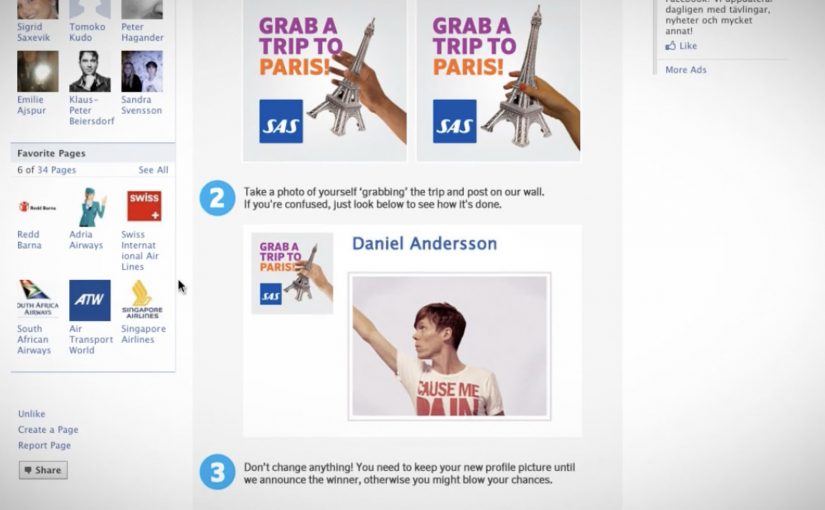
To promote a million-seat fare sale, Scandinavian Airlines (SAS) and Crispin Porter + Bogusky Stockholm ran a Facebook competition where fans could “grab” a free trip. The ask was visual and dead simple, and it turned participation into the media.

Fans changed their profile picture into a custom “Up For Grabs” image, then posted a matching photo on the SAS Facebook wall where they physically “grabbed” the trip. Every entry looked like an ad, and every ad looked like a friend.

The mechanic that turns fans into distribution

The campaign’s mechanism was a two-step loop. First, replace your profile image with a branded frame that signals you are “in”. Second, publish a playful photo on the brand wall that demonstrates the concept, grabbing the prize. That wall then becomes a live gallery of social proof, with each new post re-selling the fare sale in a more human way than a banner ever could.

In airline marketing, promotions that convert participation into shareable images can outperform price-only fare announcements.

Why it lands

It turns an abstract offer into a physical gesture. “Grab a trip” becomes something you can perform, photograph, and show. The profile-picture switch is a light commitment that broadcasts intent, and the wall post is a public performance that invites imitation. The momentum comes from visibility, because the more entries you see, the more “normal” it feels to join.

Extractable takeaway: When you need scale fast, design one participation artifact that doubles as an ad unit, and make the action easy enough that people will copy it without instructions.

What the shutdown reveals about the strategy

The campaign was reportedly against Facebook promotion terms, and it was shut down. That ending is part of the story, because it highlights the tightrope of social-first promotions. The creative is built on a behavior Facebook historically restricts for contest entry, asking people to publish specific content as a condition of participation, even if the idea is clever and the buzz is real.

The real question is whether the participation mechanic can spread the offer without depending on a platform behavior that can be switched off overnight.

The stronger strategic read is that the creative idea is right, but the distribution mechanic is too dependent on borrowed platform rules.

What to steal for your own launch

  • Make the entry format the message. If the entry itself demonstrates the offer, you get free repetition of the proposition.
  • Use a low-friction first step. Profile-picture frames and templates work because they are fast and socially legible.
  • Design a single visual trope. “Grabbing” is a trope anyone can reproduce, and that consistency creates a recognizable feed.
  • Build compliance in from day one. If the mechanic depends on prohibited platform behaviors, plan a compliant alternative before launch.

A few fast answers before you act

What is the core idea of Up for Grabs?

A Facebook contest where fans change their profile picture to a branded frame and post a “grabbing the trip” photo on the SAS wall to compete for a free flight.

Why does the profile-picture step matter?

It turns participation into persistent visibility. The frame signals “I am in”, and it spreads through everyday browsing without requiring an additional media buy.

What made the campaign travel beyond the SAS page?

Each entry was both participation and promotion. When fans changed their profile picture and posted a matching photo, the fare sale moved into personal networks instead of staying inside brand media.

Why was it shut down?

It was reportedly closed for violating Facebook promotion rules by conditioning entry on specific platform actions, such as posting photos on the wall.

How do you keep the upside without the platform risk?

Keep the visual template and the “grab” trope, but move the submission mechanic to a compliant entry flow, then allow optional sharing that is not required to participate.

Toyota: A Glass of Water

Toyota: A Glass of Water

A Glass of Water is a challenge created by Saatchi & Saatchi Stockholm for Toyota in Sweden. Its mission is to help drivers cut down their fuel consumption by 10% and reduce CO2 emissions, aligned with Toyota’s stated zero-emission vision.

When drivers register on the program website, they accept the challenge to place a glass of water on their dashboard or cup holder, then drive in a smooth manner that avoids spillage.

According to Toyota, the less you spill, the gentler you drive. Therefore the less fuel you consume.

A rule you can test on your next drive

The brilliance is the simplicity. No special car, no expert coaching, no complicated scorecard. Just a physical feedback loop that makes every harsh brake and every aggressive turn visible in the most basic way possible.

How the mechanism teaches eco-driving

Spilling is the metric. If you keep the water steady, you are accelerating, braking, and cornering more smoothly. That smoother style tends to reduce wasteful energy spikes, which is the same principle behind most eco-driving advice, translated into something you can feel immediately.

In European automotive marketing, behavior-change challenges work best when the rule is simple enough to try on the next drive.

Why it lands

It turns an abstract goal. “reduce fuel consumption”. into a personal game with instant feedback. The glass makes you self-correct without being told what to do, and it makes eco-driving feel like mastery rather than sacrifice. It also travels well as a story because anyone can explain it in one sentence.

Extractable takeaway: If you want people to change a daily behavior, give them a physical, low-effort indicator that converts “doing better” into a visible result they can improve on.

What Toyota is really buying

This is not just awareness. It is repeatable participation. Each drive becomes a new attempt, and each attempt reinforces the brand’s association with smarter, calmer driving rather than with lecturing about emissions.

The real question is how to make smoother driving feel self-evident and repeatable, not how to explain eco-driving more forcefully.

What to steal from the water-glass challenge

  • Use a single, legible metric. Spills are binary and instantly understood.
  • Make the feedback loop physical. Physical cues outperform abstract dashboards for habit shifts.
  • Lower the start barrier to almost zero. If people can start today, they will.
  • Turn restraint into skill. People adopt habits faster when it feels like competence.

A few fast answers before you act

What is A Glass of Water?

A driving challenge where you place a glass of water on the dashboard or cup holder and try to drive smoothly enough not to spill, as a proxy for reducing fuel consumption.

Why does “not spilling” relate to fuel savings?

Because avoiding spills requires gentler acceleration, braking, and cornering. That smoother driving style tends to reduce inefficient energy spikes.

What makes this different from typical eco-driving advice?

It replaces instructions with immediate feedback. The glass shows you how you are driving without needing an expert or a complex display.

What is the biggest risk with this kind of challenge?

If people treat it as a stunt rather than a habit tool, the effect fades quickly. The challenge needs repetition to translate into lasting driving style change.

How should a brand measure success for a behavior challenge like this?

Participation volume, repeat participation, and any measured or self-reported fuel consumption improvement among participants, not only views or clicks.

Volkswagen: The Speed Camera Lottery

Volkswagen: The Speed Camera Lottery

The winning idea of the Volkswagen fun theory award was submitted by Kevin Richardson, USA.

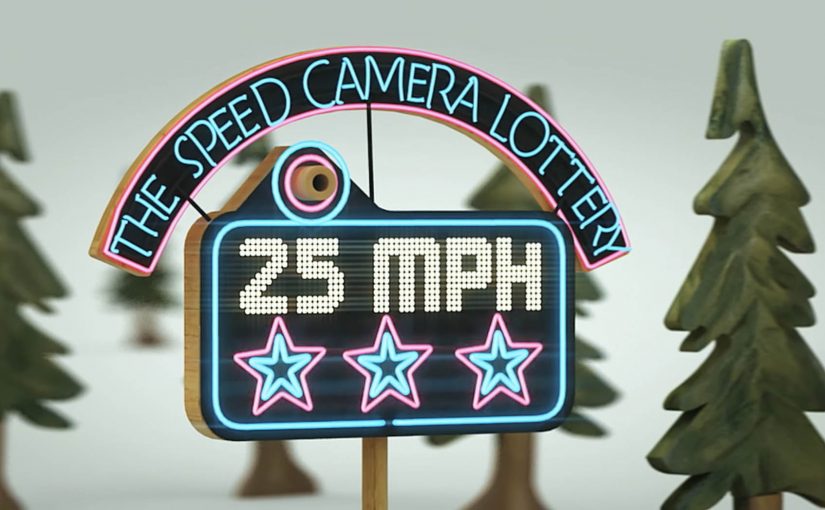
Can we get more people to obey the speed limit by making it fun to do. This is the question Kevin’s idea answers, and Volkswagen, together with The Swedish National Society for Road Safety, makes the idea real in Stockholm, Sweden.

A speed camera that rewards, not just punishes

The core twist is simple. The concept is described as a lottery wrapped around a speed camera. Drivers who pass at or under the speed limit are entered into a draw. The prize money is described as coming from the fines paid by drivers who speed.

That inversion matters because it changes the emotional frame. Instead of “the camera is there to catch me”, the camera becomes “a chance to win if I do the right thing”.

The mechanic: turn compliance into a game loop

The loop is short and repeatable:

  • Trigger: you approach the monitored zone.
  • Action: you choose to stay within the limit.
  • Reward: you are entered into a lottery, and someone wins.
  • Reinforcement: the story travels because “I won by driving properly” is novel.

Why it lands: it makes “doing the right thing” emotionally positive

Most enforcement is built on fear of loss. This flips motivation into the hope of gain, without removing consequences for speeding. It keeps the stick, but adds a carrot that people actually want.

Extractable takeaway: If you want everyday behavior to change, do not only increase the cost of the bad action. Add a visible, repeatable reward for the good action, and make the reward easy to understand in one glance.

In urban road-safety environments, messaging often underperforms because it feels like punishment instead of shared benefit.

The real question is how to make compliance feel desirable often enough that people repeat it without being re-taught each time.

What the brand really gets from this

Volkswagen is not selling a feature here. It is sponsoring a philosophy. Make better choices feel desirable, and the brand becomes associated with modern, optimistic problem solving rather than lecturing.

That is also why the execution travels so well as a film. It is a simple story with a surprising twist, and it is easy to retell without technical explanation.

What to steal for your own behavior-change campaign

  • Pay attention to framing: the same rule feels different when it is presented as “win” versus “don’t get caught”.
  • Make the rule legible instantly: people must understand the mechanic in seconds.
  • Design for repeat exposure: behavior change needs loops, not one-off impressions.
  • Fund rewards credibly: link the reward source to the problem so it feels fair.
  • Keep it measurable: define the behavior metric first, then build the experience around it.

A few fast answers before you act

What is the Speed Camera Lottery?

It is a road-safety concept where drivers who obey the speed limit are entered into a lottery, making compliance feel rewarding rather than purely punitive.

Why does adding a lottery change behavior?

It introduces a positive incentive that people talk about. The hope of gain can be a stronger daily motivator than the fear of a fine for many drivers.

Does this replace enforcement?

No. The idea is described as keeping normal enforcement for speeding, while adding a reward layer for drivers who comply.

What makes this a “Fun Theory” idea?

It tries to prove that fun, not just rules, can shift behavior. The experience makes the better choice feel more attractive in the moment.

What should you measure if you copy this?

Average speed and speed variance at the intervention point, compliance rate over time, and whether the effect persists once novelty fades.