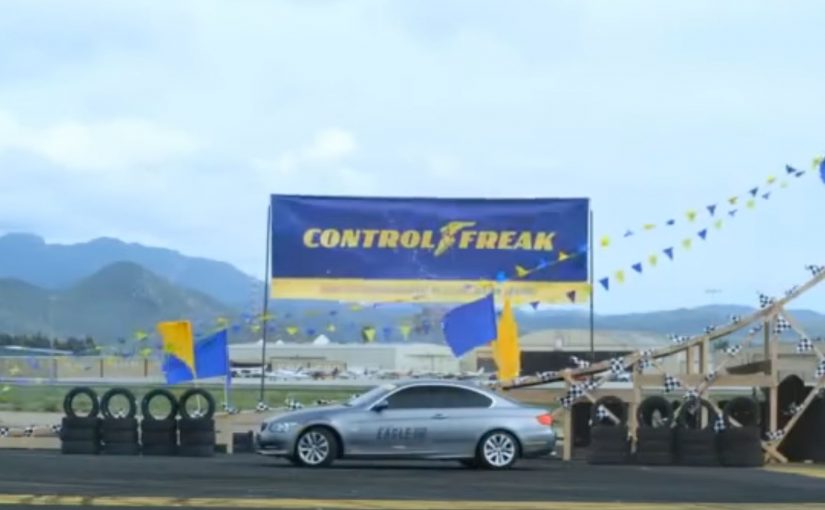
Goodyear does not try to “tell” you that a tire grips better. They stage a test drive that makes you feel it.
A customer walks into a Goodyear retail store expecting the usual sales conversation. Instead, a salesman offers a test drive. The customer gets into a performance car with what looks like a normal driver. Then the drive turns into a controlled, choreographed, Hollywood-grade demonstration. The driver is a disguised stunt professional. The “test route” includes conditions that exaggerate what traction and control actually mean when things get unpredictable.
That single choice is the unlock. The product story is no longer a brochure. It is an experience.
The idea in one line
Goodyear turns a retail test drive into entertainment that proves performance.
Why this works so well
Most tire marketing struggles with the same problem. Performance is hard to visualize until you are already in a situation where you need it. “Better grip” sounds like every other claim until something slips.
This activation removes that abstraction by doing three things at once:
- It makes proof visible.
The story is designed around moments where traction and handling show up as a physical result. You do not need to understand tread compounds to understand what you just felt.
- It creates real human reaction.
A staged product demo can feel like a stunt. A real customer reaction makes it believable, and shareable, at the same time.
- It anchors the brand in the point of sale.
This is not a distant TV spot. The narrative starts inside the tire store. The purchase context is baked into the content, so the jump from awareness to intent is shorter.
The “retail first” storytelling pattern
A lot of experiential marketing starts with spectacle, then tries to connect it back to the product.
This one starts with the most ordinary commercial moment. A customer is about to buy tires. Then the experience expands outward. That sequencing matters, because it keeps the brand motive clear. This is not adrenaline for its own sake. It is a dramatic way to demonstrate a benefit that is otherwise invisible.
If you are a brand leader trying to justify experiential investment, this is a useful blueprint. It is not “brand theater.” It is a product demonstration that happens to be entertaining enough to travel.
What to borrow if you run marketing or commerce
Design for “proof moments,” not messages
Write down the one thing a customer must believe for your product to win. Then ask what they would need to see, feel, or experience for that belief to become non-negotiable.
Build the experience around the buying context
Placing the opening scene in a retail outlet removes friction. The story is already where the decision happens. For many categories, that is the most underrated advantage.
Treat the camera as a distribution strategy
The activation is designed to be filmed. Multiple angles. Real people. A sequence that escalates. In practice, the video becomes the scalable media layer on top of a physical stunt.
Make the customer the hero, not the brand
The most memorable part is not a feature list. It is the reaction. The brand earns attention by giving the customer an experience worth talking about.
The deeper point
This is a category where functional proof usually loses to price promotions and familiarity. Goodyear flips that by turning functional proof into an event.
It is a reminder that “performance marketing” does not always mean dashboards and retargeting. Sometimes it means engineering a moment where the product benefit cannot be unseen.
A few fast answers before you act
What is the campaign actually demonstrating?
It demonstrates traction and handling in exaggerated all-season conditions, so the benefit becomes tangible.
Why stage it in a retail store instead of a track?
Because the purchase decision lives in retail. The story starts where intent is highest.
What makes this feel credible instead of gimmicky?
Real customer reactions plus a clear link between the stunts and the product promise. The entertainment serves the proof.
What is the repeatable lesson for other categories?
Find your “invisible benefit” and create a safe, dramatic way to make it visible, then film it for scale.
When does this approach fail?
When the experience is spectacle with no causal link to a product benefit. If you cannot explain what is being proven, you are buying attention, not belief.