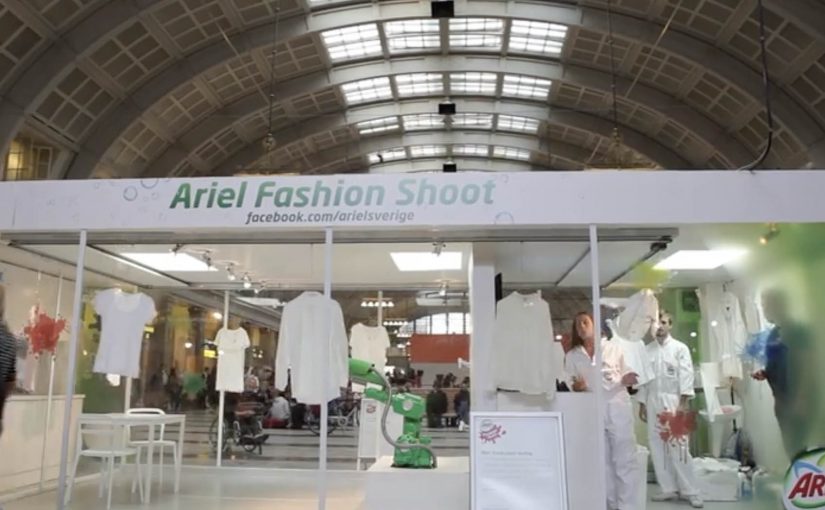
Procter & Gamble Nordics, in collaboration with Saatchi & Saatchi Stockholm, B-Reel and Atomgruppen, creates an interactive campaign centered on a specially built glass installation in Stockholm Central Station, Sweden.
For one week, passers-by at Stockholm Central Station can watch designer clothes hung on a washing line being soiled by ketchup, drinking chocolate and lingonberry jam via fans on the Ariel Sweden Facebook page (or Denmark, Norway, Finland equivalents).
The mechanic: stain it from Facebook, then win it back clean
In order to win the designer clothes, Ariel fans use a Facebook-controlled industrial robot cannon to soil them. The stained clothes are then sent in the post after being washed on-site with regular Ariel Actilift.
In high-traffic European transit hubs, the strongest “social media” ideas are the ones that visibly change the physical world in front of everyone, not just the feed.
Why it lands: it makes participation feel consequential
This is a neat reversal of how most product demos work. Instead of the brand creating a controlled “before and after”, it invites the audience to create the mess themselves, then proves the wash result under public scrutiny.
Extractable takeaway: If you want participation that people remember, make the audience’s input irreversible in the moment, then let your product do the recovery. The contrast between “I caused this” and “it still comes out” is stronger than any claim line.
The glass box is doing strategic work. It turns a Facebook click into a visible event for commuters, which makes the campaign feel bigger than the people who are actually playing.
What the campaign is really selling
At a surface level it is a stunt to win clothes. At a deeper level it is reassurance. The mess is extreme and deliberately unglamorous, so the cleanliness result reads as confidence, not a carefully staged demo.
The real question is whether a Facebook click creates enough public consequence to make the cleaning proof feel worth watching.
What to steal for your next social-plus-physical idea
- Let the audience create the proof: user-generated “inputs” that change the outcome are more persuasive than brand-controlled setups.
- Use a public stage: a transparent environment creates trust because the product has nowhere to hide.
- Keep the control surface simple: one clear action. One obvious effect. No complicated UI.
- Design a real reward path: the prize should be operationally credible, not a vague “chance to win”.
- Make the brand step undeniable: show the product moment on-site so the claim is witnessed, not narrated.
A few fast answers before you act
What is the core idea of this Ariel activation?
A Facebook interface controls a robot cannon that stains designer clothes in a glass installation. Ariel then washes the clothes on-site, and participants can win the cleaned items.
Why combine Facebook with a physical installation?
Because it turns digital participation into a public spectacle. The online action has a visible consequence in the real world, which makes it more engaging and more shareable.
What product truth is being demonstrated?
That Ariel can handle tough, visible stains. The audience creates the stains, and the brand shows the wash outcome under observation.
What makes this different from a normal product demo?
The brand gives up control of the “mess creation” to the public. That makes the demonstration feel less scripted and more credible.
What should you measure if you run something like this?
Participation rate, dwell time at the installation, social engagement tied to the control interface, earned media pickup, and any lift in product consideration during the activation window.