
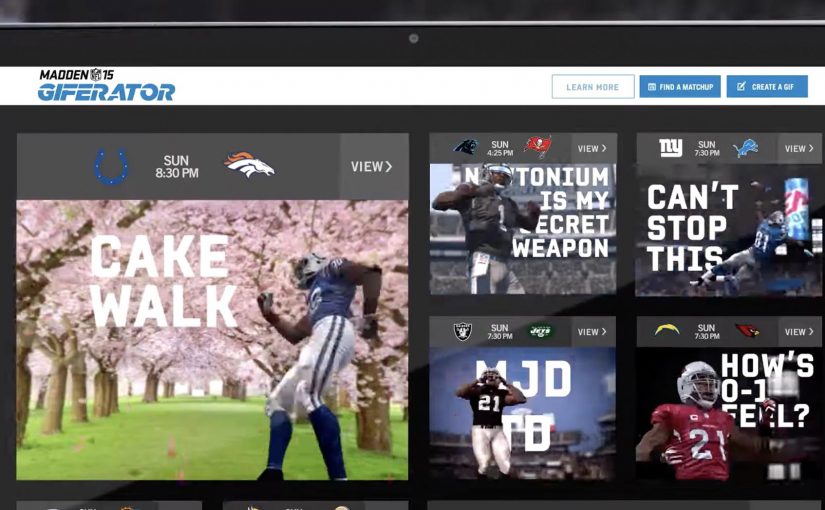
EA SPORTS: Madden NFL 15 GIFERATOR

To launch their new game Madden NFL 15, EA Sports wanted to connect with young, football-obsessed fans and grow its association with the real world NFL. Since the average football fan was watching the game with their smartphone in hand, EA teamed up with Google to allow sport fans to provoke rivals from the comfort of their own sofa and bring trash talk into the 21st century.

Using pioneering technology, live NFL data was fused with Madden 15 game footage to generate GIF highlights for every single game. All of this was delivered via real-time ads across sports websites and apps. As a result there was an ever growing collection of GIFs that football fans could simply take, edit and share to shove in the face of their rivals.

How the GIFERATOR works

The mechanic is a real-time trigger loop. As live NFL moments happen, a data signal maps those moments to a library of Madden NFL 15 visuals, headlines, and team-specific ingredients. The system then assembles a ready-to-share GIF that matches what fans are watching, right when the emotion spike is highest.

In sports marketing, second-screen behavior turns live moments into shareable social currency.

Why it lands

The creative idea is not “GIFs”. It is timing plus relevance. Because the asset shows up while the emotion spike is still live, it feels native to the fan conversation instead of delayed brand content. When fans are already checking stats, group chats, and social feeds mid-game, you meet them where their thumbs already are. The format just happens to be the internet’s fastest unit of trash talk.

Extractable takeaway: If you can translate a live moment into a personalized, ready-to-share asset within the same minute, you convert attention into participation, and participation into distribution.

Where the real value sits

The real question is how to make a boxed game feel as live, social, and rivalry-ready as the sport it simulates.

This is also a credibility move. By fusing live NFL action with Madden footage, the game positions itself as culturally current, not just a boxed product. It borrows the emotional heat of real games and channels it into the Madden universe, play after play.

What second-screen marketers should steal

  • Build a trigger map: define which live signals create which assets, and keep the mapping simple enough to scale all season.
  • Design for viewer control: let people tweak copy or choose variants, so the output feels like “mine”, not “an ad”.
  • Win the second screen: deliver creative where fans already browse during live events, not only on your owned channels.
  • Make rivalry the editor: structure content around opponents, not around generic brand lines, so sharing feels inevitable.
  • Ship a content engine, not a one-off: the compounding library is the advantage, because it stays fresh week after week.

A few fast answers before you act

What is the Madden GIFERATOR?

It is a real-time GIF creation system that generates Madden NFL 15-themed GIFs that match what is happening in live NFL games, designed for instant sharing and trash talk.

Why does “real-time” matter here?

Because it catches fans during peak emotion. The closer the asset appears to the live moment, the more it feels like part of the conversation instead of an interruption.

What is the core pattern to reuse?

Use live signals to automatically assemble relevant, lightweight assets, then distribute them on the channels people naturally use while watching.

Is this mainly a social campaign or an ad campaign?

Both. The distribution is described as real-time advertising across sports sites and apps, while the product experience is built for fans to edit and share the output socially.

What is the biggest execution risk?

Relevance drift. If the mapping from live moments to generated assets feels off, or if the output arrives too late, it stops feeling “in the game” and becomes just another banner.
Ralph Lauren: Polo 4D

In September 2012, Hugo Boss live streamed its Boss Black Fall Winter 2012 fashion show directly in 3D. Now fast forward to 2014 and Ralph Lauren launches their Polo for Women Spring 2015 collection via a cinematic 4D experience. Here, “4D” means a physical projection experience that uses water, light, film, and live atmosphere to create depth and immersion.

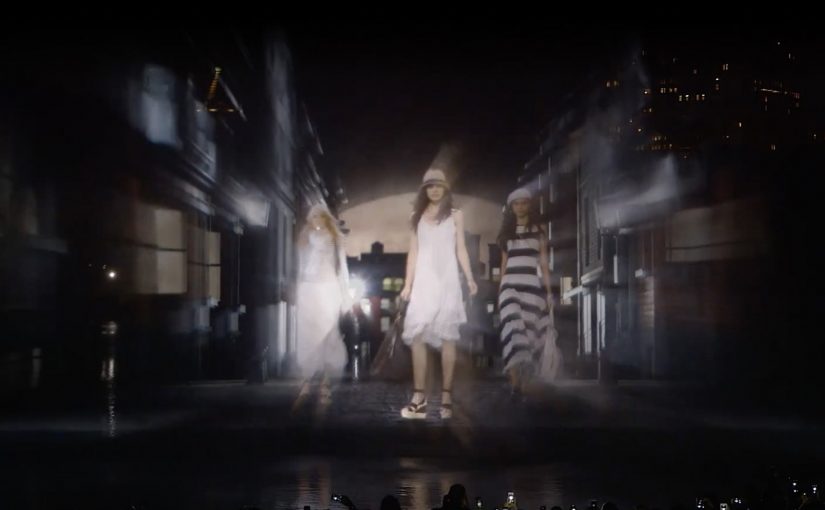
On the evening of September 8th, during New York Fashion Week, Ralph Lauren turns the idea of a runway into a 60-foot-tall water-screen projection that towers above Manhattan’s Central Park, fusing fashion, art, and technology.

A runway made of water, light, and film

The mechanism is a projection-mapped water screen that functions like a living canvas. High-resolution scenes and “models” are projected onto a fan-shaped spray of water, creating the effect of figures moving across a surface that reads as a runway, even though it is literally water.

In global fashion marketing, immersive show formats are used to signal modernity and earn attention beyond the invited audience.

Why it lands

This works because it treats the collection launch as a public cultural moment, not a closed industry ritual. The scale is instantly legible. The format borrows from cinema. The setting adds myth. Central Park at night turns the presentation into something people talk about even if they cannot describe the garments in detail. Because the water-screen illusion reduces the show to one instantly retellable image, the experience travels beyond the guests who were physically there.

Extractable takeaway: When your category is saturated with beautiful imagery, compete on format. If the show itself becomes the story, the brand gets disproportionate reach without relying on louder messaging.

What Ralph Lauren is really doing

The real question is whether the launch format can make Polo for Women feel more culturally current than a conventional runway could. Ralph Lauren is using spectacle less to explain the collection than to position Polo as a modern media brand. The 4D framing functions as a brand statement. It positions Polo for Women as contemporary and city-native, and it uses spectacle to bridge runway tradition with a media behavior that is already screen-first.

What brand launch teams can borrow

  • Choose a “native stage”. A location with cultural meaning can do as much work as the production itself.
  • Make scale part of the idea. If it reads in one glance, it travels faster in photos, recaps, and retellings.
  • Build a film, not a documentation. When the content is cinematic by design, it holds up outside the event moment.
  • Let tech serve a single clear illusion. “Models walking on water” is the story. Everything else supports that.

A few fast answers before you act

What is Ralph Lauren Polo 4D?

It is a New York Fashion Week presentation that uses a projection-mapped water screen in Central Park to stage a cinematic runway-style experience for Polo for Women Spring 2015.

Why call it “4D”?

Coverage describes it as “4D” because the visuals are engineered to feel more immersive than a flat projection, with the water spray and depth effects contributing to the illusion.

How big was the water screen?

Reporting describes a water screen around 60 feet tall and 150 feet wide.

What makes this different from a normal runway show?

It blends film, set design, and projection mapping so the “runway” becomes an environment and a story, not just a walk-and-look format.

What is the transferable lesson for brand launches?

If you want a launch to travel, design for one clear, repeatable illusion that audiences can describe in a sentence.

Drone-vertising: Wokker and Cup Noodles

Unmanned aircraft have been used to carry out military strikes, to film weddings, and are also being explored for product delivery from companies like Amazon, Netflix, Francesco’s Pizzeria and Flower Delivery Express.

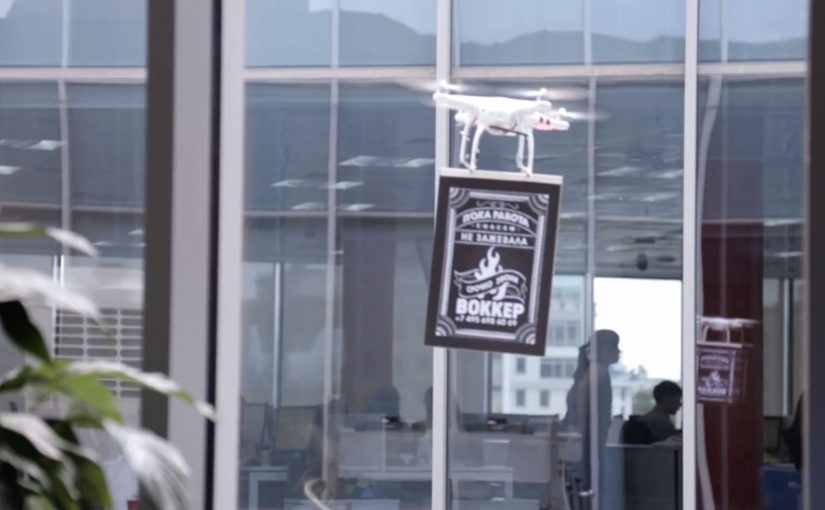
Until the legalities of commercial use are cleared up by local governments, companies in Russia and Brazil go ahead with what are described as early drone-vertising campaigns. Drone-vertising is using drones as moving media, either by flying banners through high-attention locations or by staging a delivery moment that doubles as a filmed ad.

Airspace as a new media channel

The mechanism is straightforward. Put a message or a product on a drone. Fly it where the audience is already looking. Capture the moment on video so the stunt can travel beyond the people who witnessed it live. Because the drone enters an uninvited sightline, it creates surprise, which is why the filmed moment gets retold and replayed.

In dense urban districts where attention is scarce, brands keep searching for formats that create surprise without requiring new screen time.

The real question is whether the brand promise stays clear when the novelty fades, or whether the drone becomes the headline and the product becomes the footnote.

Russia

As ordinary advertising channels continue to be congested, Russian creative agency Hungry Boys uses drones to advertise noodle company Wokker.

Wokker banners are attached to drones and flown around high-rise business buildings in Moscow’s financial district, drawing the attention of office workers as the drones pass windows. The campaign is described as driving deliveries in the targeted area up by 40%.

Brazil

Cup Noodles, the instant ramen noodles snack from Nissin-Ajinomoto, is promoted in Brazil with drones dressed as cows, chickens, corn cobs and shrimps. A two-and-a-half minute film created for the brand’s online campaign uses drones to take Cup Noodles to surfers, skateboarders and highline walkers as they practise their sport.

Why drone-vertising gets noticed

This format works because it breaks the normal media contract. People do not expect ads to appear outside their window, and they do not expect “delivery” to arrive from above. The novelty is doing most of the work. The brand then benefits from the retelling, because the story is easy to summarise and the footage is inherently watchable. Drone-vertising is only worth doing when the brand meaning is unmistakable and the safety story is boring.

Extractable takeaway: If you are betting on a new attention surface, make the idea legible in one glance and one sentence. The stunt must communicate the category benefit instantly, otherwise the drone becomes the headline and the brand becomes a footnote.

Rules worth stealing before you fly ads

  • Target a context with a clear “why now”. Wokker links to lunch-time office hunger. Cup Noodles links to being hungry while out doing sport.
  • Design for cameras as well as eyeballs. You need a clean visual read at distance, plus a story that survives reposting.
  • Keep the stunt safe and bounded. The moment you look reckless, the conversation turns from clever to irresponsible.
  • Prove impact carefully. If you cite uplift, be ready to explain what changed, where, and for how long.

A few fast answers before you act

What is drone-vertising?

It is using drones as moving media. Either by flying banners through high-attention locations or by staging a delivery moment that doubles as a filmed ad.

Why does it work particularly well near offices or public hotspots?

Because the audience is concentrated and the environment is predictable. A drone appearing in a controlled corridor creates surprise without needing people to opt in.

What is the biggest brand risk?

Safety and permission. If the flight looks uncontrolled or disruptive, attention quickly becomes negative and the brand is blamed for the intrusion.

How do you keep the idea from becoming “tech for tech’s sake”?

Tie the drone to a simple product truth that the audience recognises instantly, like lunch delivery urgency or on-the-go convenience, then make that truth the focus of the footage.

What should you measure before you claim “uplift”?

Define the exact area and time window the stunt covered, choose a baseline for comparison, and separate what changed because of the flight itself versus what changed because the filmed story spread online.