Here is a future vision video by Corning, on where they see multi-touch digital displays over the next few years…
Here is a future vision video by Corning, on where they see multi-touch digital displays over the next few years…
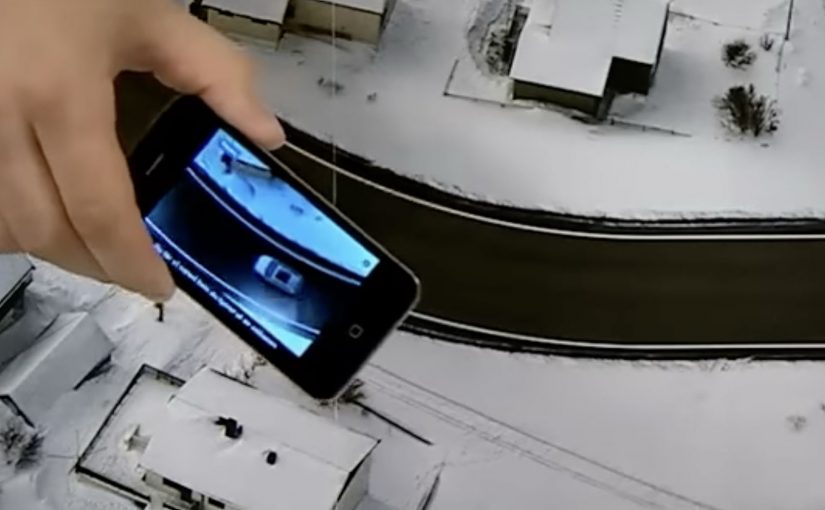
You open a magazine and see a long, empty road. Then you hover an iPhone over the printed page and a Volkswagen appears to “drive” along that road on your screen. It is a test drive that happens inside a print ad, with summer and winter road versions depending on the magazine insert.
Volkswagen Norway builds this as a hybrid print and mobile experience. Readers are prompted to download an app, developed by Mobiento, that turns the printed road into a track. The phone becomes the controller and the page becomes the environment. The payoff is simple viewer control. You move the phone. The car moves with you.
An augmented reality print ad is a piece of print that a camera can recognize as a trigger. Once recognized, an app overlays a digital layer onto the page, anchored to the printed design so the interaction feels connected to the physical medium.
The experience is designed to demo three features in a way print usually cannot. Lane assist, adaptive lights, and cruise control. It is not a real test drive, but it is a clear and surprisingly tactile explanation of systems that are otherwise hard to “feel” from a magazine spread.
Driver-assist features are abstract until you see them respond to a road situation. Here, the road is literally in your hands. The app turns a passive reading moment into a short simulation where the benefit is demonstrated rather than claimed.
This is a positioning move as much as a product demo. It says Volkswagen brings technology into everyday life and it does it with familiar media, not only with future-facing formats. Print becomes the doorway into a mobile experience, and that contrast makes both feel more interesting.
It is a magazine ad that works with an iPhone app. When you hover the phone over the printed road, the app overlays a car on screen and lets you simulate driving along the page.
The experience is built around lane assist, adaptive lights, and cruise control, using the printed road as the scenario that triggers the system behaviours.
Because it shows behaviour, not descriptions. The viewer sees the system respond in a road context, which is more memorable than reading about it.
Volkswagen Norway bills it that way, and the work is widely described as an early example of augmented reality applied to print as a functional “test road”.
Friction. If install or recognition is slow, people stop. The first payoff has to arrive quickly so the novelty turns into understanding.
In 2010, AXA was the first insurance company in the market to launch an iPhone application for car insurance. In 2011, AXA took this one step further and developed an iPhone application for fire insurance.
“Mobile Service Home” is described as a first for the Belgian insurance market, so the product was launched with a method designed to feel just as inventive. AXA and ad agency Duval Guillaume Antwerp. Modem developed what they called an i-Mercial. A television spot for viewers to step into.
The mechanism is a second-screen bridge: the TV spot includes an on-screen code, and the viewer uses an iPhone to scan it. That scan unlocks an extended layer of the story on the phone, so you move from watching the house on TV to exploring what happened inside it on your own screen.
In European insurance markets, this kind of second-screen interactivity turns a passive TV spot into a hands-on service demonstration.
It makes “mobile service” tangible. If the promise is speed and guidance in stressful moments, an interactive format is a better proof than a claim.
It gives the viewer control. The audience is not asked to remember a URL later. The action happens in the moment, and the phone becomes the interface for continuing the narrative.
It turns a CTA into an experience. Scanning is not a bolt-on gimmick. It is the creative idea, because it lets the viewer literally step into the ad.
Extractable takeaway. Interactive advertising works when the phone is used as a second screen to continue the story and demonstrate the service. The TV spot creates the prompt. The mobile interaction delivers the proof.
A TV commercial designed to continue on an iPhone, so the viewer can interact with the ad rather than only watch it.
By scanning an on-screen code with an iPhone during the broadcast, which unlocks an extended experience on the phone.
Because it demonstrates mobile-guided service behavior immediately, instead of asking viewers to imagine how the app helps.
Link rot. If the scan destination or app flow is no longer maintained, the core mechanic breaks and the campaign loses its point.
When you want people to believe a mobile service, make the first brand interaction mobile, interactive, and simple enough to complete in the moment.