
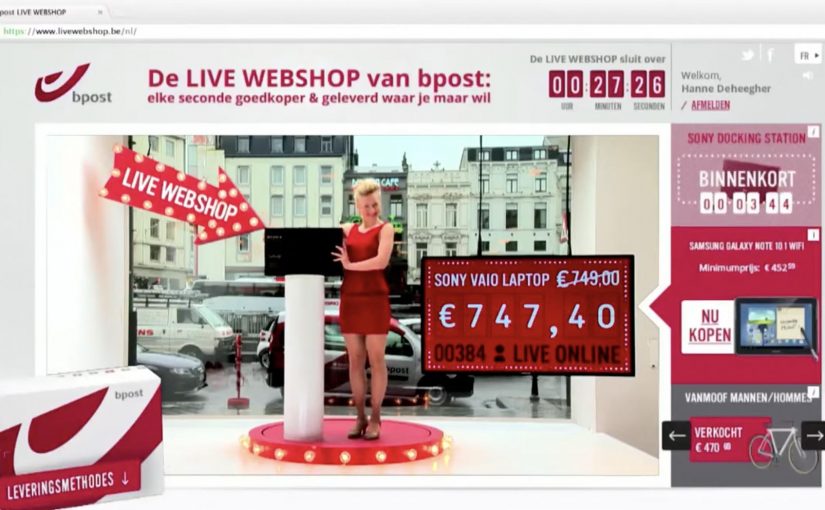
bpost Live Webshop: Every second cheaper

bpost is Belgium’s postal operator. To prove their ability to deliver, and to fend off new contenders in the delivery market, they open a pop-up store right in central Brussels that you can watch like a shop window.

A range of must-have items is put on display, from smartphones to designer coffee makers. The twist is that the only way to buy them is through a special online auction where the price of every product drops every second.

People have to act fast to catch an item before someone else does. Once sold, the item is picked up by a postman right in front of the webcam and delivered to the winning bidder, so everyone watching can see how quick and reliable the service is.

In European parcel and delivery markets, the hardest promise to prove is speed and reliability, so public demonstrations often land harder than product claims.

As a result, awareness of the specific service, bpack, is reported as rising to 65%. In 6 days, 260,000 unique visitors are reported. For every hour the shop is online, bpost is reported as selling 8 products on average.

A webshop you can watch, not just click

The pop-up window makes the online mechanic tangible. People see the products in real life, then experience the purchase as a live moment, with delivery turning into the proof point rather than a line in the footer.

Why the “dropping price” mechanic creates urgency

A price that decreases every second builds a clear trade-off: wait for a better deal, or buy now before someone else does. That tension is the game. It keeps attention locked and makes the checkout decision feel like winning, not spending.

What bpost is really selling with bpack

The service story is simple: “wherever you are, we deliver.” The activation turns that into something visible, with a postman dispatching the parcel immediately after purchase. The product is delivery confidence.

What to steal for your own service proof campaign

  • Make the benefit observable. If your promise is speed, show speed in public.
  • Use a mechanic that explains itself. A visible countdown beats a paragraph of copy.
  • Build in a live “receipt”. The moment of dispatch is the proof people remember.
  • Design for spectators. If watching is entertaining, the audience becomes the distribution layer.

A few fast answers before you act

What is the bpost Live Webshop?

It is a pop-up retail window in Brussels where products can only be bought via a live webshop auction, with prices dropping every second and delivery shown on camera to prove service speed.

How does the “price drops every second” auction work?

Each product starts at a set price and continuously decreases over time. The first person to click and buy wins the item at that moment’s price.

Why show a postman picking up the parcel live?

Because it turns a delivery claim into visible proof. The dispatch moment demonstrates reliability and speed better than messaging can.

What is bpack in this campaign?

bpack is positioned as the delivery service being promoted. The activation is designed to raise awareness and trust in that specific service.

What is the main lesson for brands selling services?

When trust is the barrier, do not just explain the promise. Stage it so people can watch the promise being kept.
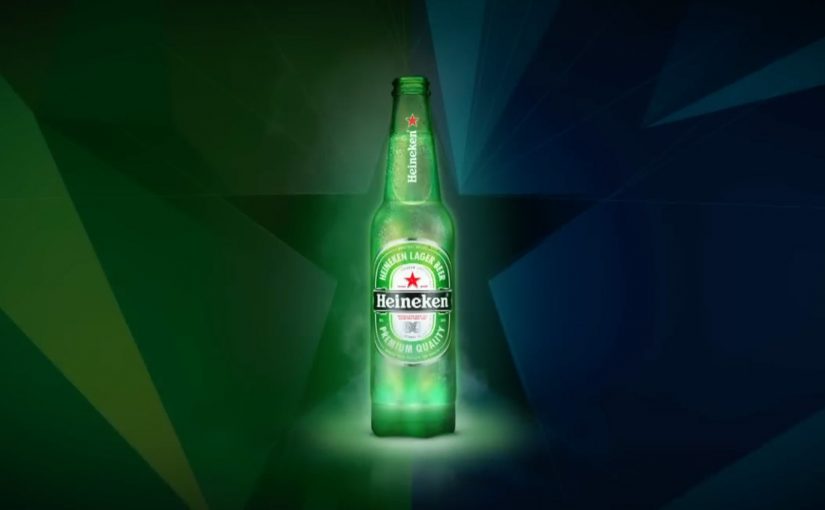
Heineken Ignite

Last year I had written about StartCap, the world’s first digitally enabled bottle top. Now, Heineken has created LED based “smart bottles” that put serious tech into drinking beer.

These interactive bottles are designed to react to the gestures that already define a night out. Cheer and clink bottles together and the LEDs flash. Drink and the light pattern speeds up. Put the bottle down and it shifts into an idle “breathing” mode. The concept also includes software control so bottles can synchronize to music cues for a coordinated light show.

Heineken Ignite is a prototype bottle module that combines LEDs, motion sensing, and wireless synchronization so the bottle becomes part of the club experience, not just the drink in your hand.

What makes it more than a novelty light

What separates this from a gimmick is the engineering story. Coverage around the prototype describes an Arduino based circuit board housed in a reusable 3D printed casing that clips onto the bottom of a standard bottle. The electronics include multiple LEDs, a motion sensor to detect cheers and drinking, and wireless connectivity so the “party” effect can spread across a room.

This is also why the commercial challenge is real. In prototype form, the tech sits in an external module. To reach a mass market use case, the experience needs to be cheaper, smaller, and embedded, not attached.

In European nightlife culture, the most effective brand innovation is the kind that turns the product itself into a social signal.

Why it was shown at Milan Design Week

The concept was unveiled during Milan Design Week as part of Heineken’s future of nightlife exploration. That matters because it frames the bottle as design plus experience, not only packaging. It is a statement about how brands might use connected objects to shape atmosphere in shared spaces.

Recognition and why it matters

Heineken later reported that its Ignite bottle earned a Silver Lion at Cannes Lions 2013 for Exhibitions or Live Events, as part of a broader set of design and innovation activations. Awards do not make a product viable, but they do validate that the idea is legible as a new format for brand experience.

What to steal

  • Use the product as the interface. When the object in hand is the experience, you do not need to fight for attention elsewhere.
  • Design for social gestures. “Cheers” is a better trigger than any forced interaction because people already do it.
  • Make synchronization the payoff. One glowing bottle is a toy. A room that reacts together is a moment.
  • Prototype in public. Early demonstrations can generate press and learning long before the supply chain is ready.

A few fast answers before you act

What is Heineken Ignite?

Heineken Ignite is a prototype “smart bottle” concept that uses LEDs, motion sensing, and wireless synchronization so the bottle lights up in response to cheers, drinking gestures, and music cues in club environments.

How does the prototype work technically?

Reporting describes a clip-on module under the bottle that houses an Arduino based circuit board, LEDs, motion sensing, and wireless connectivity. The module detects motion patterns and can coordinate lighting across multiple bottles.

Why is syncing to music the key feature?

Because it turns individual behavior into shared atmosphere. Synchronization makes the experience visible at a crowd level, which is what creates talkability and makes the brand feel “in the room”.

What is the biggest barrier to commercializing a concept like this?

Miniaturization and cost. A clip-on prototype can prove the idea, but mass market use needs the tech to be smaller, cheaper, and more seamlessly integrated into production packaging.

What is the main marketing lesson here?

If you want to own a nightlife moment, design around existing social rituals. When the trigger is already natural, the experience feels additive instead of forced.

The SOS SMS

Street children begging for food and money near busy traffic stops are a common sight in metropolitan cities like Rio de Janeiro. Accustomed and tired of this routine, drivers have the habit of shutting their car windows to ignore these children and avoid any contact with them.

So to raise awareness and obtain more donations, “Obra do Berço”, a day care for underprivileged children in Brazil, found a way to make the children’s voices heard through the windows.

Bluetooth antennas were hidden near the traffic signals where a large concentration of these children tend to gather. When drivers stopped there, the antennas would send out an SOS SMS…