
Audi City London: Future of Auto Retail

Audi City London: Future of Auto Retail

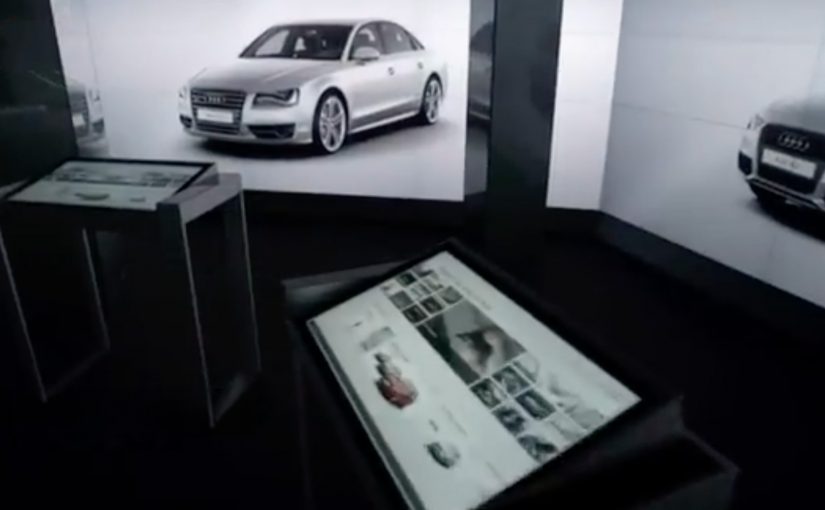
To solve space challenges at its retail outlet in Piccadilly Circus, Audi has used groundbreaking technology to present its growing model line-up.

Visitors can now digitally select their vehicle from several hundred million possible configurations and experience it in realistic 1:1 scale on special powerwalls. Here, “powerwalls” are wall-sized, high-resolution display surfaces built for life-size visualization.

Various details such as drivetrain, bodyshell, LED light technology etc are presented with interactive gestures, touch and physical sample recognition methods. Physical sample recognition means the system detects physical samples as an input. The whole immersive experience helps make the innovations understandable on an intuitive level.

The future of automotive retail is here and Audi is leading the way, with plans to roll out the experience at 20 locations in major international cities by 2015.

Why Audi City matters beyond “wow”

This is not digital for digital’s sake. It is a retail operating model that turns limited floor space into effectively unlimited shelf space, without forcing the customer to imagine the product from a brochure or a small screen.

Extractable takeaway: When physical space is scarce, move your long tail of options into a high-fidelity interface so the store sells decisions, not inventory.

  • Scale without inventory. Hundreds of millions of combinations without storing hundreds of cars.
  • Confidence through realism. A 1:1 representation reduces the gap between selection and purchase.
  • Innovation made tangible. Drivetrain, bodyshell, and lighting become understandable through interaction.

The showroom becomes an interface

Audi City treats the store like an interface layer between customer intent and product complexity. Gesture, touch, and physical sample recognition are not gimmicks. They are interaction patterns designed to help people explore, compare, and decide.

That is the critical shift. Instead of staff explaining everything verbally, the environment itself becomes the explainer. The real question is whether your showroom is optimized to help customers decide, or just to show what you have in stock. Because the interface externalizes complexity into something people can manipulate, it shortens the explanation loop and increases decision confidence.

In global automotive retail, immersive configuration experiences matter most when they reduce decision friction without expanding showroom footprint.

What this signals about the future of automotive retail

If Audi rolls out this concept across major cities, the implication is clear. Physical retail will not disappear. It will evolve into fewer, smaller, higher-impact locations that are designed for configuration, education, and decision-making, while fulfilment happens elsewhere.

  1. Fewer cars on the floor. More options in the system.
  2. More guided discovery. Less brochure-driven selling.
  3. More consistent global experience. Less dependence on local store size.

What to take from this if you run retail or CX

  1. Use digital to remove physical constraints. The business problem here is space, not “innovation theatre”.
  2. Design interaction for comprehension. Gestures, touch, and samples work when they help people understand complexity quickly.
  3. Make exploration feel premium. 1:1 scale and high fidelity visuals create confidence and desire.
  4. Separate “experience” from “inventory”. Let stores sell decisions, not stock.

A few fast answers before you act

What is Audi City London?

It is an Audi retail concept in Piccadilly Circus that uses large digital powerwalls to let visitors configure vehicles from hundreds of millions of combinations and view them in realistic 1:1 scale.

Why does 1:1 scale matter in a configurator?

It reduces uncertainty. People can judge proportions, design choices, and visual details more confidently than on a small screen.

How does the experience help explain innovation?

By presenting components like drivetrain, bodyshell, and LED lighting through interactive exploration using gestures, touch, and physical sample recognition.

What business problem does Audi City solve?

It addresses limited showroom space while still presenting a broad and growing model line-up and configuration depth.

What is the transferable lesson for other retailers?

Use immersive digital interfaces to expand choice and understanding without expanding physical footprint, and design interactions that make complex decisions feel intuitive.

Goodyear Eagle F1 Test Drive

Goodyear Eagle F1 Test Drive

Goodyear does not try to “tell” you that a tire grips better. They stage a test drive that makes you feel it.

A customer walks into a Goodyear retail store expecting the usual sales conversation. Instead, a salesperson offers a test drive. The customer gets into a performance car with what looks like a normal driver. Then the drive turns into a controlled, choreographed, Hollywood-grade demonstration. The driver is a disguised stunt professional. The “test route” includes conditions that exaggerate what traction and control actually mean when things get unpredictable.

That single choice is the unlock. The product story is no longer a brochure. It is an experience.

Goodyear describes this execution as entertainment built around retail-store proof for its Eagle F1 Asymmetric All-Season line, often referred to as “Control Freak”. The point is not the stunt. The point is that grip becomes a felt outcome, not a claim.

The core move

Goodyear turns a retail test drive into entertainment that proves performance.

The real question is: how do you turn an “invisible” performance claim into belief at the moment intent is forming.

How the proof is staged

The stunt is engineered as a sequence of “proof moments” that escalate. The customer starts in a familiar retail context, then the driver introduces controlled chaos where traction and handling show up as outcomes you can feel. Because the demo is structured around cause and effect, the viewer does not need tire expertise to understand what is being proven.

In enterprise marketing organizations where retail, brand, and performance teams operate in different rhythms, retail-first proof content is one of the fastest ways to shorten the distance between awareness and intent.

Why this works so well

Most tire marketing struggles with the same problem. Performance is hard to visualize until you are already in a situation where you need it. “Better grip” sounds like every other claim until something slips.

Extractable takeaway: When a benefit is hard to evaluate in everyday life, do not buy more media to repeat the claim. Engineer one credible moment where the benefit becomes undeniable, then scale that moment through video.

This activation removes that abstraction by doing three things at once. Here, “activation” means a real-world, point-of-sale experience designed to prove one product claim with live human reaction and camera-ready structure.

  1. It makes proof visible.
    The story is designed around moments where traction and handling show up as a physical result. You do not need to understand tread compounds to understand what you just felt.
  2. It creates real human reaction.
    A staged product demo can feel like a stunt. A real customer reaction makes it believable, and shareable, at the same time.
  3. It anchors the brand in the point of sale.
    This is not a distant TV spot. The narrative starts inside the tire store. The purchase context is baked into the content, so the jump from awareness to intent is shorter.

The “retail first” storytelling pattern

A lot of experiential marketing starts with spectacle, then tries to connect it back to the product.

This one starts with the most ordinary commercial moment. A customer is about to buy tires. Then the experience expands outward. That sequencing keeps the brand motive clear. This is not adrenaline for its own sake. It is a dramatic way to demonstrate a benefit that is otherwise invisible.

If your category is dominated by price and familiarity, you win by making functional proof unignorable. You do not win by shouting “better” louder.

The deeper point

This is a category where functional proof usually loses to price promotions and familiarity. Goodyear flips that by turning functional proof into an event.

It is a reminder that “performance marketing” does not always mean dashboards and retargeting. Sometimes it means engineering a moment where the product benefit cannot be unseen.

What to borrow if you run marketing or commerce

  • Design for “proof moments,” not messages. Write down the one thing a customer must believe for your product to win. Then define the single moment they would need to see, feel, or experience for that belief to become non-negotiable.
  • Build the experience around the buying context. Placing the opening scene in a retail outlet removes friction. The story is already where the decision happens. For many categories, that is the most underrated advantage.
  • Treat the camera as a distribution strategy. The activation is designed to be filmed. Multiple angles. Real people. A sequence that escalates. In practice, the video becomes the scalable media layer on top of a physical stunt.
  • Make the customer the hero, not the brand. The most memorable part is not a feature list. It is the reaction. The brand earns attention by giving the customer an experience worth talking about.

A few fast answers before you act

What is the campaign actually demonstrating?

It demonstrates traction and handling by forcing controlled situations where grip and stability show up as physical outcomes, not claims.

Why stage it in a retail store instead of a track?

Because the purchase decision lives in retail. The story starts where intent is highest, so the proof is already in the buying context.

What makes this feel credible instead of gimmicky?

Real customer reactions plus a clear cause-and-effect link between the stunts and the product promise. The entertainment serves the proof.

What is the repeatable lesson for other categories?

Find your “invisible benefit,” create a safe way to make it visible through one engineered proof moment, then film it so it scales beyond the physical experience.

When does this approach fail?

When the experience is spectacle with no causal link to a product benefit. If you cannot explain what is being proven in one sentence, you are buying attention, not belief.

LEGO: Builders of Sound barrel organ

LEGO: Builders of Sound barrel organ

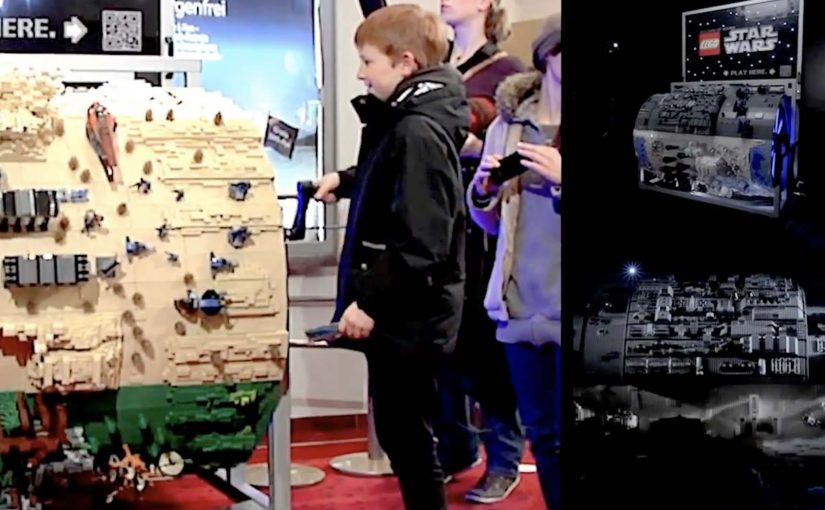
The 3D premiere of Star Wars Episode 1 in early 2012 was a cinematographic milestone for the Star Wars saga. To celebrate it, LEGO and Serviceplan Munich created a unique LEGO sound installation that actually plays the Star Wars main theme.

The installation is a huge barrel organ built from over 20,000 LEGO pieces. Four Star Wars worlds (Hoth, Tatooine, Endor and the Death Star) are constructed on the turning barrel. As it rotates, LEGO elements trigger mechanical sensors that strike the keys of a built-in keyboard, playing the tune.

A Star Wars theme you can crank with your hands

The most effective detail is the constraint. There is no “press play” button. You have to turn the organ. That one decision makes the experience feel earned. The song arrives as a result of your motion, not as background audio triggered by a screen.

How bricks become music

This is not a metaphor. It is a mechanical translation. LEGO pieces are arranged to behave like pins on a traditional barrel organ. The rotation sequence becomes a score, and the score becomes the melody via real key strikes. The four worlds on the barrel are not just decoration. They turn product and story into one continuous surface.

In European entertainment and toy launches, the strongest activations turn fandom into something people can physically operate, not just watch.

Why it lands as a cinema activation

Star Wars fans already love collectibles and craft. This installation rewards that mindset with a live proof of “impossible build meets real output.” It also gives the audience a clean social script, meaning a simple sequence people can follow without instructions. Stop. Watch someone crank it. Step in. Try it yourself. Film it. Share it.

Extractable takeaway: When a brand idea is about “bringing something into a new dimension,” the fastest route is to convert a familiar object into a physical interface and let the audience generate the outcome.

What the launch is really doing for LEGO

The real question is whether your launch gives people one obvious action that produces a repeatable, shareable payoff.

It positions LEGO Star Wars sets as more than toys. It frames them as a medium. Something that can build worlds, build machines, and even build music. That is a stronger proposition than “new sets available now,” especially around a film re-release where attention is already concentrated in cinemas.

Steal-worthy moves from Builders of Sound

  • Make the mechanism the message. The build itself should prove the claim, not just support it.
  • Use one obvious action. Turning a crank is universally understood, and it invites participation.
  • Design for bystanders. The experience should be readable from a distance, even before someone tries it.
  • Let sound do the heavy lifting. A recognisable theme turns a mechanical demo into an emotional moment.
  • Extend the experience online without changing the core gesture. If the physical version is “crank,” the digital version should feel similarly tactile.

A few fast answers before you act

What is LEGO “Builders of Sound”?

It is a LEGO Star Wars activation built around a giant barrel organ made from over 20,000 LEGO pieces. When the barrel is turned, the mechanism triggers keys to play the Star Wars main theme.

Why a barrel organ for a Star Wars release?

Because it turns a familiar, physical music machine into a participatory interface. The audience does not just hear the theme. They generate it, which makes the moment feel personal and shareable.

What makes this more than a sculpture?

Mechanical output. The build produces a real, repeatable result. That cause-and-effect shifts it from “impressive object” to “experience people line up to try.”

How do you translate a physical installation like this into an online experience?

Keep the core gesture and the immediacy. In this case, the online version is described as playable via a simple control input that mimics the physical turning action.

What should a brand measure for an installation like this?

Participation rate, repeat interactions, dwell time, the volume of user-recorded video, and any downstream actions tied to the product, such as set interest or ordering intent.