Liaison Dangereuse: Striptease Shopping

Liaison Dangereuse: Striptease Shopping

Valentine’s lingerie shopping, turned into a show

Liaison Dangereuse, a German lingerie brand, gave Serviceplan a creative challenge: increase lingerie sales around Valentine’s Day.

Seduction always works. So what about making the buying experience attractive and unique for men by giving them the opportunity of buying lingerie directly from the body of beautiful models, and pairing that with a memorable striptease? Thus a new way to sell online lingerie was created.

The mechanism that changes behavior

The idea reframes checkout as participation. Instead of browsing product grids, the customer “shops” from the model, which makes selection feel more like discovery than transaction, and reduces hesitation at the moment of choice.

In European ecommerce and performance marketing, the fastest lever is reducing hesitation by making the path to purchase feel emotionally easy and socially tellable.

The real question is whether you can turn your highest-friction step into a guided, retellable moment without breaking brand trust.

This kind of mechanic is worth copying only when it fits your brand voice and clear consent boundaries.

Why it lands with the intended buyer

This is built for a very specific Valentine’s reality: many male buyers want help choosing, and they want the moment to feel confident, not awkward. A guided, theatrical experience removes indecision and makes the purchase feel like part of the gift.

Extractable takeaway: When the buyer feels unsure about choice, redesign selection so confidence is the default and the mechanic becomes the story.

Earned media as a built-in distribution layer

Serviceplan not only generated free media coverage from major websites, newspapers and magazines in Germany, it also reported additional traffic of 155% to the Liaison Dangereuse website. Reported sales went up by 50% during the promotion.

Click here to watch the video on Ads of the World website.

Steal this conversion mechanic

  • Design for the buyer’s emotion. Remove embarrassment and decision anxiety. Add guided confidence.
  • Make the shopping path the story. If the mechanic is inherently retellable, distribution comes with it.
  • Focus the experience on the highest-friction moment. Choice, not payment, is often the real dropout point.
  • Measure what matters. Track uplift in qualified traffic, add-to-cart rate, and conversion, not just press mentions.

A few fast answers before you act

What is “Striptease Shopping” for Liaison Dangereuse?

It is a Valentine’s-focused ecommerce activation that lets shoppers buy lingerie through a model-led, striptease-style interface, turning product selection into a playful, guided experience.

Who is the experience designed for?

It targets gift-buyers who feel unsure about lingerie choices. The mechanic reduces awkwardness and indecision by making selection feel assisted rather than self-directed.

What is the behavioral mechanism that improves conversion?

It reframes checkout as participation. By turning browsing into a simple, story-like interaction, it reduces hesitation and makes the purchase feel emotionally easy.

Why did it generate strong earned media?

The buying mechanic is unusual and instantly demonstrable. That makes it easy to describe, easy to show, and inherently shareable across press and social channels.

What results were reported from the promotion?

Campaign summaries reported +155% website traffic and +50% sales during the promotion period.

What is the key risk to manage with “seduction” mechanics?

Brand fit and boundaries. If the experience feels exploitative or off-brand, the attention can backfire. The idea needs clear intent, consent, and tone discipline.
Superette: Short Shorts

Superette: Short Shorts

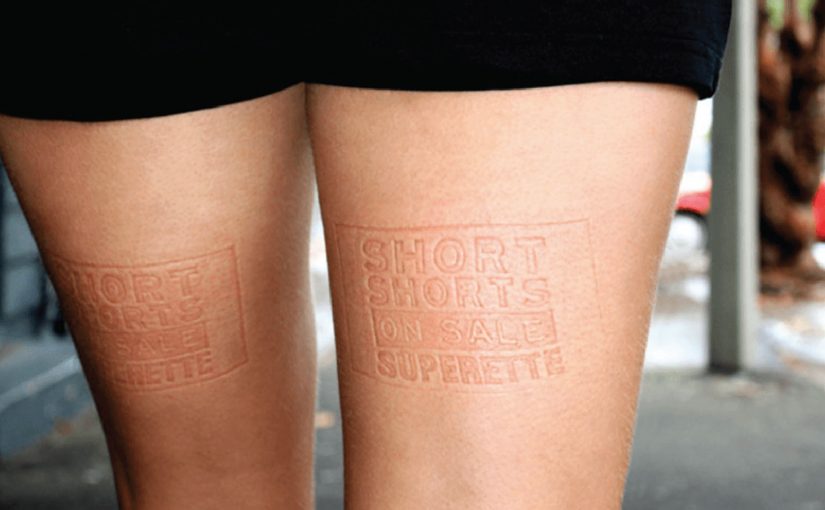
In the inner city, someone stands up from a bus-stop bench and notices a message pressed into their thigh. It reads like a sale reminder, and it travels with them for the next hour.

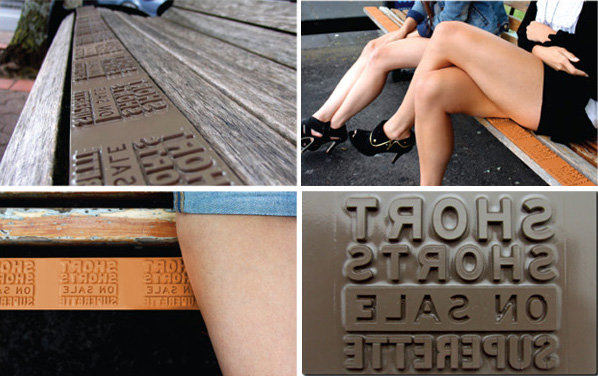
That is the execution DDB Auckland creates for Superette’s short shorts sale. Indented plates are fitted across bus stops, mall seats, and park benches in the fashion district, so when people sit down, the message is imprinted on the bare skin exposed by the trend. The result, as described, is branded seating plus a moving wave of free media: thousands of temporary imprints that last up to an hour, and show up most visibly on exactly the style-setters the retailer wants.

Superette’s short shorts sale campaign.

How the imprint works

This is body imprint advertising: a physical surface transfers a readable message onto skin through pressure, like a temporary stamp without ink. The media buy is the furniture people already use. The “placement” is the moment the audience sits down.

In fashion retail, the fastest way to make a promotion feel native is to attach it to the lived behavior and the exposed product context, not a separate media channel.

Why it lands in the street

The idea carries its own proof. The imprint is not a claim you read; it is a thing that happens to you, and that makes it unusually hard to ignore or forget. It also creates a social moment. People compare marks, laugh, take photos, and inadvertently become distribution. The targeting is embedded in the location strategy: benches in inner-city and fashion-district zones bias the audience toward the “hippest young cats” already dressed for visibility.

Extractable takeaway: When your offer is simple and time-bound, design a mechanic where the audience physically carries the message for a short period, then place that mechanic where the right crowd naturally gathers.

What Superette is really buying

Not just awareness. The campaign buys cultural permission. It signals that the sale belongs to a specific scene and that the brand understands how that scene moves, sits, and shows skin. The imprint is a cheap, repeatable proof-point of “this is for you” without ever saying it directly.

The real question is whether the sale message can travel through the scene as social proof instead of behaving like an ad bolted onto it.

What retail teams can steal from this

  • Turn existing infrastructure into media. Find the surfaces your audience already uses, then engineer the message into the touchpoint.
  • Make the ad portable. If people carry the message with them, your reach compounds without extra placements.
  • Target by behavior, not demographics. Location and context can do the filtering when the creative is inseparable from the setting.
  • Keep the message legible and short. Physical imprint media rewards minimal copy and a single, clear action.

A few fast answers before you act

What is “body imprint advertising” in this campaign?

A message is created as a temporary impression on skin by sitting on seats fitted with indented plates. No ink is needed. Pressure creates the readable mark.

Why does putting the ad on benches make sense for a shorts sale?

The trend exposes bare thighs, so the sale message can live on the same body area the product is designed to reveal. The medium and the product context reinforce each other.

What makes this feel like “free media” after the placement?

Once a person stands up, the imprint travels with them for a while. Every subsequent encounter becomes an additional impression without buying another seat or poster.

What is the main risk with this approach?

If the imprint feels intrusive or uncomfortable, the novelty can flip into backlash. The mechanic depends on perceived playfulness, not coercion.

When should a brand use a tactic like this?

When the message is ultra-short, the audience is location-clustered, and the idea can be experienced instantly in a way that people will talk about and show others.

Volkswagen Twitter Zoom

Volkswagen Twitter Zoom

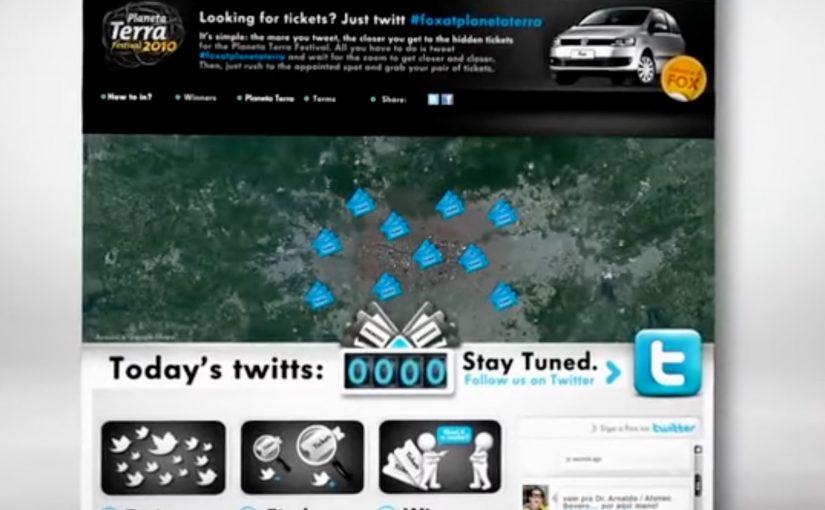
Tickets are scattered across São Paulo. A live city map sits online. Every tweet pulls the zoom closer. Volkswagen sponsors the Planeta Terra Festival, a major music event in São Paulo, as a way to bring its trendy car, the Fox, closer to the city’s youth.

The challenge for AlmapBBDO is clear. Spread the Fox message beyond the festival walls, and reach youngsters across the entire city. The answer is Twitter Zoom. Twitter Zoom is a tweet-to-zoom scavenger hunt where hashtag volume progressively narrows a live map view toward a hidden target.

The real question is how you turn social participation into shared, visible progress that makes people act.

This kind of campaign only earns attention when the audience can see their action change the system.

First, a series of tickets is placed in different locations across São Paulo. Then a simple online platform launches with a Google Maps view of the entire city. The mechanic is straightforward. The more people tweet #foxatplanetaterra, the closer the zoom gets on the map. As the view tightens, the hunt becomes more precise. The first person to reach the ticket wins it. This runs for four days straight.

In large-city youth marketing, a shared, real-time progress indicator can turn social chatter into coordinated action.

Within less than two hours, #foxatplanetaterra hits Trending Topics in São Paulo, and it stays there for the full length of the competition.

Why this works

The loop is simple. Public participation produces visible progress, and visible progress invites more participation because everyone can watch the goal getting closer.

Extractable takeaway: When every audience action creates shared, visible progress, people keep participating and recruit others to accelerate the loop.

It turns social volume into visible progress

Most hashtags create noise with no payoff. Here, every tweet has a clear purpose. It moves the map. People can see the impact building in real time, and that visibility keeps the loop going.

It creates a city-wide scavenger hunt without complex rules

The instruction is easy to understand. Tweet the hashtag. Watch the zoom. Run. The simplicity makes it easy to join, explain, and share.

It makes the audience do the distribution

To win, participants need more tweets. That requirement naturally drives peer-to-peer sharing. The community scales the campaign because the community benefits from scale.

What to measure beyond impressions

  • Speed to momentum. How quickly the hashtag reaches a meaningful participation rate.
  • Unique contributors. How many distinct people tweet, not just total tweet volume.
  • Progress milestones. How many zoom stages are reached, and how long each stage holds attention.
  • Winner validation. Whether the “first to the ticket” outcome is trusted and replayed as a story.

Risks and guardrails that matter

  • Spam incentives. Volume mechanics invite low-quality tweeting. Add constraints or validation to protect credibility.
  • Platform dependency. If Twitter or the map experience glitches, the game breaks instantly.
  • Perceived fairness. If people doubt the winner selection, the campaign turns from fun to frustration.
  • Accessibility. Ensure the mechanic does not exclude people who cannot physically sprint across the city.

Steal the tweet-to-zoom pattern

  1. Pick a “canvas” people instantly understand. A city map, a countdown, a reveal grid, or any visual that can tighten, unlock, or progress.
  2. Convert participation into a tangible system response. Every action must visibly change something, immediately.
  3. Timebox the game. A short window keeps urgency high and reduces fatigue.
  4. Design fairness upfront. Clarify how wins are validated, and prevent obvious spam or gaming.
  5. Make the reward match the audience. Here, tickets fit the festival context and the youth target.

A few fast answers before you act

What is Volkswagen Twitter Zoom?

A city-wide campaign where tweets with #foxatplanetaterra trigger a Google Maps zoom. As the map zooms in, participants race to find hidden tickets across São Paulo.

Why does the mechanic spread so fast?

Because every new tweet visibly improves everyone’s chances. Participation behaves like progress, not just conversation.

What is the core design principle?

Make the audience action directly move a shared system, and make that movement visible in real time.

What is the simplest way to recreate it in another category?

Use a progressive reveal that unlocks with verified participation, then reward the first verified completion, not raw volume.

What is the biggest failure mode?

When the campaign can be gamed, or when the platform experience fails. Trust and momentum collapse immediately.