
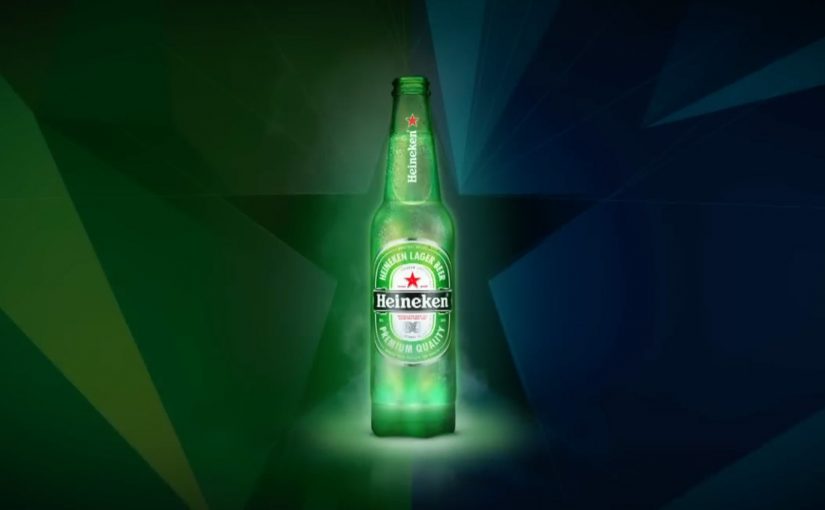
Heineken Ignite

Heineken Ignite

Last year I had written about StartCap, the world’s first digitally enabled bottle top. Now, Heineken has created LED based “smart bottles” that put serious tech into drinking beer.

These interactive bottles are designed to react to the gestures that already define a night out. Cheer and clink bottles together and the LEDs flash. Drink and the light pattern speeds up. Put the bottle down and it shifts into an idle “breathing” mode. Here, “breathing” means the LEDs pulse slowly when the bottle is stationary. The concept also includes software control so bottles can synchronize to music cues for a coordinated light show.

Heineken Ignite is a prototype bottle module that combines LEDs, motion sensing, and wireless synchronization so the bottle becomes part of the club experience, not just the drink in your hand.

Why it lands. When the bottle becomes the signal

What separates this from a gimmick is the engineering story. Coverage around the prototype describes an Arduino based circuit board housed in a reusable 3D printed casing that clips onto the bottom of a standard bottle. The electronics include multiple LEDs, a motion sensor to detect cheers and drinking, and wireless connectivity so the “party” effect can spread across a room. Wireless synchronization matters because it scales the effect from one person’s bottle to a room level cue that people can notice together. This is not a gimmick.

Extractable takeaway: If you want a brand experience to spread in a venue, instrument the object people already hold so natural gestures trigger visible, shared feedback.

This is also why the commercial challenge is real. In prototype form, the tech sits in an external module. To reach a mass market use case, the experience needs to be cheaper, smaller, and embedded, not attached. The real question is whether the connected layer can be made cheap and embedded enough that the bottle ships as the interface, not an accessory.

In European nightlife culture, the most effective brand innovation is the kind that turns the product itself into a social signal.

Why it was shown at Milan Design Week

The concept was unveiled during Milan Design Week as part of Heineken’s future of nightlife exploration. That matters because it frames the bottle as design plus experience, not only packaging. It is a statement about how brands might use connected objects to shape atmosphere in shared spaces.

Recognition and why it matters

Heineken later reported that its Ignite bottle earned a Silver Lion at Cannes Lions 2013 for Exhibitions or Live Events, as part of a broader set of design and innovation activations. Awards do not make a product viable, but they do validate that the idea is legible as a new format for brand experience.

Steal the pattern: product-led nightlife cues

  • Use the product as the interface. When the object in hand is the experience, you do not need to fight for attention elsewhere.
  • Design for social gestures. “Cheers” is a better trigger than any forced interaction because people already do it.
  • Make synchronization the payoff. One glowing bottle is a toy. A room that reacts together is a moment.
  • Prototype in public. Early demonstrations can generate press and learning long before the supply chain is ready.

A few fast answers before you act

What is Heineken Ignite?

Heineken Ignite is a prototype “smart bottle” concept that uses LEDs, motion sensing, and wireless synchronization so the bottle lights up in response to cheers, drinking gestures, and music cues in club environments.

How does the prototype work technically?

Reporting describes a clip-on module under the bottle that houses an Arduino based circuit board, LEDs, motion sensing, and wireless connectivity. The module detects motion patterns and can coordinate lighting across multiple bottles.

Why is syncing to music the key feature?

Because it turns individual behavior into shared atmosphere. Synchronization makes the experience visible at a crowd level, which is what creates talkability and makes the brand feel “in the room”.

What is the biggest barrier to commercializing a concept like this?

Miniaturization and cost. A clip-on prototype can prove the idea, but mass market use needs the tech to be smaller, cheaper, and more seamlessly integrated into production packaging.

What is the main marketing lesson here?

If you want to own a nightlife moment, design around existing social rituals. When the trigger is already natural, the experience feels additive instead of forced.
Maes: A Barrel for Every Maes

Maes: A Barrel for Every Maes

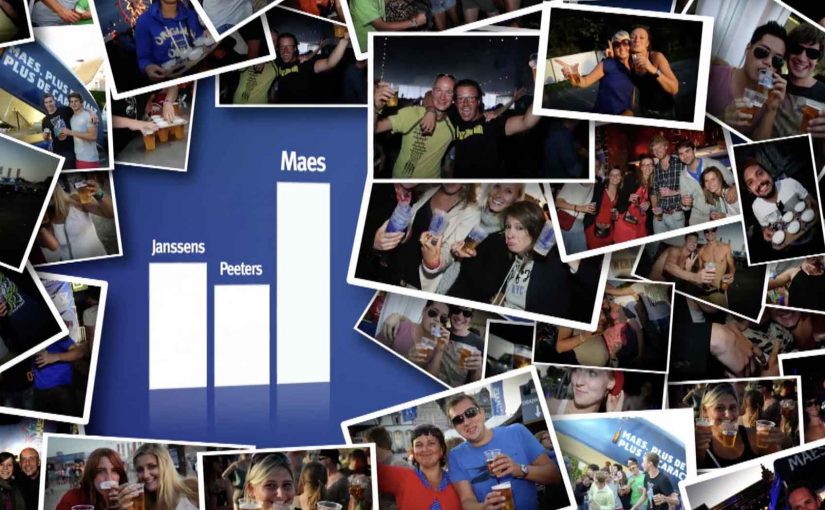
Maes is described as Belgium’s second most popular beer, and “Maes” is also described as the country’s third most common surname. With the market leader said to be outselling Maes by roughly 4 to 1, the brand looks for leverage where it can actually own something. The name.

So Maes decides to rally the Maes families of Belgium by giving them a free barrel of beer, and turning that offer into a reason to gather, invite, and celebrate publicly.

The mechanism: a surname offer with a social booking loop

Eligible families sign up through a custom Facebook app to claim the barrel. The same flow lets them book a pub for a chosen date and invite friends, so the reward is designed to be shared rather than quietly consumed.

In Belgian FMCG marketing, turning a broad brand problem into a narrow community identity can create disproportionate participation and talk value.

Why this lands

This works because it converts a discount into status. You are not “getting a deal.” You are being singled out because of who you are, and the campaign immediately pushes you into a social moment where other people experience the brand alongside you. The pub booking is the smart part, because it transforms redemption into an event.

Extractable takeaway: If you need advocacy, attach the reward to an identity trigger and force the payoff into a shared setting, so the benefit becomes a gathering people naturally document and retell.

What the brand is really doing

The real question is how a challenger beer brand turns a shared surname into a social growth loop that scales beyond the free barrel itself.

Maes is using a surname as a distribution engine. The name creates a defined audience, the free barrel creates urgency, and the “book a pub and invite friends” flow turns each participant into a micro-host who does recruitment for you.

What to steal from the Maes mechanic

  • Exploit a unique ownership angle. If you can credibly “own” a name, place, ritual, or identifier, build the campaign around that.
  • Design the share into the redemption. Booking a pub and inviting friends is a built-in amplification mechanic.
  • Reward the group, not just the individual. Group rewards create social proof and higher perceived value.
  • Keep eligibility simple. One clear rule beats a complicated promo code maze.

A few fast answers before you act

What is “A barrel for every Maes”?

It’s a promotion that offers a free barrel of Maes beer to people with the surname “Maes,” turning surname identity into a social recruitment mechanic.

How do people redeem the offer?

By signing up through a custom Facebook app that also lets them book a pub date and invite friends.

Why is the pub booking part important?

It converts redemption into an event, which increases sharing, attendance, and the number of people who experience the brand in a social setting.

What problem is this trying to solve?

It’s designed to build advocacy and attention for a challenger brand by mobilising a defined community rather than competing only on mass advertising.

What is the key risk with identity-based offers?

If eligibility or verification feels unfair or confusing, it can backfire. The rule has to be clear, and the experience needs to feel welcoming rather than exclusionary.

Renault Clio: A Test Drive Takes a Sexy Turn

Renault Clio: A Test Drive Takes a Sexy Turn

TNT’s “A dramatic surprise on an ice-cold day” meets Pepsi MAX’s “Jeff Gordon test drive prank” in this latest test drive video for the all new Renault Clio.

In the video a couple of guys are seen taking the Renault Clio for a spin. After a regular beginning, the salesman shows off the “va va voom” button, a prank trigger that flips the drive into a choreographed romantic scene.

This is a staged test-drive prank, not a feature demonstration. The “va va voom” button is the trigger that flips an everyday drive into a choreographed French fantasy.

And here is a version for the ladies.

The button as a narrative trigger

The mechanism is a single, irresistible cue. A salesman introduces a mysterious button. The driver presses it. The world outside the windows transforms into a set-piece built from instantly recognizable signals, so the passenger can “feel” the promise without a single spec sheet.

In automotive marketing, test drive formats often double as shareable entertainment that reaches far beyond the dealership.

The real question is whether the launch gives people a story worth retelling once the drive is over.

Why it lands

This works because it turns a low-drama ritual into an event with a clear before-and-after. The joke is simple enough to follow in seconds, and the escalation is visual enough to hold attention without context. Most importantly, it makes the test drive itself the content, not the car brochure. The stronger creative move is the trigger-led transformation, not the flirtation itself.

Extractable takeaway: If you can attach a single, obvious trigger to a dramatic “world change”, you turn a routine product interaction into a personal story. Personal stories are easier to retell, and harder to forget, than feature lists.

What to borrow without copying the exact gag

  • One trigger, one transformation: keep the entry point unmistakable and the payoff immediate.
  • Design for first-time viewers: someone should understand the premise even if they start watching mid-scene.
  • Let the participant stay authentic: the strongest moments are the unscripted reactions, not the actors.
  • Use stereotypes carefully: shorthand can make an idea legible fast, but it can also age poorly if the tone tips.
  • Make the edit do the persuasion: pace and escalation matter more than how many “surprises” you add.

A few fast answers before you act

What is the Renault Clio “va va voom” test drive video?

It is a staged test-drive prank where pressing a “va va voom” button triggers a choreographed romantic, Paris-themed scene around the car.

Why does this format work for car launches?

Because it makes the test drive itself feel like an event. That creates watchable reactions and gives people a reason to share the experience, not just talk about the vehicle.

What’s the key mechanic to reuse?

A single, easy-to-understand trigger that causes an immediate, visible change in the environment. The trigger creates curiosity. The transformation creates the story.

Is the “va va voom” button a real product feature?

No. In this context it functions as a storytelling device that kicks off the prank and reframes the test drive as a fantasy sequence.

What’s the main risk with this style of stunt?

Tone control. If the surprise feels awkward, intrusive, or relies on stereotypes in a way that offends, the conversation can flip from “fun” to “cringe” fast.