
Misereor: The Power of a Coin

Misereor: The Power of a Coin

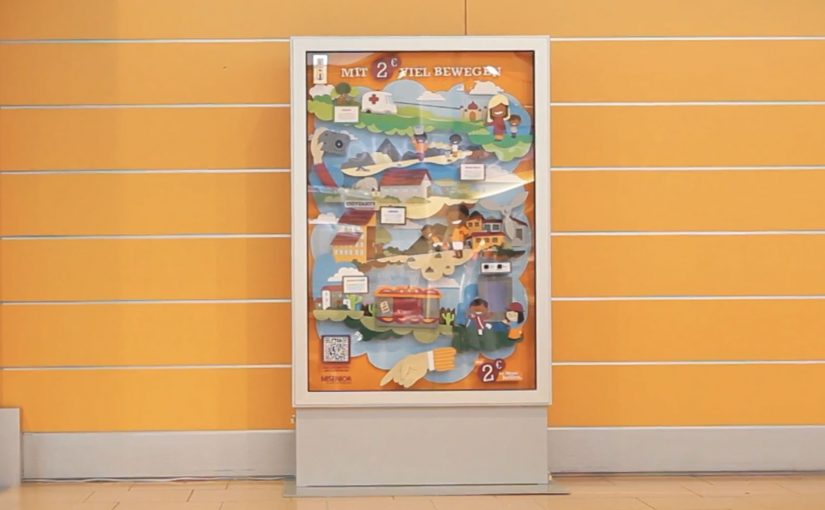
A billboard at Hamburg Airport does not just ask for money. It takes a 2-euro donation and immediately shows what that coin can do.

Misereor has been committed to fighting poverty in Africa, Asia and Latin America for over 50 years. To drive more donations, they install a billboard with a donation box built into it. When people put in 2 euros, the billboard brings to life how that coin can help across Misereor’s aid projects.

The billboard also links the offline act to an online conversation. It takes a photo of the donor and posts it to the campaign’s Facebook app. A QR code on the billboard lets donors share the promotion on their own Facebook page.

How the interaction is designed to convert

The mechanism is a tight, three-step loop. Physical donation triggers an immediate visual payoff. The payoff translates “impact” from an abstract promise into a concrete scene. The scene then becomes shareable proof through an automatic photo post and a QR-driven sharing prompt.

In high-traffic public spaces where attention is fragmented and dwell time is unpredictable, donation design wins when it minimizes steps and makes impact visible immediately.

Why it lands

This works because it replaces guilt with clarity. You do not just hear that your money helps. You see a specific outcome the moment you give, which makes the decision feel both meaningful and finished.

Extractable takeaway: If you want more donations, build a “give. see. share.” loop where the act of giving triggers instant, legible impact, and the sharing step is optional but effortless.

The real goal behind the 2-euro choice

The real question is whether a donation ask can feel immediate, visible, and worth doing before the traveler walks away. A 2-euro ask is small enough to feel impulse-safe, especially in an airport moment where people already make small purchases without overthinking. The campaign then uses the experience to recruit advocates, not just donors, by turning each donor into a visible participant online.

What this donation design gets right

  • Make the donation amount frictionless. Small, fixed amounts reduce decision paralysis.
  • Show impact instantly. The payoff must happen before the donor walks away.
  • Bridge offline to online. Capture a shareable artifact, but keep it consent-friendly.
  • Keep the interface obvious. A slot, a prompt, a clear result. No instructions required.

A few fast answers before you act

What is “The Power of a Coin”?

An interactive airport billboard for Misereor where a 2-euro donation triggers an animation that shows how the money helps, and then offers easy sharing via photo and Facebook.

What is the core mechanism?

Donate a fixed amount, get an immediate visual “impact reveal”, then optionally share via an automatically posted donor photo and a QR-enabled share prompt.

Why is the instant animation important?

It turns “trust us” into “watch this”. Immediate feedback reduces skepticism and increases the chance of giving in-the-moment.

What is the biggest risk with the social layer?

Consent and platform drift. If posting feels automatic in a way donors did not expect, or if platform permissions change, the sharing layer can backfire or break.

What is the transferable lesson for other causes?

Design the donation moment like a product demo. One action triggers a clear result, then the donor can share proof without extra effort.
LEGO: Builders of Sound barrel organ

LEGO: Builders of Sound barrel organ

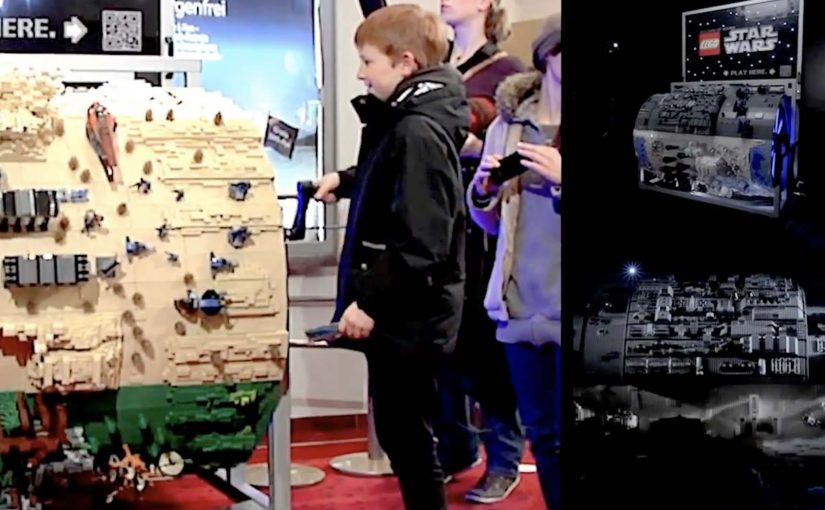
The 3D premiere of Star Wars Episode 1 in early 2012 was a cinematographic milestone for the Star Wars saga. To celebrate it, LEGO and Serviceplan Munich created a unique LEGO sound installation that actually plays the Star Wars main theme.

The installation is a huge barrel organ built from over 20,000 LEGO pieces. Four Star Wars worlds (Hoth, Tatooine, Endor and the Death Star) are constructed on the turning barrel. As it rotates, LEGO elements trigger mechanical sensors that strike the keys of a built-in keyboard, playing the tune.

A Star Wars theme you can crank with your hands

The most effective detail is the constraint. There is no “press play” button. You have to turn the organ. That one decision makes the experience feel earned. The song arrives as a result of your motion, not as background audio triggered by a screen.

How bricks become music

This is not a metaphor. It is a mechanical translation. LEGO pieces are arranged to behave like pins on a traditional barrel organ. The rotation sequence becomes a score, and the score becomes the melody via real key strikes. The four worlds on the barrel are not just decoration. They turn product and story into one continuous surface.

In European entertainment and toy launches, the strongest activations turn fandom into something people can physically operate, not just watch.

Why it lands as a cinema activation

Star Wars fans already love collectibles and craft. This installation rewards that mindset with a live proof of “impossible build meets real output.” It also gives the audience a clean social script, meaning a simple sequence people can follow without instructions. Stop. Watch someone crank it. Step in. Try it yourself. Film it. Share it.

Extractable takeaway: When a brand idea is about “bringing something into a new dimension,” the fastest route is to convert a familiar object into a physical interface and let the audience generate the outcome.

What the launch is really doing for LEGO

The real question is whether your launch gives people one obvious action that produces a repeatable, shareable payoff.

It positions LEGO Star Wars sets as more than toys. It frames them as a medium. Something that can build worlds, build machines, and even build music. That is a stronger proposition than “new sets available now,” especially around a film re-release where attention is already concentrated in cinemas.

Steal-worthy moves from Builders of Sound

  • Make the mechanism the message. The build itself should prove the claim, not just support it.
  • Use one obvious action. Turning a crank is universally understood, and it invites participation.
  • Design for bystanders. The experience should be readable from a distance, even before someone tries it.
  • Let sound do the heavy lifting. A recognisable theme turns a mechanical demo into an emotional moment.
  • Extend the experience online without changing the core gesture. If the physical version is “crank,” the digital version should feel similarly tactile.

A few fast answers before you act

What is LEGO “Builders of Sound”?

It is a LEGO Star Wars activation built around a giant barrel organ made from over 20,000 LEGO pieces. When the barrel is turned, the mechanism triggers keys to play the Star Wars main theme.

Why a barrel organ for a Star Wars release?

Because it turns a familiar, physical music machine into a participatory interface. The audience does not just hear the theme. They generate it, which makes the moment feel personal and shareable.

What makes this more than a sculpture?

Mechanical output. The build produces a real, repeatable result. That cause-and-effect shifts it from “impressive object” to “experience people line up to try.”

How do you translate a physical installation like this into an online experience?

Keep the core gesture and the immediacy. In this case, the online version is described as playable via a simple control input that mimics the physical turning action.

What should a brand measure for an installation like this?

Participation rate, repeat interactions, dwell time, the volume of user-recorded video, and any downstream actions tied to the product, such as set interest or ordering intent.

Fantastic Delites: Delite-O-Matic

Fantastic Delites: Delite-O-Matic

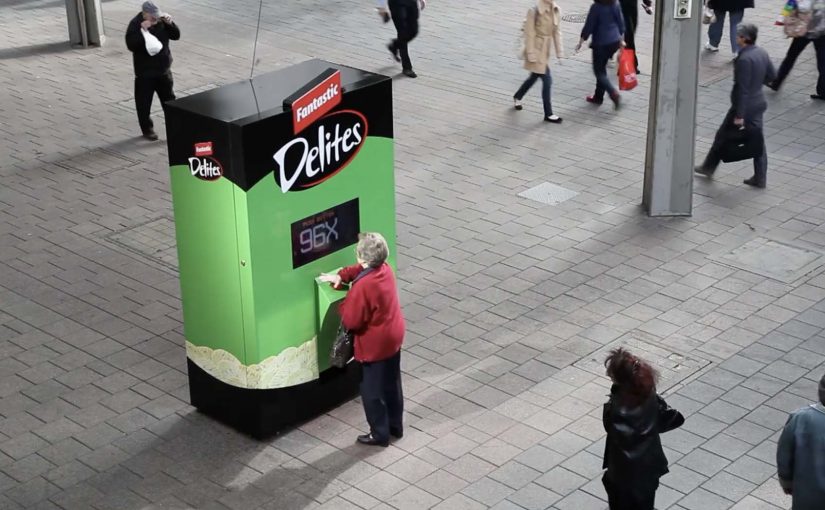
In this latest example, ad agency Clemenger BBDO Adelaide set out to see how far people will go for a free pack of Fantastic Delites.

So a machine dubbed the “Delite-O-Matic” was created that gave people a free pack of Fantastic Delites by means of pushing a button hundreds of times or performing challenges. It was then put out on the streets to prove that because Fantastic Delites taste so good, people would go to incredible lengths to get them.

Sampling that people choose to earn

Interactive vending machines are a great way to get consumer participation and engagement on the ground. There are tons of examples out there, of which some have been covered here.

The mechanic that makes it watchable

The mechanism is effort-based reward. The machine sets an instruction, the participant complies, and the prize is dispensed only after the effort is visible. The escalating “work” becomes the entertainment, and the entertainment becomes the message.

In FMCG sampling and retail activations, interactive vending machines are a repeatable way to exchange effort for product trial.

That structure works because visible effort gives the crowd a simple story to follow before the product appears.

Why it lands

This works because it turns sampling into a story people can instantly judge. The point is not only “free snack”. The real question is what kind of visible effort makes a simple product feel worth watching and worth wanting. Each extra button press or challenge makes the product feel more desirable, and the crowd becomes a built-in audience.

Extractable takeaway: When you make the cost of entry visible, you turn a giveaway into a social moment. That moment carries the brand further than a silent handout ever could.

What to steal from Delite-O-Matic

  • Make the exchange legible: people should understand the rule in one glance, and the effort should be obvious on camera.
  • Escalate, then release: tension comes from “will they do it”. Satisfaction comes from the dispense moment.
  • Keep the prize simple: the product is the hero. The machine is the stage.
  • Design for bystanders: the best sampling stunts recruit a crowd even before the first pack comes out.
  • Let participation become proof: the more people comply, the stronger the implicit claim becomes.

A few fast answers before you act

What is the Delite-O-Matic?

It is an interactive vending machine activation that dispenses a free pack of Fantastic Delites after people complete button-mashing or challenge-style tasks.

Why use effort instead of a simple giveaway?

Effort creates a story. It increases attention, pulls in bystanders, and makes the reward moment feel earned, which boosts recall and sharing.

What’s the key behavioral trick?

Visible commitment. When people publicly invest effort, the product feels more “worth it”, and the scene becomes entertainment for everyone around.

Where does this work outside snacks?

Anywhere trial is the goal and the product is easy to dispense or unlock. Beauty samples, quick-service food, entertainment promos, and event activations.

What’s the main risk?

If the tasks feel humiliating or unfair, the tone can flip. The sweet spot is playful challenge with a clear, quick payoff.