
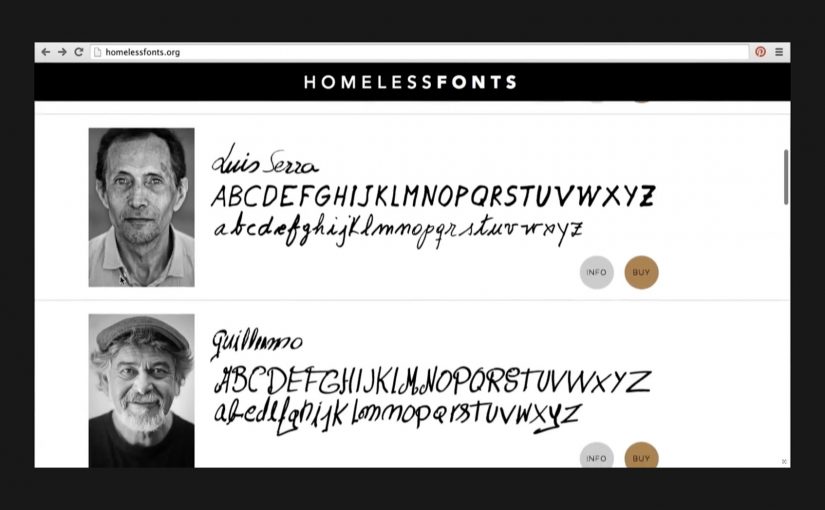
Homeless Fonts: Fonts from Cardboard Signs

Homeless Fonts: Fonts from Cardboard Signs

When you walk by a homeless person holding a cardboard sign, you usually see an anonymous face struggling to survive. Homeless Fonts flips that moment. It turns the most visible part of street life. The handwriting. Into something people and brands can actually pay for.

From street sign to typeface

The Cyranos McCann teamed up with the Arrels Foundation in Barcelona to launch HomelessFonts.org. The site features fonts built from the real handwriting of local homeless people, available for purchase by marketers who want something more human than a default type library.

Here, a “font” is a downloadable typeface file that designers can license and use across ads, packaging, and digital interfaces, just like any other professional typeface.

In urban European cities, design-led micro-commerce can convert overlooked skills into dignified income streams.

Where the money goes

The money raised from the website is intended to support accommodation, food, social programs, and health care for people experiencing homelessness. For more information visit www.HomelessFonts.org.

Why this lands

It works because it asks brands to buy a useful asset instead of “donating to a cause.” You are not funding an abstract promise. You are paying for a tool that visibly changes the tone of your message, and the purchase itself carries a story your audience can recognize instantly.

Extractable takeaway: If you want purpose marketing to stick, attach the donation mechanic to a practical, reusable brand input (a font, a template, a dataset, a sound pack) so the act of funding also improves the work.

What it’s really trying to change

The real question is whether brands will pay for contribution instead of performative concern.

This is a stronger model than pure cause messaging because it gives people commercial value, not just visibility.

Beyond fundraising, the campaign reframes homeless people from passive recipients to contributors with identity and craft. The typefaces carry names and personality, and that shifts the conversation from pity to participation.

What to steal from Homeless Fonts

  • Sell a tool, not a feeling. Build the fundraising mechanic around something buyers genuinely need.
  • Make the proof visible. The output (handwriting) is instantly recognizable, which makes the story easy to retell.
  • Design for everyday reuse. The more places the asset can live (print, digital, packaging), the more sustainable the model becomes.
  • Keep the transaction simple. Clear product. Clear price. Clear destination for proceeds.

A few fast answers before you act

What is Homeless Fonts?

It’s a collection of purchasable fonts created from the handwriting of homeless people in Barcelona, sold via HomelessFonts.org.

Who created it?

The project was launched by the Arrels Foundation in partnership with Cyranos McCann.

How do brands actually use the fonts?

Like any licensed typeface. Designers can apply them in headlines, posters, packaging, social content, landing pages, and campaign visuals to add a distinctly human texture.

What does buying a font change versus asking for donations?

It turns support into a market exchange for a useful asset. That reduces “charity fatigue” and gives brands a concrete output that carries the story forward every time it’s used.

Where is the money intended to go?

The campaign describes proceeds being used for accommodation, food, social programs, and health care supporting people experiencing homelessness.

Nar Mobile: The Donor Cable

Nar Mobile: The Donor Cable

Azerbaijan is often described as having an unusually high incidence of children born with thalassemia, a hereditary blood disorder found across Mediterranean and nearby regions. The illness can require extensive blood transfusions for babies, and hospitals can struggle with shortages of donated blood.

So Y&R Moscow partnered with Azerbaijan cellular network Nar Mobile to re-imagine blood donation for a more digital daily life. Together they created a special wearable bracelet. A donor cable is a wearable charging cable that lets smartphone owners easily donate battery power to another person, and uses that act as a prompt to donate blood.

A wearable that makes donation tangible

The Donor Cable is a charging cable designed as a bracelet. When someone’s phone is dying, you can connect phone to phone and transfer power. The campaign then bridges that familiar “help” moment to a bigger one. Donate blood.

A donor cable is a physical connector that enables one person’s phone battery to recharge another device. The campaign uses that simple transfer as a metaphor for medical donation.

In mobile-first markets, translating “helping” into a familiar phone habit can lower friction for real-world donation behaviour.

Why this lands

This works because it does not start with guilt or abstract altruism. It starts with a small, instantly useful act between two people, then reframes that feeling of helping as the reason to do the harder, higher-impact thing. The bracelet format also keeps the reminder on you without requiring ongoing media.

Extractable takeaway: If you need behaviour change, start with a low-friction action that already feels rewarding, then create a clear bridge and an immediate next step to complete the “real” action while motivation is still warm.

What the numbers are trying to prove

The stronger strategic move here is the bridge from everyday phone help to real blood donation, not the bracelet itself.

The real question is whether the campaign makes the jump from symbolic transfer to actual donation immediate enough to convert intent into action.

Campaign coverage described the donor cables as an instant hit and reported an increase in blood donation of 335%. Treat that percentage as reported performance unless you have a primary measurement source to cite.

What behaviour-change teams should steal

  • Make the metaphor usable. A real action beats a slogan.
  • Put the reminder on the object. Wearable prompts outlast a media flight.
  • Collapse distance to conversion. Pair the story with an easy path to donate.
  • Keep the rule explainable. If it takes a paragraph to understand, it won’t spread.

A few fast answers before you act

What is the Donor Cable?

A wearable charging cable that lets one person transfer battery power to another phone. It is used as a behavioural prompt to encourage blood donation.

Why connect phone charging to blood donation?

The idea uses a clear analogy. A small, immediate “donation” of power makes the bigger act of donating blood feel more approachable, and more top-of-mind.

How does the bracelet change behaviour beyond awareness?

It creates a repeatable micro-action people can perform in public, then links that positive social moment to a concrete next step. Donate blood.

Is the 335% figure a verified metric?

It is presented in campaign coverage as a reported result. If you want it stated as verified, you would need a primary measurement source.

What’s the main risk if you copy this pattern?

If the bridge from the small action to the real action is not immediate, the analogy stays clever but does not convert. The donation step must be easy to find and easy to complete.

Hellmann’s: Recitweet

Hellmann’s: Recitweet

In the past, Hellmann’s has used novel ways to encourage consumers to use their mayonnaise for more than just sandwiches. Now, for their latest campaign, they team up with Ogilvy Brazil to create Recitweet.

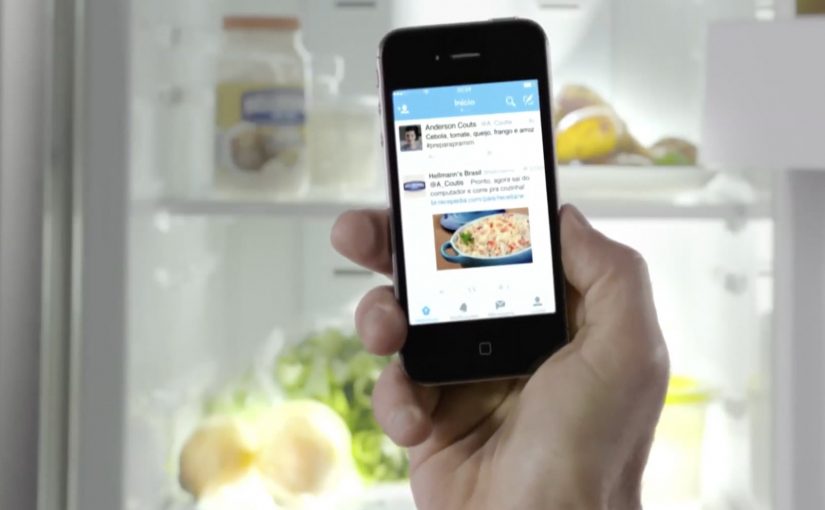
The use case is instantly familiar. You open the fridge, you see ingredients, and you still do not know what to cook. With Recitweet, consumers tweet their ingredients with the hashtag #PreparaPraMim (“prepare for me” in Portuguese). Hellmann’s replies with a recipe that is designed to use those exact ingredients.

A recipe engine built on a social reply

The mechanism is ingredient matching through a public tweet. The input is a short list of what you have at home. The output is a tailored recipe suggestion delivered back as a tweet reply, so the brand behaves like a lightweight cooking helper rather than a broadcaster.

In FMCG food brands, this utility-led social pattern turns content into a small service that appears at the exact moment the consumer is stuck.

The real question is: can a food brand reliably remove the “what should I cook” hurdle in the channel where people already ask for help. When you can answer fast and specifically, the helper role beats another round of broadcast recipes.

Why it lands

It respects the consumer’s real problem. “I have food, I lack an idea.” The campaign does not start with a product claim. It starts with a decision obstacle, then uses the brand to remove it. That makes the engagement feel earned, because the interaction produces something usable in the next 30 minutes.

Extractable takeaway: If your product is an ingredient, win by solving the “what do I do with what I already have” question. Make the brand the shortest path from inventory to action, using the channel where the consumer already asks for help.

Stealable moves for social utility

  • Constrain the input. A short list of ingredients forces clarity and makes the interaction easy to start.
  • Return a specific next step. A recipe beats a generic tip, because it includes implied quantities, sequence, and outcome.
  • Make the service feel personal, at scale. The reply is the moment of value. Treat it like customer service, not advertising copy.
  • Design for repeat behavior. The best activations are not one-off stunts. They create a habit loop people can use again the next time the fridge looks random.

A few fast answers before you act

What is Recitweet in one sentence?

Recitweet is a Twitter-based recipe helper that takes a list of tweeted ingredients and replies with a recipe designed to use them.

Why use a hashtag like #PreparaPraMim?

It standardizes the request so the brand can find, process, and respond to it consistently, while keeping participation friction low.

What makes this more effective than posting recipes on a website?

It is contextual and initiated by the consumer. The recipe arrives when the person is actively deciding what to cook, using what they say they have.

What is the minimum viable version of this idea?

A constrained ingredient input and a fast, specific reply that gives one clear next step, without forcing the consumer to leave the channel to “go search.”

What is the biggest operational risk?

Response quality and response time. If replies are slow, irrelevant, or repetitive, the “service” framing collapses and it starts to feel like a gimmick.