
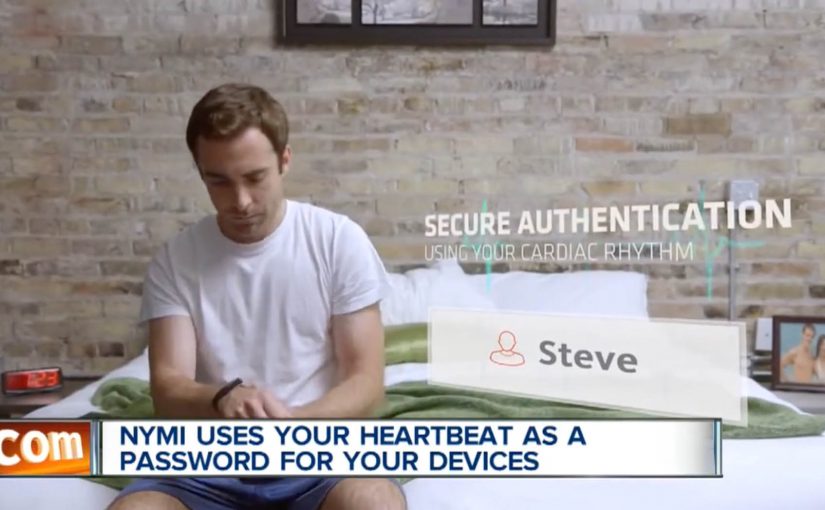
Replace your passwords with your heartbeat

Replace your passwords with your heartbeat

Imagine never having to type a password, and never needing to pull out your credit card to make a payment ever again. A biometrics startup called Bionym is positioning exactly that future with Nymi, a sleek wristband that uses your heartbeat to authenticate your identity.

The promise is simple. If your identity can be verified passively, you can unlock everyday things without friction. Bionym presents Nymi as a way to unlock your favourite devices such as your computer, smartphone, and even your car. If this kind of wearable is adopted at scale, it becomes a first step toward replacing keys and passwords with something you already carry on you.

What is actually being launched

Nymi is positioned as a consumer-ready wristband with a clear job. Authenticate you, then unlock the devices and services you use most. The interesting part is not the form factor. It is the shift from remembering secrets to proving identity continuously.

In this context, “authenticate” means proving your identity without typing a secret. That shift matters because it removes repeated login interruptions from the moments you are trying to get something done.

In global consumer and enterprise environments where people move between devices, services, and locations all day, authentication friction becomes a quiet tax on usage.

Why passive identity is so tempting

Passwords and keys interrupt you at exactly the point you want momentum. A wearable that verifies you in the background reframes identity from an event (login) to a state (you are present), which makes everyday unlocks feel like flow instead of checkpoints.

Extractable takeaway: When identity proof becomes a background signal, you remove “stop and sign in” moments that quietly kill adoption.

The ecosystem requirement that decides whether it matters

A wearable authentication layer only becomes valuable when it works across many endpoints. That means third-party developers and partners need to build a thriving ecosystem of apps and devices that can use Nymi for access and verification.

The real question is whether “heartbeat as login” can become a shared standard across devices and services, because without broad integrations it stays a niche accessory.

Pre-order details

You can pre-order the Nymi for $79, but it is not going into production until later this year. Between now and launch, the real work is adoption. Getting integrations, partners, and use cases that make “heartbeat as login” feel normal.

Moves worth copying for frictionless login

  • Make the promise tangible. Give the product one clear job (unlock) instead of selling biometrics as a vague “future”.
  • Design for passive confirmation. Reduce prompts, but make the authenticated state obvious enough that people trust it.
  • Win integrations before awareness. Treat partners and endpoints as the product, because a single-device unlock story does not change behaviour.

A few fast answers before you act

What is Nymi?

A wristband from biometrics startup Bionym that uses your heartbeat to authenticate your identity and unlock devices.

What kinds of things can it unlock?

Bionym positions it as a way to unlock devices such as computers, smartphones, and cars, reducing the need for passwords and keys.

What has to happen for this to scale?

A strong third-party ecosystem of apps and device integrations, so the wristband works across many real-world use cases.

Is heartbeat authentication inherently safer than passwords?

It can reduce risks tied to memorized secrets, like reuse across services. Security still depends on how the wristband, the endpoints, and the fallback flows are implemented.

What should you look for before betting on a wearable login?

Look for real integrations with the devices and services you actually use, because the ecosystem decides whether this becomes a habit or a gimmick.

Super Bowl 2014 Ads

Super Bowl 2014 Ads

Super Bowl Sunday is the mecca of television advertising year after year. Advertisers on this day have a golden opportunity to create valuable brand buzz and recognition through astronomically priced 30 second television spots. By brand buzz, I mean people repeating your brand name or distinctive cue unprompted in the hours and days after the game.

After watching over 60 ads that use both time-tested and unconventional strategies to attract attention, I have come up with my most entertaining list.

I start with one that immediately sets the tone for why Super Bowl ads matter. Big emotion. High memorability. Then I round it out with a mix of humour, characters, and simple ideas executed with confidence.

How I picked these ten

I looked for spots that make one clear choice, emotion, humour, or a character you can describe in a sentence, then execute it cleanly enough that you remember the brand, not just the joke.

In global consumer brands and agencies, Super Bowl work is a stress test for whether a brand can earn attention and stay memorable in a single crowded media moment.

Why these spots stick

When a spot commits to one simple idea and pays it off with a clear emotional or comedic beat, it becomes easy to retell, and retellability is what turns a 30 second moment into memorability.

Extractable takeaway: If people cannot retell your ad in one sentence, they will not carry your brand name with it.

The real question is which parts of a 30 second story people still remember when the game is over and the next morning is crowded with other brands.

I lean toward ads that trade clever complexity for a single, confident idea that stays attached to the brand at the moment you remember.

Budweiser: Puppy Love


Volkswagen: Wings


Dannon Oikos Greek Yogurt: The Spill


Bud Light: Ian Up For Whatever


Heinz: If you are happy


Kia K900: The Truth


Hyundai Genesis: Dad’s Sixth Sense


Duracell: Trust Your Power


Doritos: Time Machine


M&M’S: Delivery

What to borrow for your next brief

  • Choose one main beat. Pick emotion, humour, or character first, then let everything else serve that choice.
  • Make the brand part of the payoff. Ensure the remembered moment still carries the brand name or distinctive cue.
  • Keep it retellable. If the premise cannot be repeated in one sentence, it will not travel beyond game night.
  • Use characters as memory hooks. A simple, consistent character or device can do more work than extra plot.
  • Execute with confidence. Simple ideas win when they are committed to, not over-explained.

A few fast answers before you act

What is this post?

A curated list of my most entertaining Super Bowl 2014 ads, selected after watching over 60 spots.

How many ads are on the list?

Ten.

Which brands are included?

Budweiser, Volkswagen, Dannon Oikos, Bud Light, Heinz, Kia, Hyundai, Duracell, Doritos, and M&M’S.

How should I use this list?

As a fast reference for what stands out on the biggest advertising day of the year. Then use it to compare how different brands earn attention through emotion, humour, and memorable ideas.

Bud Light: Ian Up for Whatever

Bud Light: Ian Up for Whatever

Super Bowl ads are the miniature version of the film industry. There is huge money involved and brands are torn between creating something new and noteworthy or falling back on established formulas.

So for its 2014 Super Bowl commercial, Bud Light throws in a stack of famous faces including Arnold Schwarzenegger, Don Cheadle, and Minka Kelly, plus one unsuspecting “normal guy” called Ian Rappaport. The story is built as a rapid escalation. One small choice becomes a night that keeps getting stranger, bigger, and more unbelievable.

A stunt disguised as a spot

The mechanism is simple and ruthless. A regular guy is offered a Bud Light and asked if he is “up for whatever’s next”. Then the ad turns into a filmed chain reaction of increasingly absurd moments, reported as captured with hidden-camera choreography rather than traditional performance. The celebrity cameos are not decoration. They are the accelerant that keeps raising the stakes.

In US mass-reach advertising, Super Bowl spots act as high-budget cultural moments where brands compete on surprise, talk value, and rewatchability.

Why it lands

This works because it behaves like a dare the viewer can imagine accepting. The idea is not “Bud Light tastes better”. The idea is “your night can go anywhere”. Ian is the audience proxy, so every escalation feels like it is happening to you, not to a paid spokesperson.

Extractable takeaway: When you want a broad audience to share your story, give them a single, relatable choice at the start, then let that choice trigger visible escalation. The audience should understand the rule in one sentence and predict the next beat, then still be surprised by the size of the payoff.

What Bud Light is buying with this format

The real objective is platform reset, meaning one mass-reach moment that makes a positioning line feel newly believable. The real question is whether the brand feels like the trigger for spontaneity or just the label attached to it. Bud Light gets this right because the brand behaves like the trigger for the entire experience, not a sponsor bolted on afterward. “Up for Whatever” is a positioning line that needs proof, not repetition. This spot supplies proof by turning the brand into the permission slip for spontaneity, and by using celebrity not as endorsement but as narrative fuel.

What to steal from Bud Light’s escalation playbook

  • Cast the audience, not a hero. Use an everyperson lead so the fantasy feels attainable.
  • Make escalation the structure. A clear upward curve keeps attention better than a clever line alone.
  • Use fame as a plot device. Cameos should change the situation, not just decorate the frame.
  • Anchor the brand to the first decision. If the brand is the trigger, it earns credit for the whole ride.

A few fast answers before you act

What is “Ian Up for Whatever”?

It is Bud Light’s 2014 Super Bowl commercial built around a regular guy, Ian Rappaport, who gets pulled into a celebrity-filled night after agreeing to be “up for whatever’s next”.

What is the core creative mechanism?

Hidden-camera style escalation. One small choice triggers a chain of increasingly surprising moments, reinforced by celebrity cameos.

Why does the “normal guy” casting matter?

It makes the audience project themselves into the situation. The fantasy becomes “this could happen to me”, not “this is happening to a spokesperson”.

What does the ad actually sell?

Positioning. Bud Light as the beer that fits whatever happens, rather than a functional product claim.

How can a brand replicate the pattern without copying the stunt?

Start with one relatable choice, design a clear escalation curve, and ensure each beat is a consequence of the choice, not a random sequence of gags.