
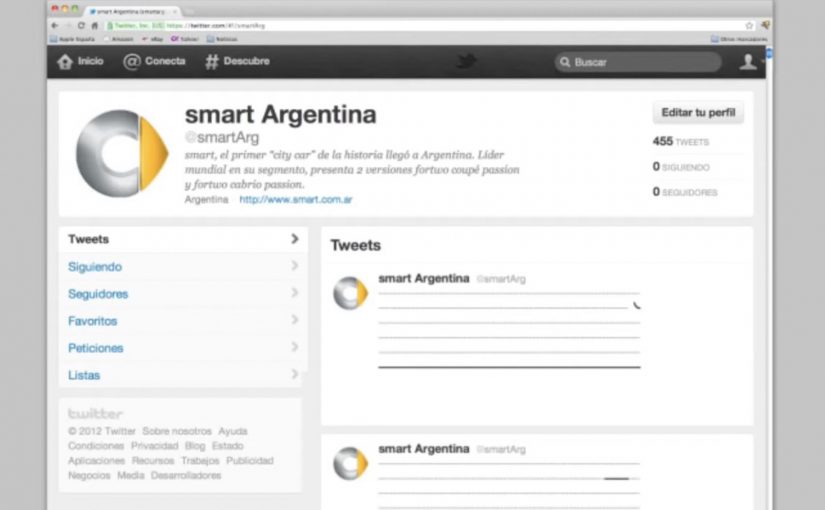
smart Argentina: The Tweet Commercial

smart Argentina: The Tweet Commercial

Argentina continues to set the standard in creative Twitter campaigns. In this latest execution, when you visit smart’s official account for Argentina, you might think some kid got in there and had his way with the keyboard. In reality, the feed is built from carefully crafted ASCII art tweets (images built from text characters) that stack into an animated sequence.

A Twitter timeline that behaves like a commercial

The mechanic is simple and slightly mischievous. The smart Argentina team publishes hundreds of ASCII frames as consecutive tweets, then relies on Twitter’s keyboard navigation to “play” them quickly. The result is billed as a Twitter-based animated commercial built from the timeline itself.

In consumer brand social media marketing, repurposing native interface behavior into a brand experience is one of the fastest ways to earn attention without buying more media.

How to watch it the intended way

Visit the smart Argentina twitter account and hold down the “J” key to move rapidly through the tweets and see the flipbook effect. Alternatively, the video below captures the idea as it was meant to be experienced.

Why this works, even though it is “just tweets”

It treats a constraint as a canvas. The 140-character format becomes the production rule, and the feed becomes the screen. That restraint is also the brand fit. A small car brand using a small-message platform to create a big-format effect is a neat piece of coherence. Because the viewer has to actively scroll to make it move, the act of watching feels like participation, which makes the trick easier to remember and repeat. The real question is whether you can make a platform’s native navigation feel like a viewing ritual, not a gimmick.

Extractable takeaway: If the interface can become the playback engine, you can turn a feed into a format, and a format into shareable proof of craft.

Steal the timeline-as-commercial pattern

  • Build the ad out of the platform. If the medium is the message, people are more likely to show others how it works.
  • Exploit one native behavior. Here, a single shortcut becomes the playback engine.
  • Make the payoff legible in seconds. The moment the animation “clicks”, the story tells itself.
  • Let craft signal effort. Hundreds of frames reads as obsession, and obsession reads as share-worthy.

A few fast answers before you act

What is “The Tweet Commercial” in one line?

A flipbook-style animation made from hundreds of ASCII tweets, designed to “play” as you move through smart Argentina’s Twitter timeline.

What role does the “J” key play?

It uses Twitter’s keyboard navigation to advance quickly through tweets, effectively turning the timeline into a fast-scrolling animation reel.

Why is the “world’s first” claim risky to repeat as fact?

Because “first ever” is hard to prove across a platform’s full history. It is safer to treat it as how the work was billed at the time.

What is the transferable lesson for brand teams?

If your platform is saturated with conventional posts, build a sequence that only makes sense in the native interface. The novelty becomes the distribution.

What is the main execution risk if platform behavior changes?

If keyboard shortcuts or timeline behavior change, the “playback” may break. Treat the navigation trick as a bonus, and make sure the idea still holds up when captured as video.
Magnum Pleasure Hunt 2: bigger, bolder sequel

Magnum Pleasure Hunt 2: bigger, bolder sequel

Last year, to launch the all new Magnum Temptation Hazelnut ice-cream, Swedish agencies Lowe Brindfors and B-Reel created an advergame, a branded game built to promote a product, called “Magnum Pleasure Hunt Across The Internet”. In the game, players are taken across 20 well known websites as they collect Bon Bons, the special ingredient of the Magnum Temptation Hazelnut ice-cream.

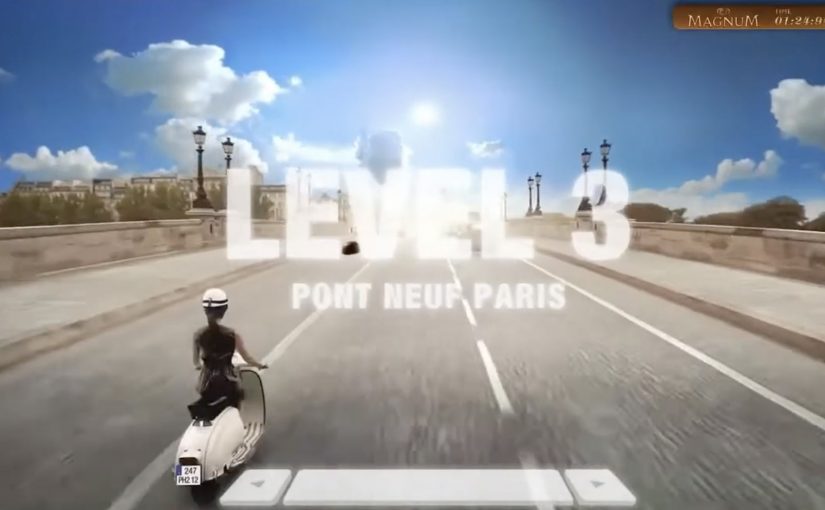
Since the game did exceedingly well, Magnum and team came up with round 2, enhanced with 3D graphics. This time players were taken on a run in New York, made to fly over Paris, and surf the waves in Rio De Janeiro, using a map and street-view style interface as the playground.

What changes from round 1 to round 2

The first game is a browser-bending sprint that treats the wider internet as a set of levels. The sequel shifts the same chase mechanic into city environments, with more depth, more spectacle, and clearer “set pieces” you can remember after one play.

In global FMCG brand launches, advergames like this work when they turn “a product promise” into a simple, replayable challenge people can explain in one sentence.

The real question is whether your sequel escalates the world without changing the one rule people already learned.

  • Round 1: web-hopping levels and Bon Bons as the core collectible.
  • Round 2: city-based runs plus a stronger 3D feel for movement, obstacles, and momentum.

Why it lands: it feels like discovery, not advertising

This is not a microsite you click once and forget. It is designed as a time-and-score loop. You play again to improve your route, your timing, and your collection count, and that repeat play is where the brand association gets built. It also matches Magnum’s “pleasure seeking” positioning with a mechanic that is literally a hunt. Because the loop rewards replay with visible improvement, the hunt association gets reinforced without asking the player to read a product pitch.

Extractable takeaway: When the brand promise is an action verb, make that verb the gameplay loop, and make replay the fastest way to feel the promise again.

The smart brand logic behind the Bon Bons

Bon Bons are a neat choice because they let the product story travel inside the gameplay. You are not only collecting points. You are collecting the “ingredient” that makes the new variant feel specific, even if you never read a product description.

I think it is a great follow up to the first version. Magnum Pleasure Hunt 2 could be experienced at www.pleasurehunt2.mymagnum.com.

Sequel campaign rules worth copying

  • Keep the core rule the same. Sequel energy comes from familiarity, then escalation.
  • Upgrade the world, not the instructions. New environments create novelty without re-teaching the game.
  • Build signature moments. New York, Paris, and Rio act like memorable chapters, not just backgrounds.
  • Make it easy to share a result. If the outcome is a score or time, people instantly understand what “good” looks like.

A few fast answers before you act

What is Magnum Pleasure Hunt?

It is a branded advergame where players chase and collect Magnum Bon Bons, originally by racing across well known websites as game levels.

What is different about Magnum Pleasure Hunt 2?

The sequel moves the action into city environments, adds a more cinematic 3D feel, and turns New York, Paris, and Rio into distinct stages of the chase.

Why does the “hunt” mechanic fit the Magnum brand?

Because it translates the idea of “pleasure seeking” into a simple action loop. Keep moving, keep collecting, keep chasing the next reward.

What makes an advergame replayable enough to matter?

Clear scoring, short rounds, and visible improvement. If players can beat their own time or score, they come back.

What is one practical takeaway for marketers?

If you plan a sequel, keep the rules familiar and escalate the world. That is how you get “new” without losing the audience you already earned.

Anthon Berg: The Generous Store

Anthon Berg: The Generous Store

Generosity is one of the basic elements in human happiness. The campaign cites research suggesting that only 1 in 10 people experience generosity from others. To help change that trend, Danish chocolate maker Anthon Berg opens “The Generous Store”.

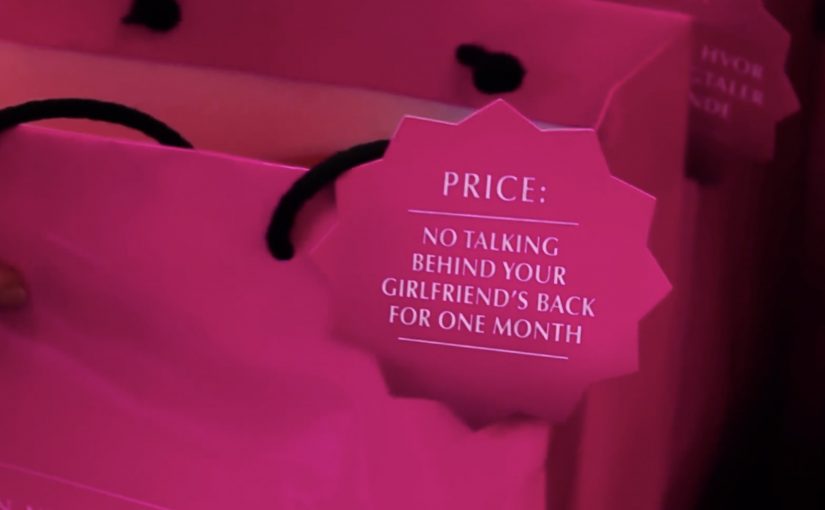
For one day only, the pop-up is described as the first chocolate shop where people cannot pay with cash or card. Instead, the store provides iPads where people log in to Facebook and post a promise of a generous deed to a friend or loved one.

When generosity becomes the price tag

The twist is simple. Chocolate is not discounted. It is “priced” in actions. Your payment is a public commitment, not a transaction, and that changes how the brand message travels.

How the mechanic works

Here, the mechanic is the rule set that turns each chocolate into a reward for a promised deed. Each product comes with a defined generous deed. At checkout you choose the deed, sign in on an in-store iPad, and publish the promise to the person you are doing it for. The store does not accept money. It accepts a visible commitment that a real person can later hold you to.

In FMCG and gifting brands, turning a private intention into a light public commitment often spreads faster than any discount ever could.

Why it lands

This works because it removes the usual friction of “sharing”. People do not share an ad. They share a promise addressed to someone they care about. That makes the post feel personal, not promotional, and it gives the brand a role as the trigger for a positive moment. The one-day constraint also adds urgency. If you want in, you have to show up and do the thing.

Extractable takeaway: If you can make the customer’s “payment” a social commitment with a clear recipient, the message travels as a relationship act, not as brand content.

What the brand is really buying

The real question is whether your brand can make the act of purchase double as a socially visible promise people want to complete.

The store trades short-term revenue for reach and association. The earned effect is not just “people talked about a pop-up”. It is that the brand gets attached to a stream of personal posts that already have attention and emotional context. That is a much stronger distribution layer than asking people to like a page or share a video.

What FMCG and gifting brands can steal

  • Use a non-monetary currency that matches your brand. Here the currency is generosity, not points.
  • Make the action specific. Vague kindness does not travel. Concrete deeds do.
  • Design for a real recipient. A named person increases follow-through and keeps it human.
  • Keep the steps brutally simple. Choice, login, post. No extra hoops.
  • Limit the window. Scarcity turns a nice idea into an appointment.

A few fast answers before you act

What makes this “social commerce” rather than a normal pop-up?

The checkout is a social action. The “payment” is a posted commitment to another person, which creates distribution inside an existing network.

Why is the Facebook post essential to the idea?

It turns intent into accountability. The promise is visible to the recipient and friends, which increases the chance of follow-through and gives the campaign its reach.

What is the main risk with a “good deeds as currency” mechanic?

If it feels forced or performative, people will reject it. The deeds must feel genuinely generous and culturally natural for the audience.

How would you adapt this if you cannot use Facebook or logins?

Keep the structure and change the channel. The key is a lightweight commitment addressed to a real person, made in a way that is easy to share and later remember.

What should you measure beyond views?

Track footfall during the activation, earned mentions, the volume of public pledges, and any lift in brand association with generosity in post-campaign tracking.