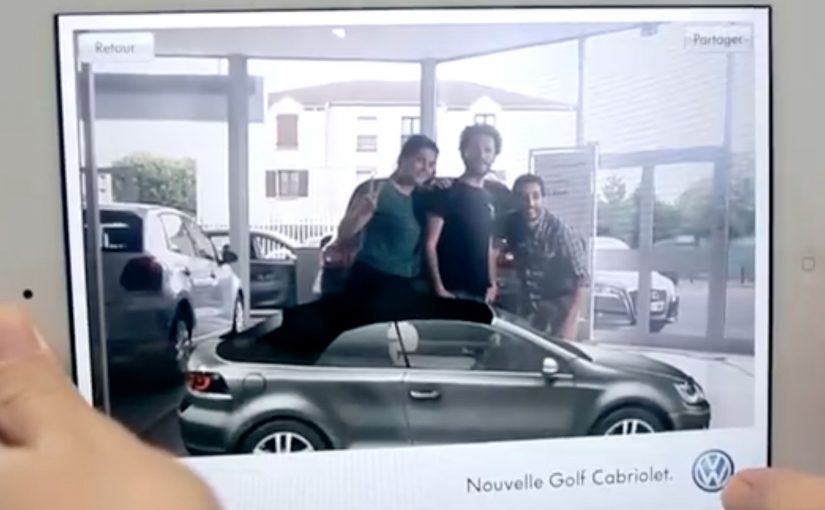
The Golf Cabriolet is back after 9 years of absence, since production was stopped in 2002. Volkswagen together with Paris based agency ‘Agency.V.’ have come up with the worlds first augmented reality car showroom app for the iPad2, iPhone and Android. Here, augmented reality means using the phone or tablet screen as a lightweight showroom for a virtual version of the car.
The app lets you explore the vehicle and play with it’s features like opening the soft-top roof, rotating the car, checking the vehicle’s details, changing the body colour or the style of the rims. You can even take a picture of yourself with the virtual car and share each step of this experience through your social networks.
Why this is a useful AR showroom idea
This is a clean, practical use of augmented reality. It gives people a way to “handle” the car without needing a dealership visit. The experience stays focused on the things people actually want to try first. The roof open and close. The rotation. The color and rim changes. Because the app turns the screen into a hands-on showroom, the product feels easier to explore and share.
Extractable takeaway: AR product demos work best when they compress first-touch exploration into a few obvious actions people already want to try.
In car marketing, that shifts the first product interaction from the dealership to the viewer’s own screen.
What Volkswagen is really demonstrating here
The business intent is not to recreate the full dealership experience. It is to move the first high-interest product interaction into a portable format people can control, personalize, and share.
The real question is whether that kind of lightweight showroom removes enough friction to make early product interest feel immediate and worth passing on.
What to take from this if you are building AR product demos
- Prototype “touch” moments first. Opening, rotating, and quick configuration are the behaviors people expect before they care about specs.
- Keep the interaction set small and obvious. A few high-intent controls beat a feature dump in early-stage AR.
- Make sharing a natural outcome of exploration. A photo-with-the-product moment is a low-friction distribution mechanic.
- Use AR to remove the dealership barrier. The value is access and play, not realism for its own sake.
A few fast answers before you act
What is the Volkswagen virtual Golf Cabriolet app?
An augmented reality car showroom app for iPad2, iPhone and Android that lets people explore and customize the Golf Cabriolet.
What can you do inside the app?
Open the soft-top roof, rotate the car, check details, change body colour, change rim styles, and take a photo with the virtual car to share socially.
Who created it with Volkswagen?
Paris based agency ‘Agency.V.’.
Why is this a useful AR showroom idea?
It brings the core product exploration moments onto a personal screen, so people can interact with the car before any dealership visit.
Where could people download it?
From the French iTunes Store for iPhone and iPad 2, and from the Android market for Android devices.