
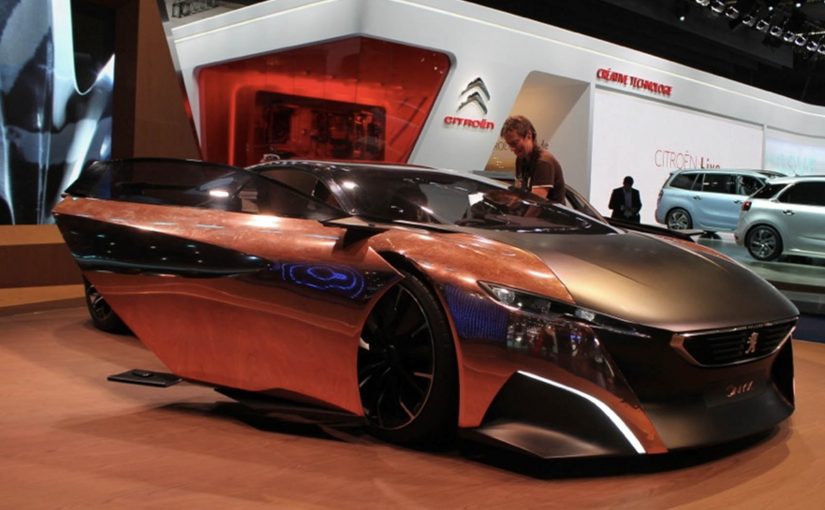
IAA 2013: Walk of Innovations

IAA 2013: Walk of Innovations

The 65th Internationale Automobil Ausstellung (IAA) has been running in Frankfurt am Main for the past two weeks. So on Saturday I decided to go for the motor show to catch up on the latest cars and also see first hand the much anticipated Nissan Nismo Watch.

Most of the car makers in this year’s show were also present in IAA 2011. In fact they were even located in the same stands as 2011, with the same high tech touch displays to promote their cars. The difference was that their 2013 car models were now more hybrid and or electric only, for example this new four seater Smart.
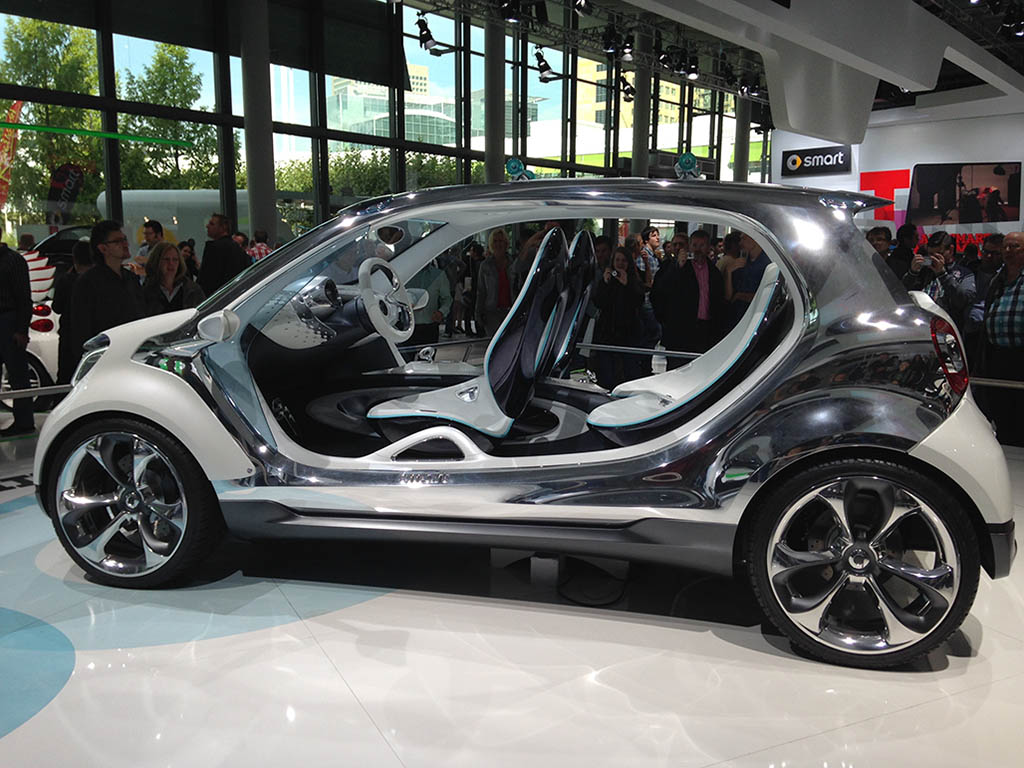
Mercedes four seater Smart

What changed on the floor

While I walked around and looked for changes vis-à-vis what was shown in IAA 2011, I noticed that apart from the now expected large screens and touch displays, car makers were using all kinds of social media to engage with their visitors.

Engagement snapshots by brand

Here is a quick photo report of my engagement experiences with the various car makers.

Audi
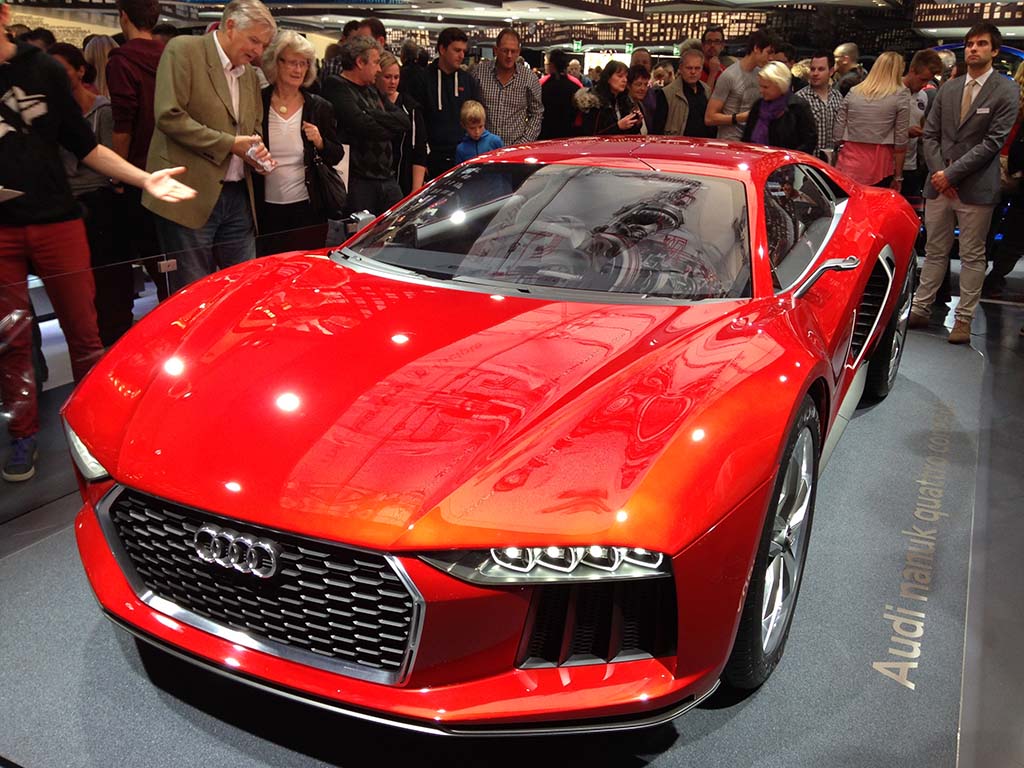
Audi Quattro Concept

To make sure I did not miss Audi this year due to 200+ people standing in line to get into the Audi stand, I decided to visit very early in the morning. The line was short, but there were already hundreds of people inside. On walking in, I noticed that the concept for the stand was taken straight out of the Hollywood movie “Upside Down”.
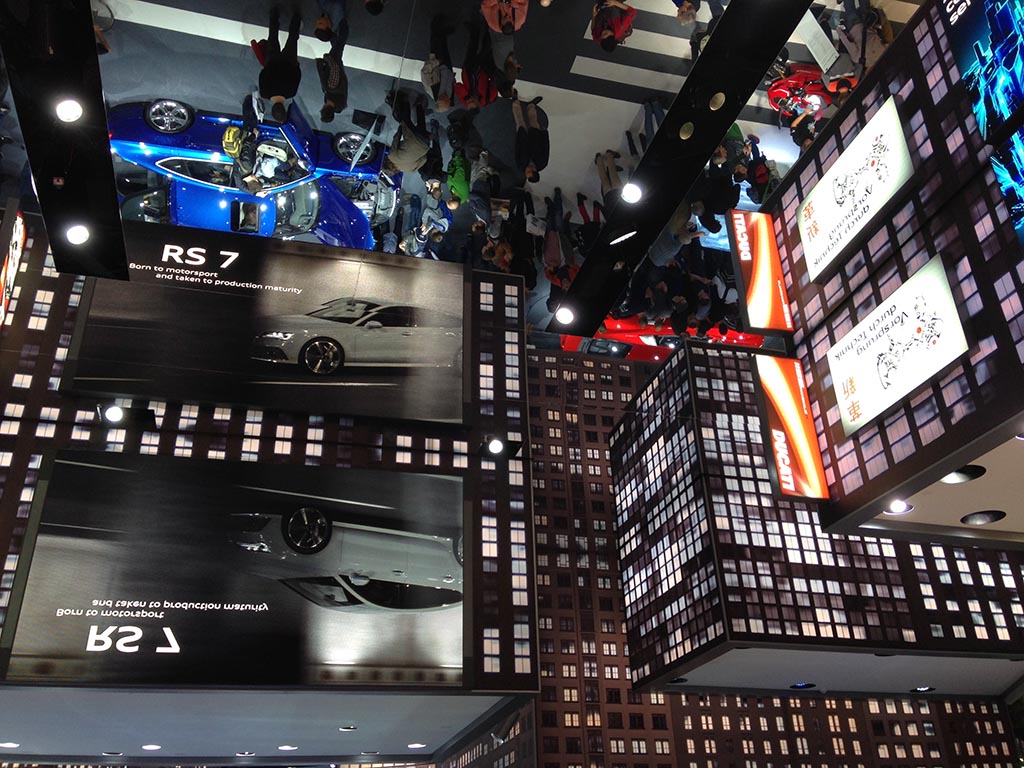
Audi Upside Down

Visitor engagement at the stand was driven through a special photo booth. While people waited in line they got an iPad to play a game and answer three questions about Audi. Winners got custom giveaways like keychains, gummy bears, etc. After that, visitors were ushered into the photo booth which superimposed the photos onto custom Audi backgrounds. Visitors could take home a printed copy and later also download soft copies from www.audiphotoautomat.com.

Mercedes

Next stop was the Mercedes stand which was also impossible to get into in 2011. From the below picture you can see why.
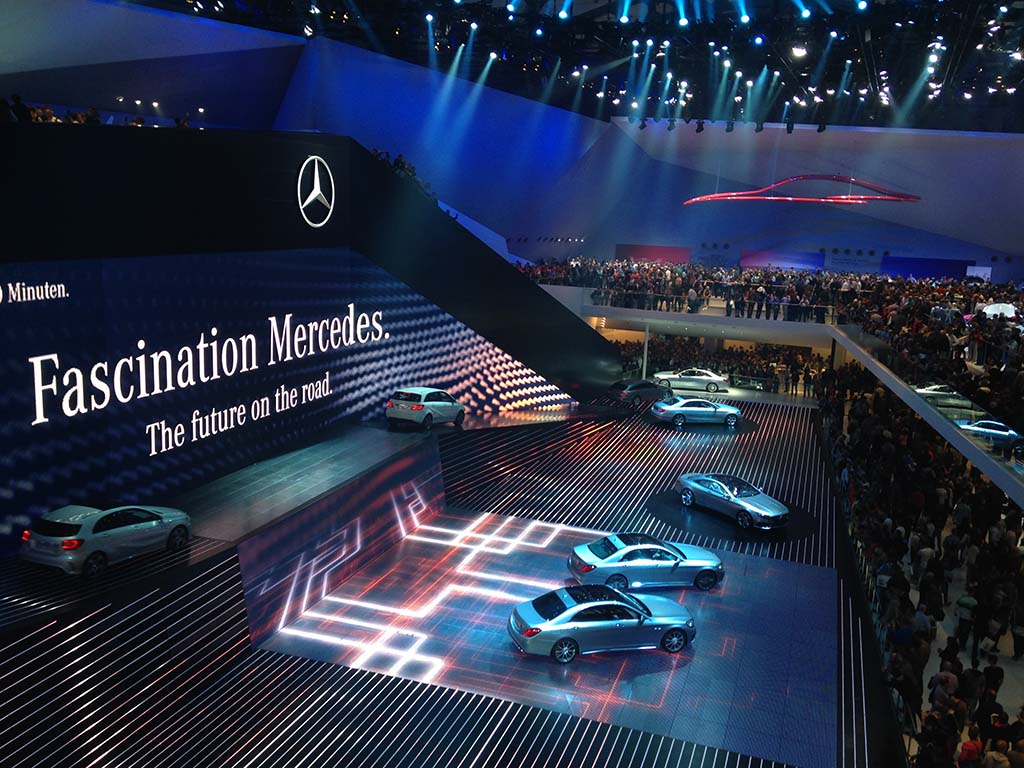
Fascination Mercedes

Mercedes put up a huge multi-sensory show that went on for over 20 minutes, while thousands of people just stopped and watched. Children visiting the stand were kept busy with car simulators.
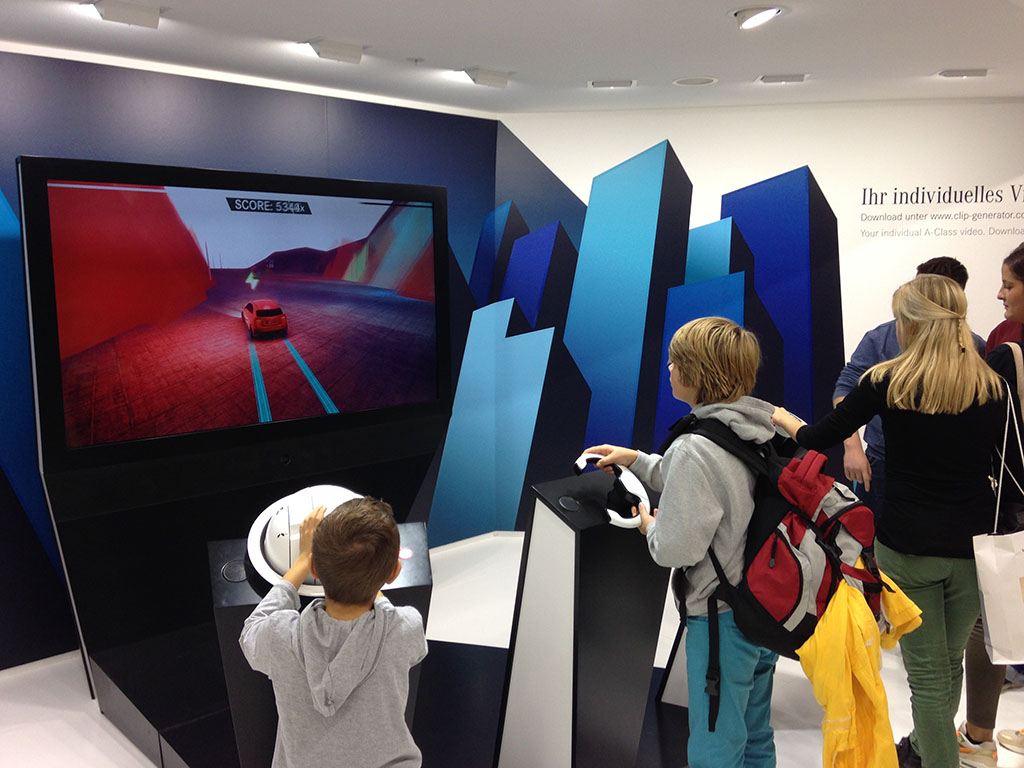
Mercedes Car Simulator

Outside the stand one could test drive the Mercedes off-road jeeps with the help of trained drivers.
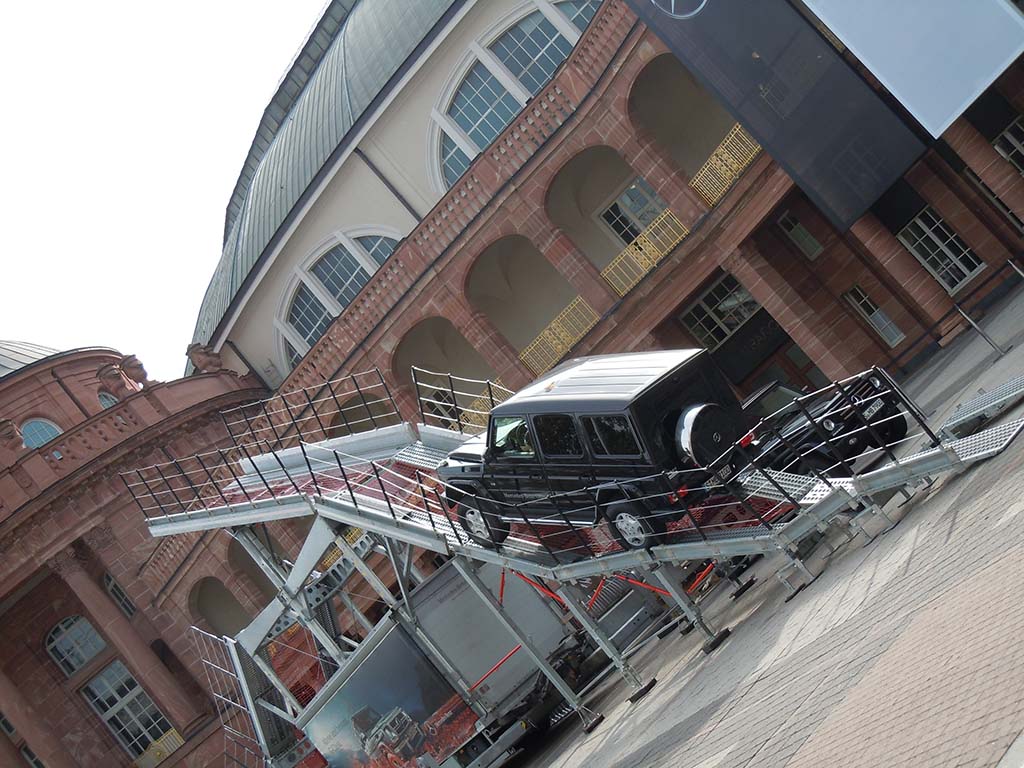
Mercedes Offroad Test Drive

Hyundai

Hyundai was the first car brand I came across that was using the event to generate Facebook fans. For liking the Hyundai Facebook page, fans at IAA could win a Hyundai i30.

Hyundai Like Us Pillar

The rear windscreen of the i30 was converted into a touchscreen which people could use to instantly “Like” the brand’s Facebook page or choose to receive the fan page link via email.
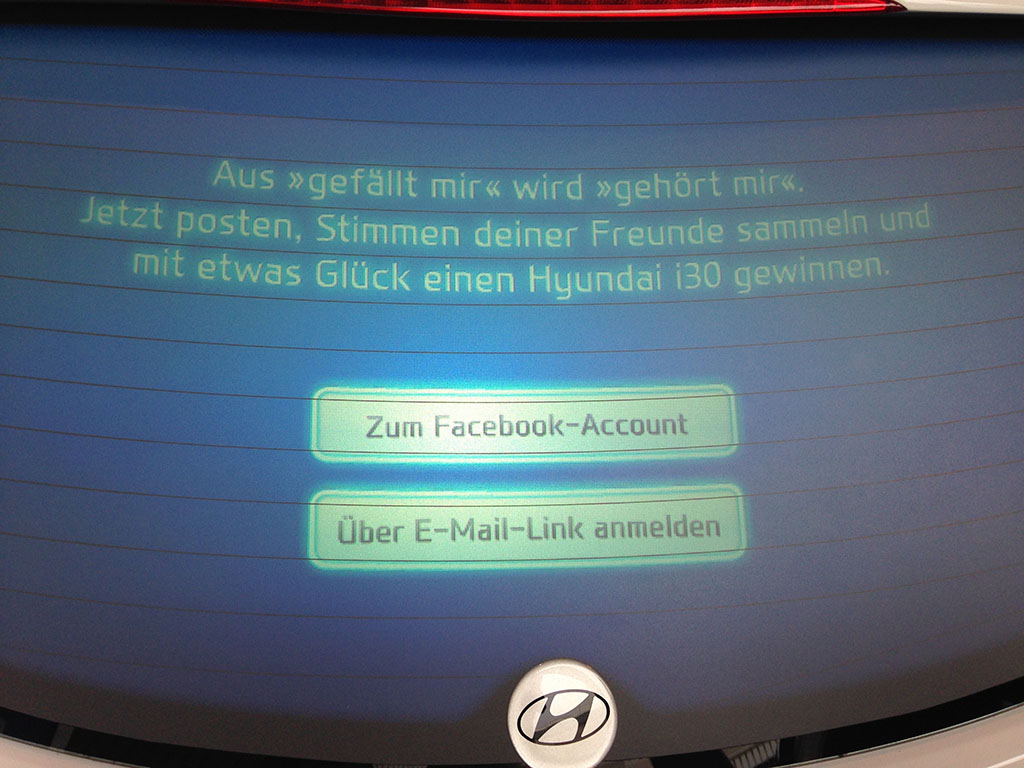
Hyundai i30 rear window

At the stand Hyundai also displayed a touchable music seat for hearing impaired drivers which vibrated as per the music being played. This was still in concept phase and the test seats were being developed out of Korea.
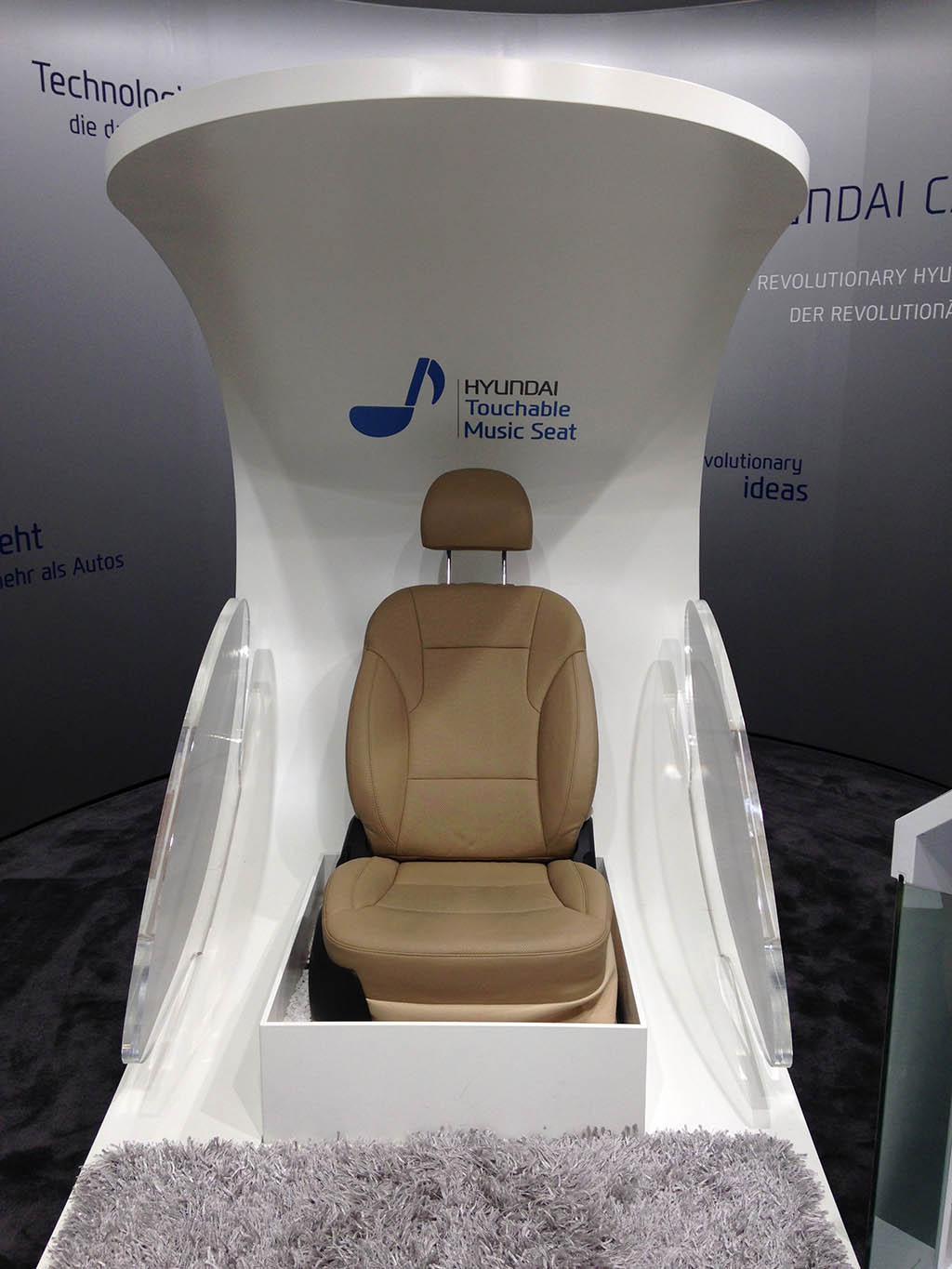
Hyundai Touchable music seat

Volkswagen

The Volkswagen “Think Blue” initiative was presented via an interactive augmented reality layer that was activated through the provided iPads.
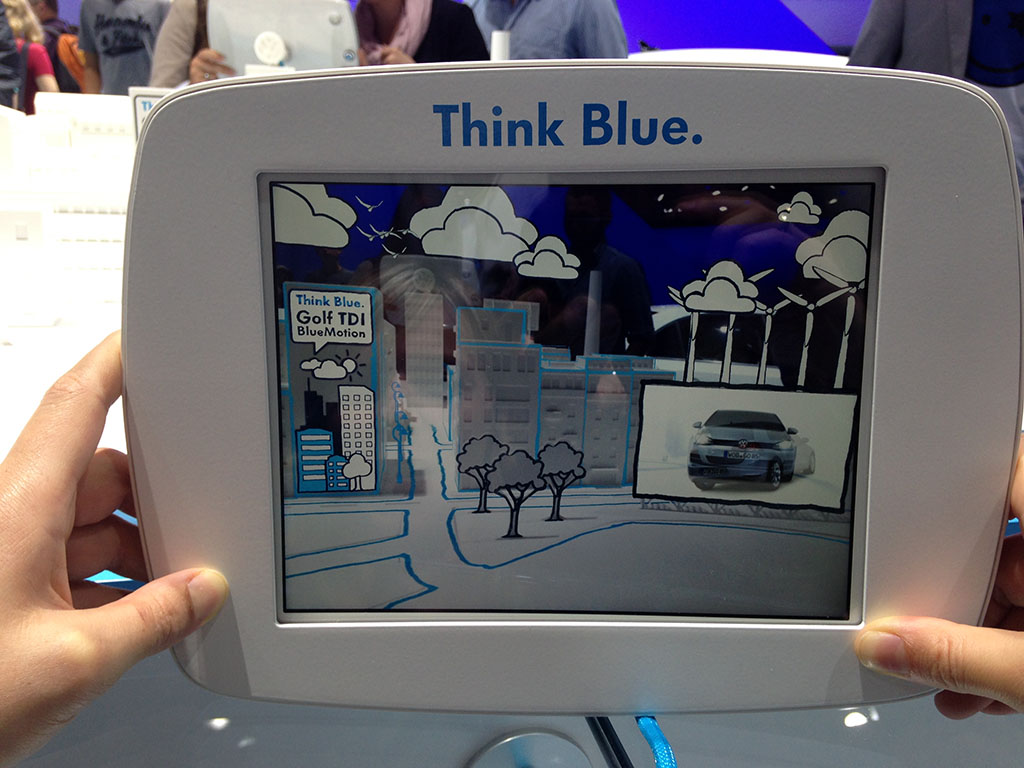
Volkswagen Think Blue

Skoda

Skoda explained their Green Line initiative via a wooden toy car that was supported by the animations in the embedded touch screens.
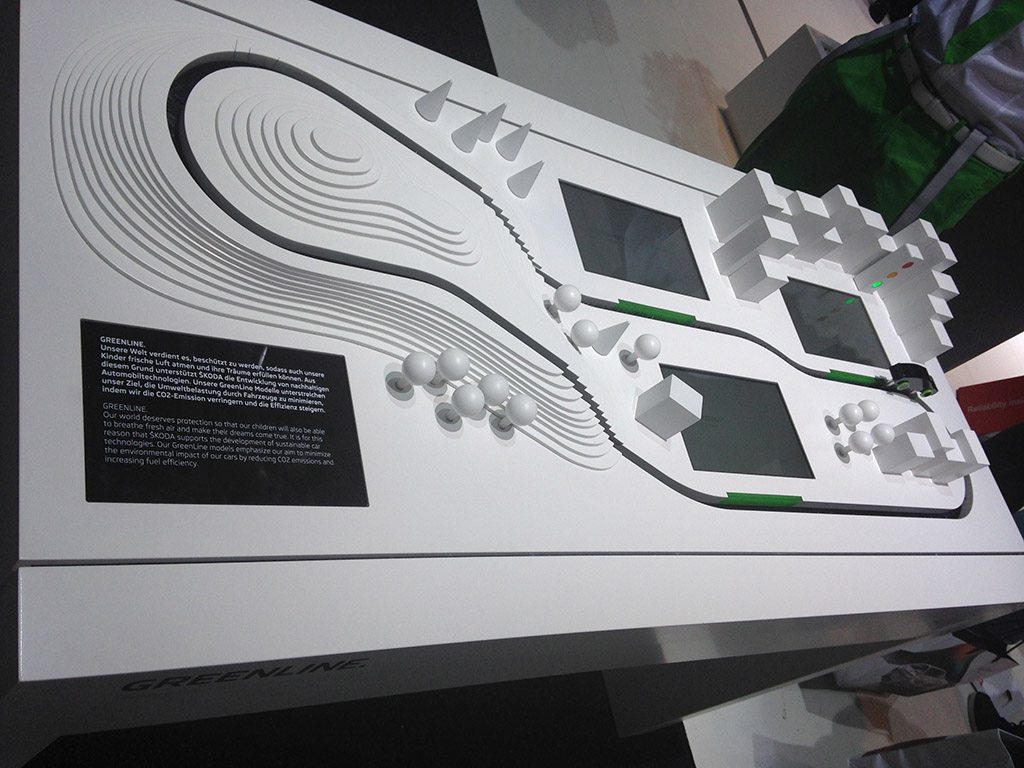
Skoda Green Line

At the neighbouring table kids were engaged with games around the Green Line initiative.
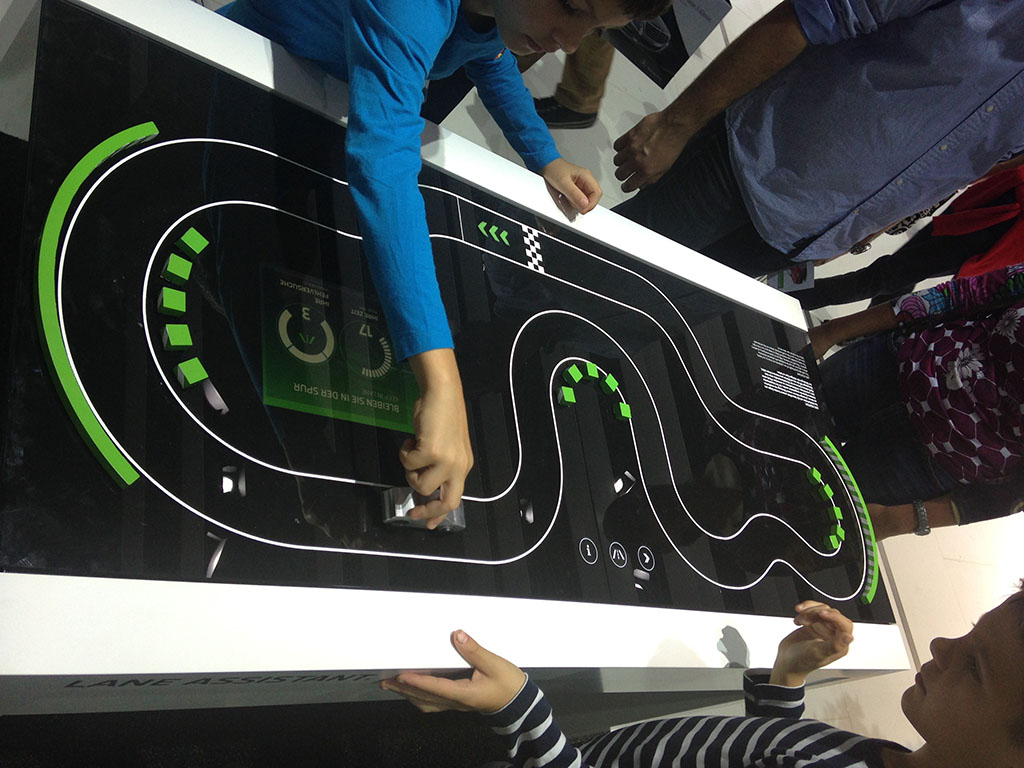
Skoda Green Line Game

Michelin

At the Michelin stand, visitors could take pictures with a virtual Michelin mascot and have the pictures emailed to themselves instantly.
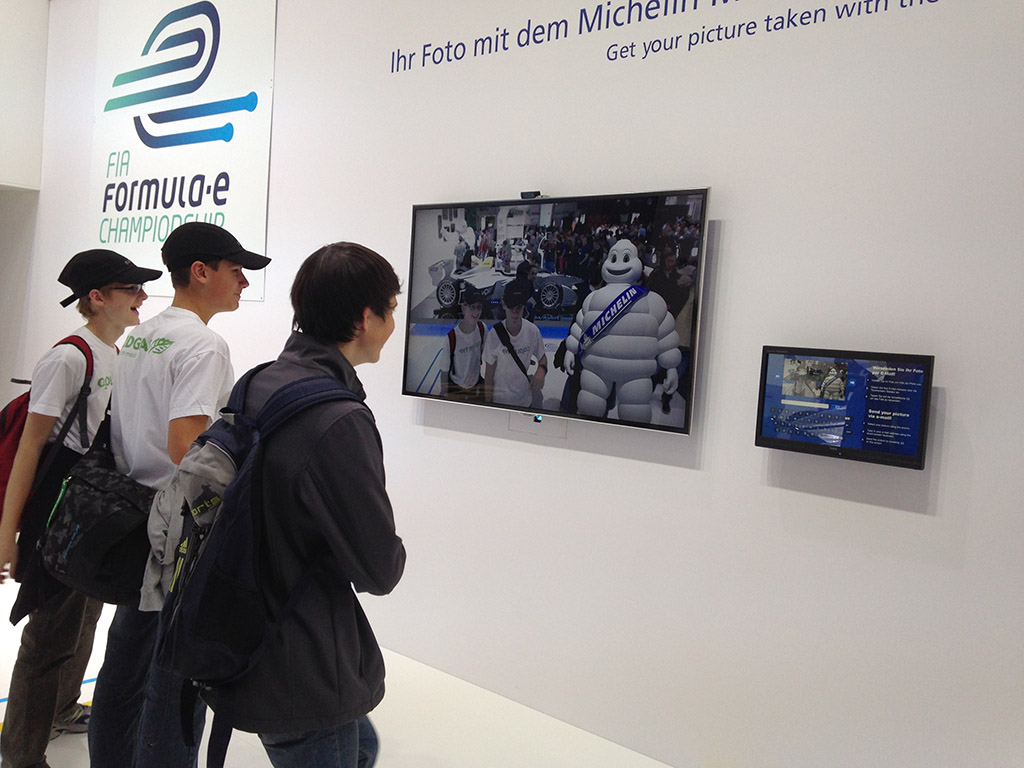
Michelin Mascot

Nissan

After having written about the Nissan Nismo Watch last week, I could not wait to see the real watch in action. But to my disappointment the watch was not there as announced. There was only a plastic dummy on display.
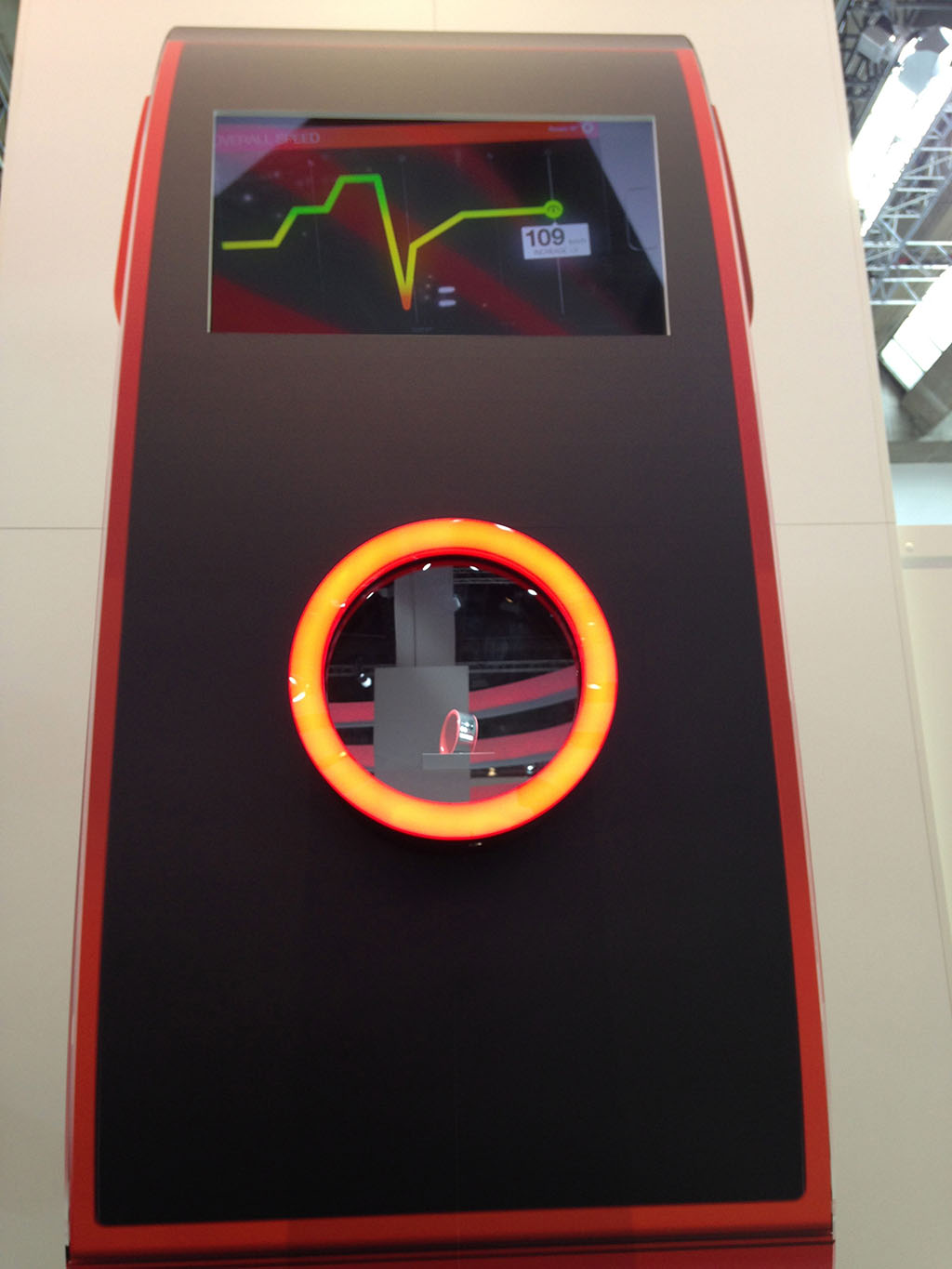
Nissan Nismo Watch

But I did take Nissan’s version of real life “Likes” for a spin (first spotted at the Renault stand in the 2011 Amsterdam Motor Show).
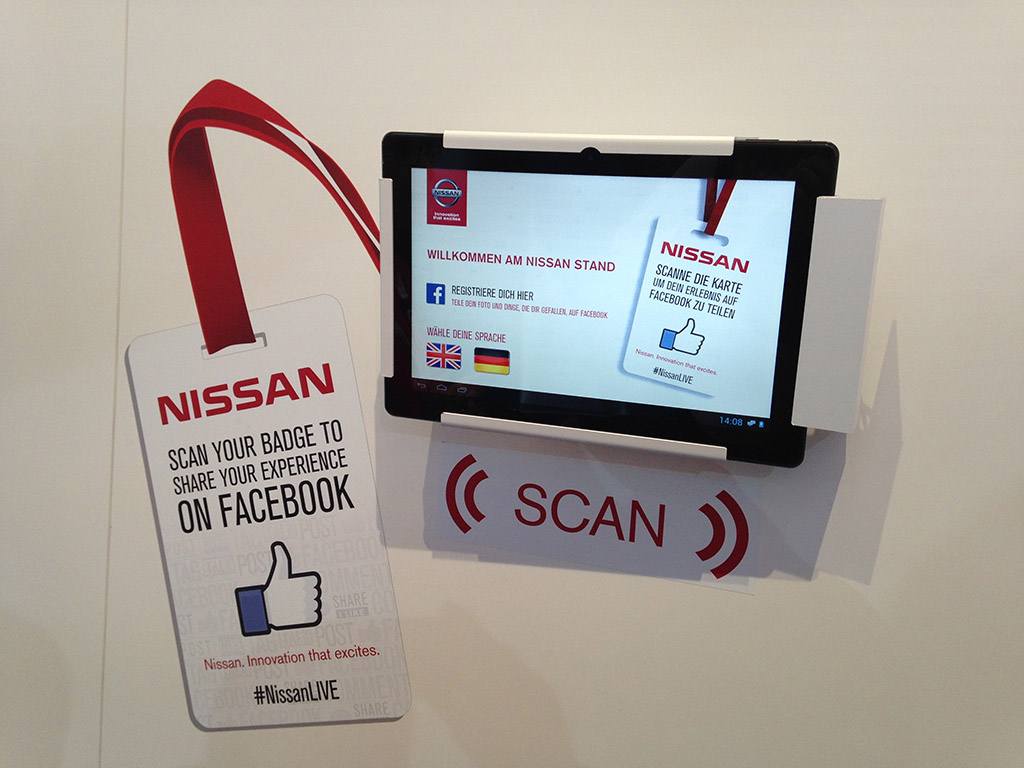
Nissan Real Life Likes

The RFID badges allowed visitors to post custom Nissan branded pictures of themselves onto Facebook.
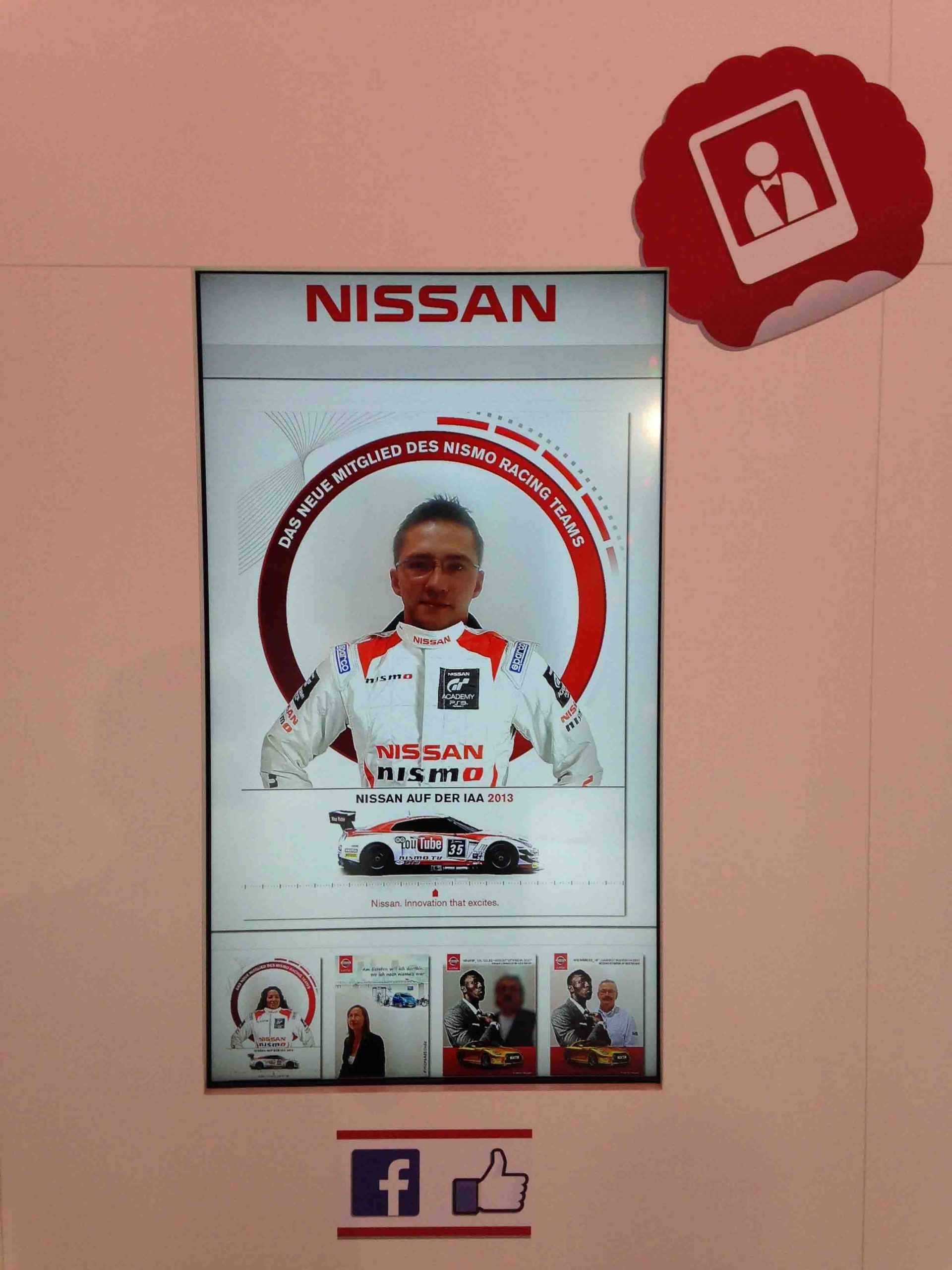
Nissan Facebook Pillar

Visitors were also given the option to share the cars they like on Facebook via special Like buttons built into the car info pillars.
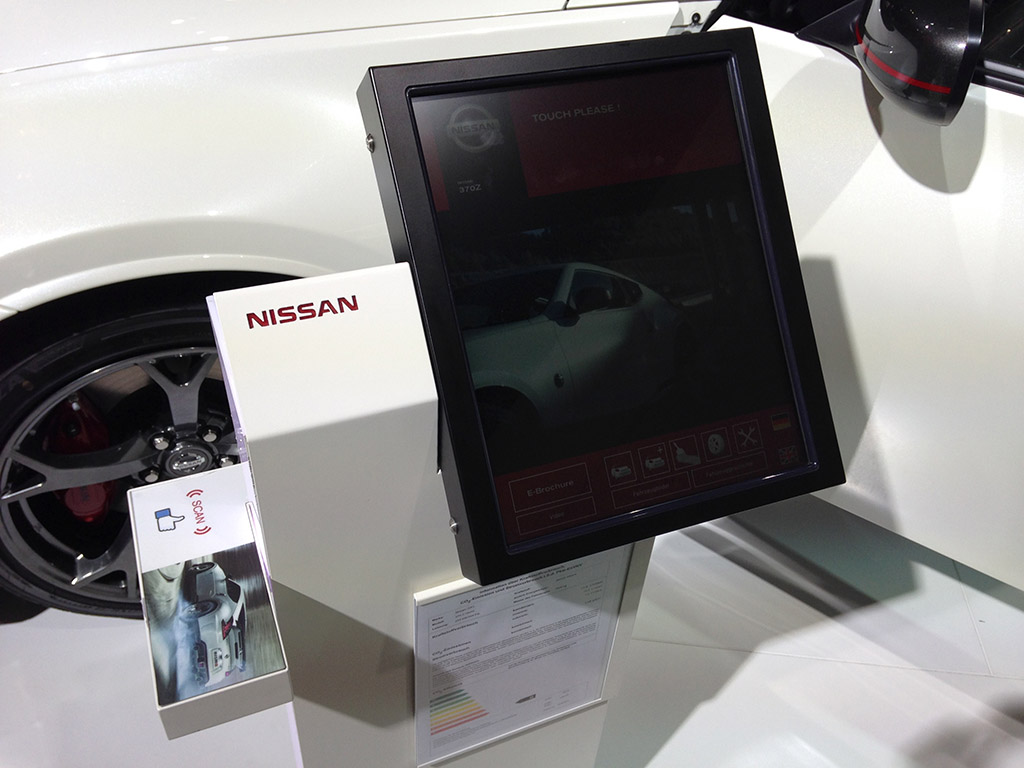
Nissan like a car button

Ford

At the Ford stand this year visitors were given head and shoulder massages.
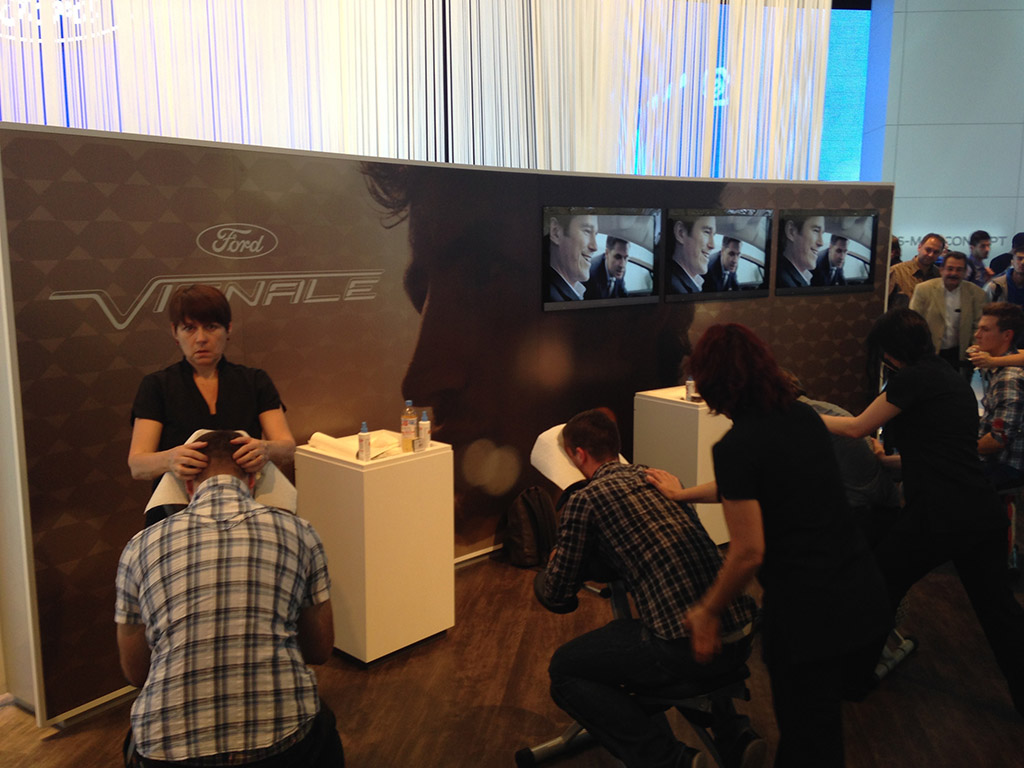
Ford head and shoulder massages

Then to experience the Ford EcoBoost, visitors were put in front of a leaf blower and their reactions captured and uploaded on the Ford Flickr channel.

And for the more social visitors, Ford had a Twitter based contest running.
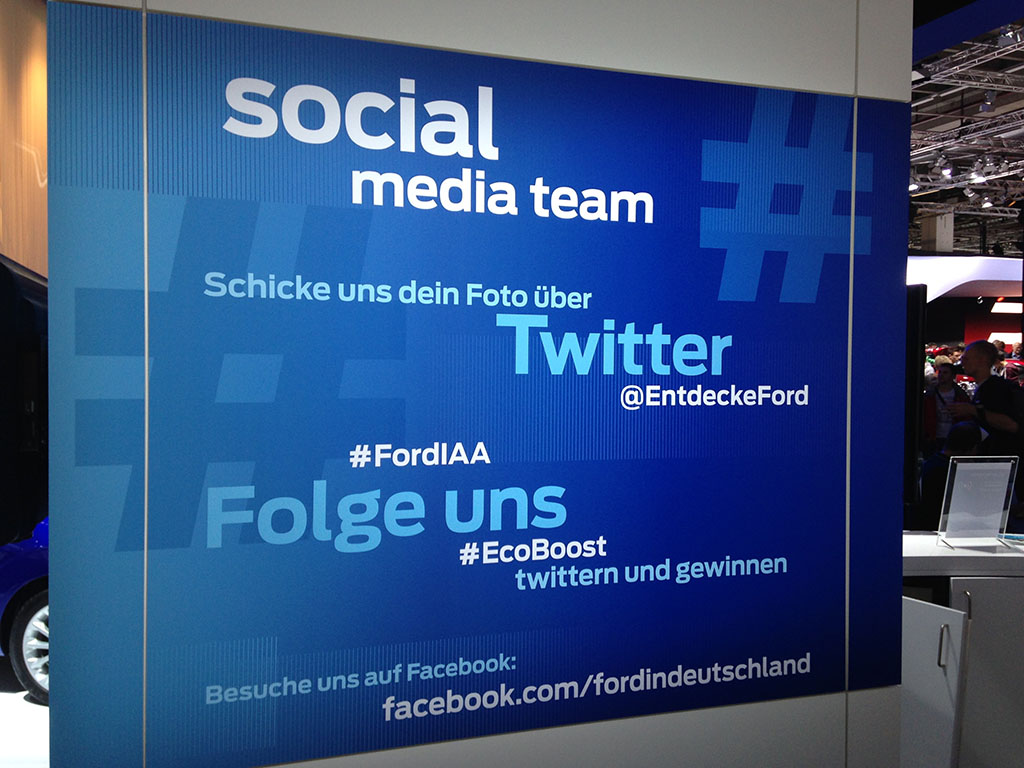
Ford IAA Twitter Contest

Kia

At Kia, visitors could superimpose their heads onto a football player and then have the custom postcard sent to their email IDs.
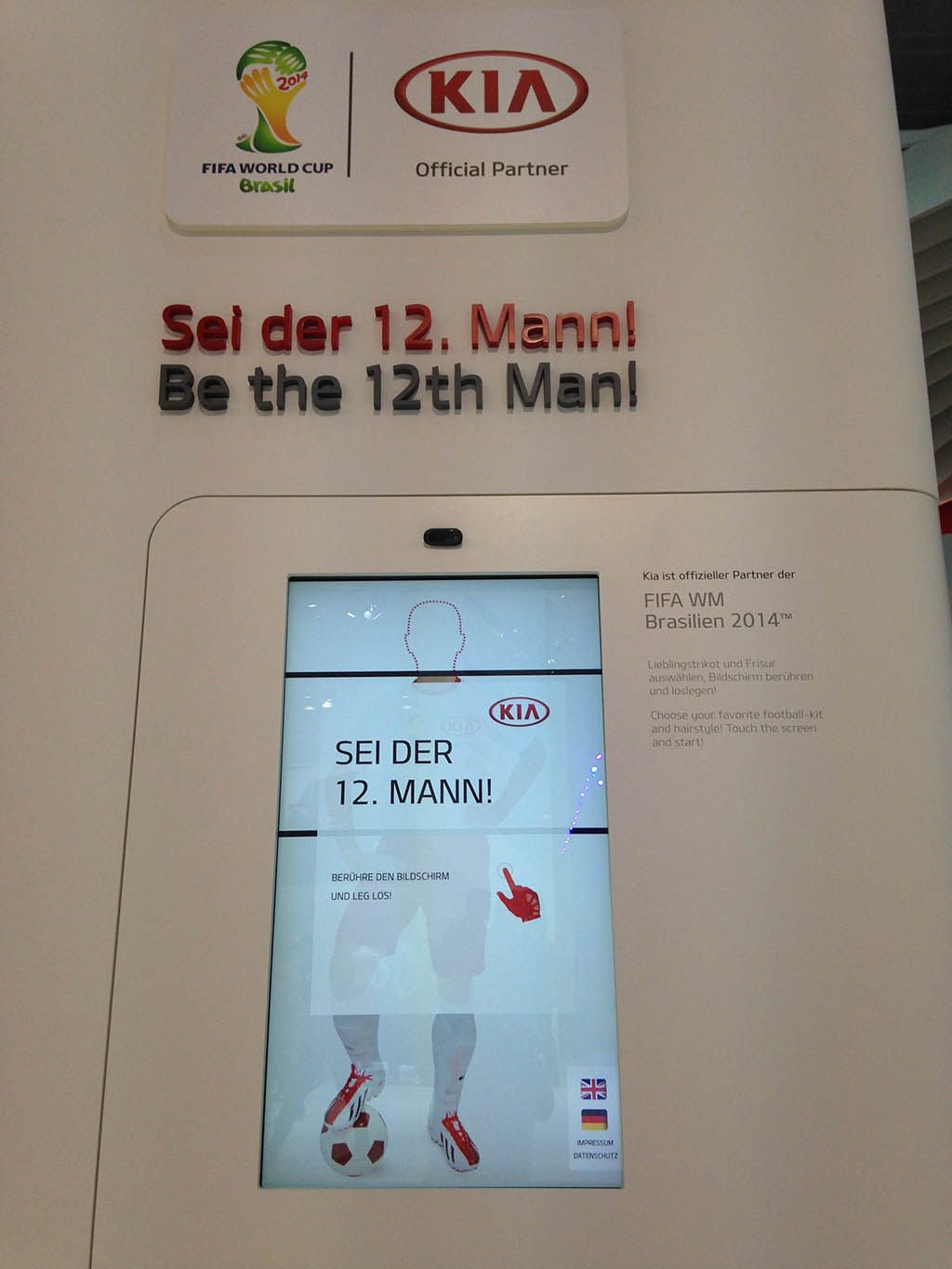
Kia 12th Man

Chevrolet

Visitors at the stand could make small flipbooks of themselves doing funny dances in front of the main character of the Hollywood film “Turbo”.
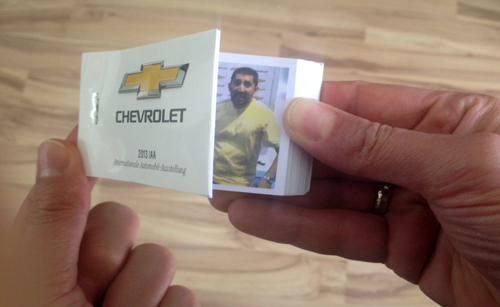
Chevrolet Flipbook

Or they could write special messages to their loved ones on a piece of paper and the team at Chevrolet would instantly convert them into wearable badges.
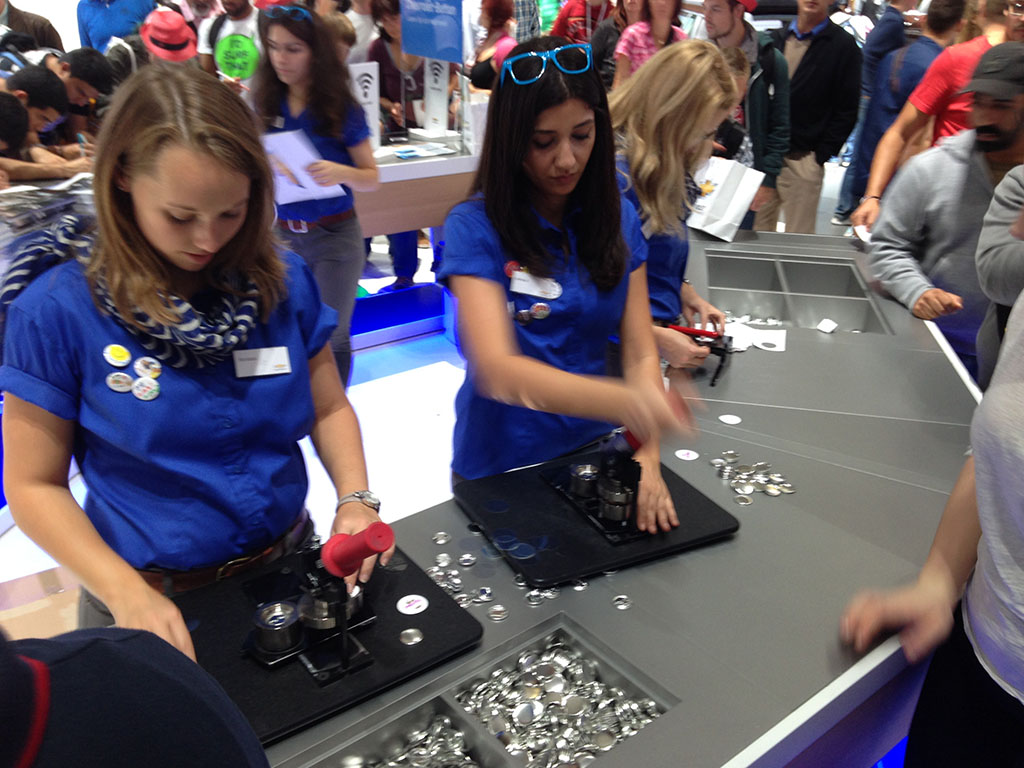
Chevrolet Badges

Chevrolet was also the only car maker at the IAA who was using Foursquare to offer discounts on their show merchandise.

Chevrolet Foursquare Check-in Special

Mini

Mini this year gave visitors the option to body paint their cars and email the photos to themselves.
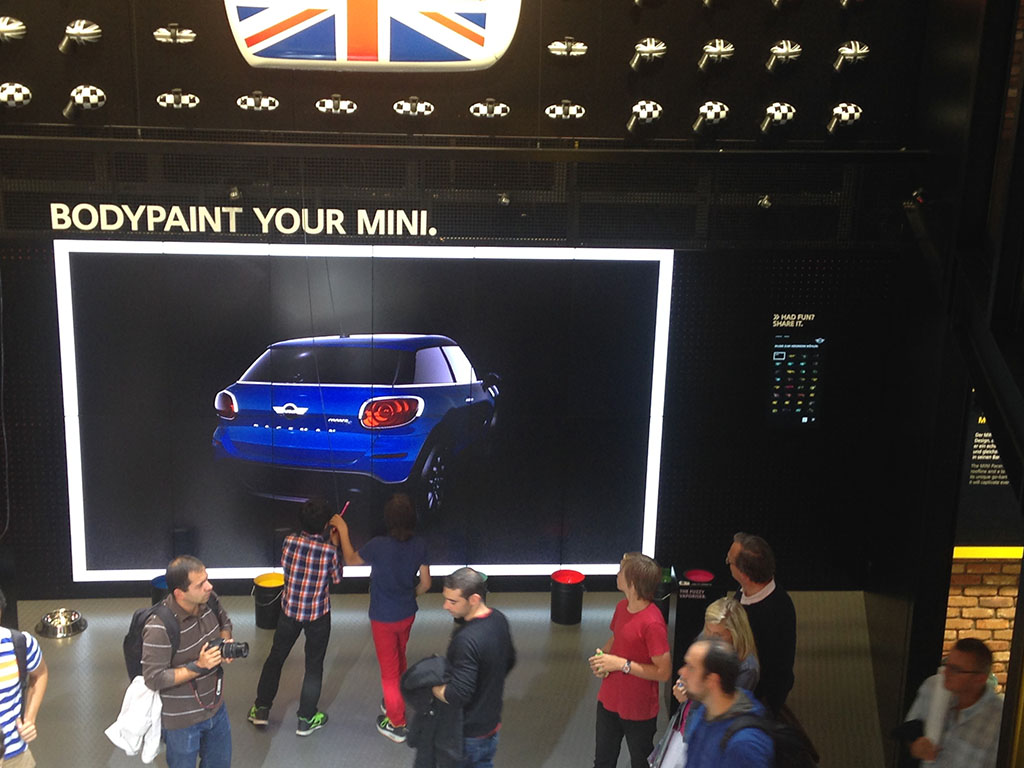
Bodypaint your Mini

Visitors could also slide down a specially created tunnel at record speeds that were also photographed and displayed on a large overhead digital screen.
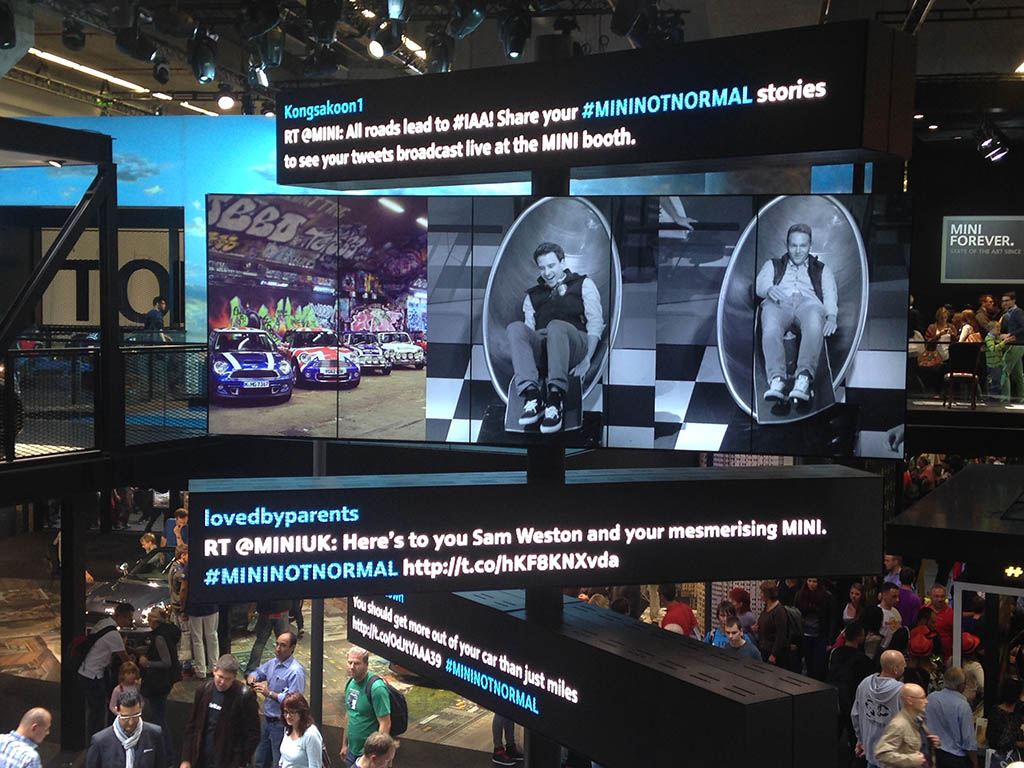
Mini Slide

BMW

BMW, like Mercedes, put up a multi-sensory show at their stand. But compared to Mercedes it was short and not as extravagant. Still pretty impressive.

BMW X5

Kumho Tyres

On the way out I spotted Kumho Tyres giving away various petrol and tyre related coupons. To win the coupons visitors had to catch them while being closed inside a wind cabin.
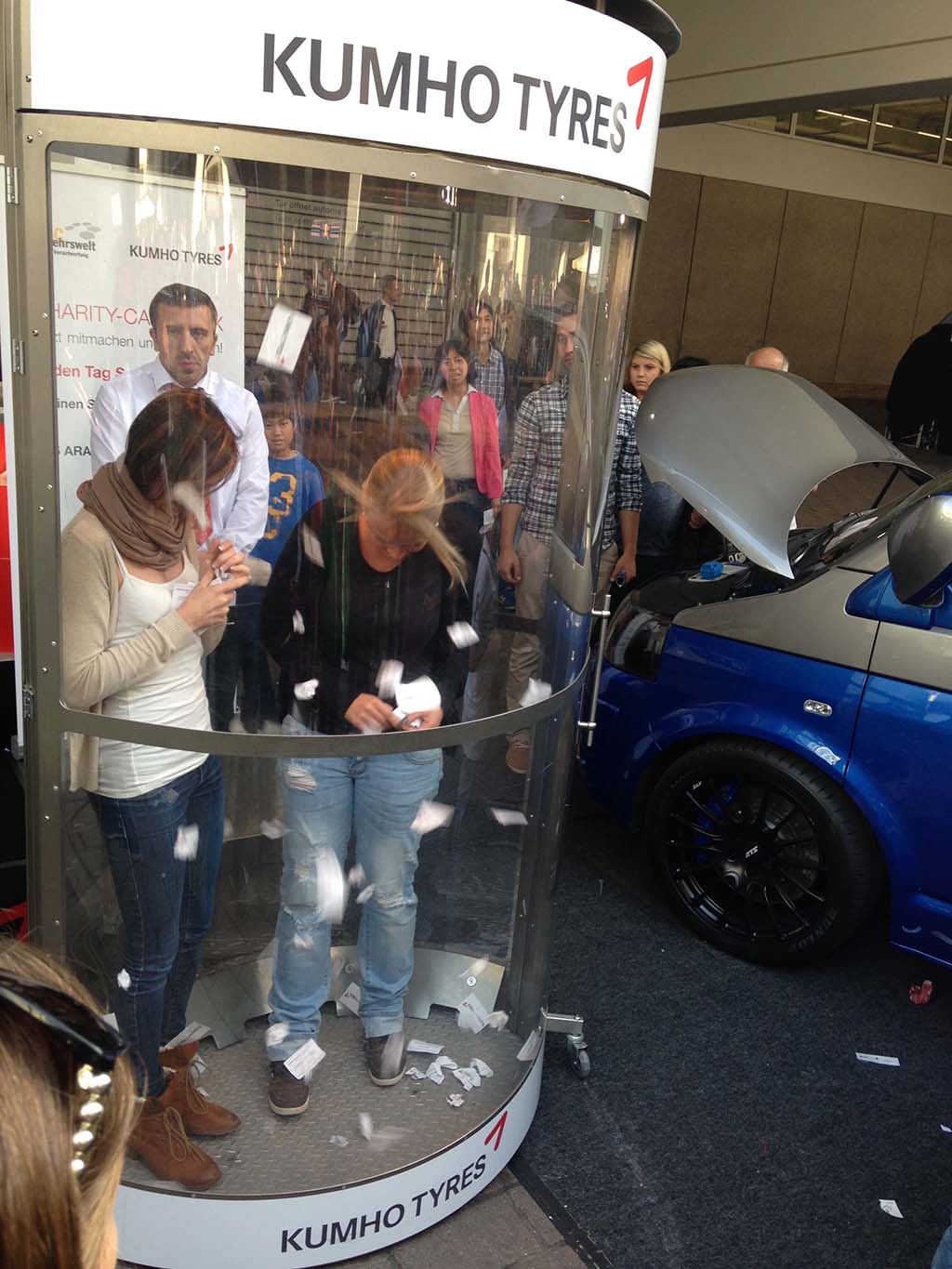
Kumo Tyres Coupons

Why this direction matters

Across the stands, the consistent pattern is not “more screens”. It is more reasons to create something. A photo. A badge. A flipbook. A posted image. A public interaction that becomes proof you were there. The stand stops being a catalogue, and starts behaving like a content studio that rewards participation. The real question is how a stand turns a visitor into a willing participant and publisher. The strongest stands here are the ones that give people something to make, not just something to look at. That works because visitors are more likely to remember, share, and talk about an experience when they leave with something they helped create.

Extractable takeaway: If you are designing for an event, do not start with channels. Start with a social object, meaning a photo, badge, flipbook, or other shareable artifact people can take away, share, or replay. Then build the simplest capture and distribution loop around it.

In large European trade shows, brands increasingly treat the stand as a live media channel where every interaction can become a shareable moment.

And that was a quick overview of what I experienced at the 65th Internationale Automobil Ausstellung. (To read about my experience at the 2011 show, click here.)

Until the next show in 2 years. This is Sunil signing off from IAA 2013.

What to steal from IAA 2013 for your next show

  • Queue utility. If people must wait, give them something to do that feeds the experience (Audi’s iPad game and questions).
  • Instant takeaways. Printed photos, emailed images, and small artifacts create memory and sharing triggers.
  • Low-friction publishing. RFID, built-in Like buttons, and email delivery reduce the “I’ll do it later” drop-off.
  • Make participation visible. Leaderboards, overhead screens, or public displays turn individual actions into crowd energy.
  • Match the mechanic to the brand truth. Eco themes paired with AR explainers, performance themes paired with physical challenges.

A few fast answers before you act

What is this IAA 2013 “walk of innovations” about?

It is a photo report from the IAA show floor in Frankfurt, focused on how different car brands used interactive touchpoints and social mechanics to engage visitors.

What is the main shift versus earlier shows?

Beyond large screens and touch displays, more stands are designed around capture and sharing, photo booths, RFID check-ins, instant email delivery, and social prompts.

Which engagement mechanics show up repeatedly?

Instant content creation (photos, flipbooks), low-friction sharing (RFID, embedded Like buttons), and public spectacle (multi-sensory shows, overhead displays).

What is the practical lesson for event marketers?

Design one clear participatory moment that produces a social object, then remove friction from capture and delivery so visitors can share immediately.

How do you keep these activations from feeling gimmicky?

Anchor the mechanic to a brand truth, and make the output useful or delightful for the visitor, not only promotional for the brand.
A New Kind of Catalog 2: IKEA’s AR catalog

A New Kind of Catalog 2: IKEA’s AR catalog

Last year Ikea re-imagined their catalog via a visual recognition app that brought its pages to life through inspirational videos, designer stories, “x-ray” views that peek inside furniture, and more.

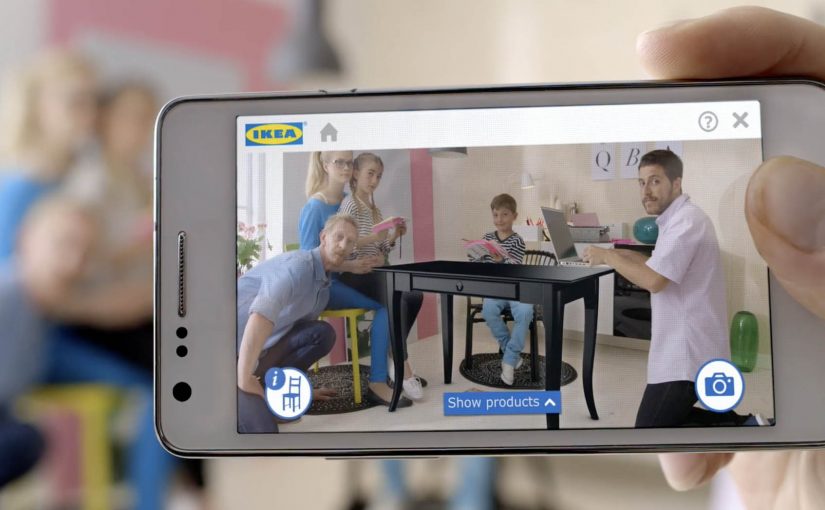
Now, for the 2014 IKEA catalogue, they push that idea into something far more useful: you can place virtual furniture directly into your home by putting the printed IKEA catalogue where you want the furniture to appear, then viewing the result through your phone or tablet using augmented reality (AR), meaning digital objects layered onto a live camera view of your real space.

The simple mechanic that makes a paper catalogue feel like a showroom

The experience design is almost disarmingly straightforward. The catalogue is not just media. It becomes the physical reference point that tells the app where “here” is, and roughly how big “life-size” should be. Because that reference point anchors position and scale, the placement feels believable enough to support a buying decision.

  • Open the IKEA catalogue app on a phone or tablet.
  • Scan a supported product page.
  • Close the catalogue and place it on the floor (or surface) where you want the item to “live.”
  • Watch the furniture appear in-context, then explore alternatives by browsing within the app.

In global retail and consumer brands, this kind of print-to-mobile AR, where the printed catalogue acts as the marker for the AR view, works because it turns “can you picture it?” into “can you see it here?” at the exact moment people are deciding.

Why it lands: utility beats novelty

AR marketing often dies as a gimmick because the “reveal” is entertaining but irrelevant. Here, the reveal is practical: scale, placement, and fit are exactly what shoppers worry about most.

Extractable takeaway: If emerging tech does not reduce a real decision friction, treat it as a distraction, not a strategy.

Even when the rendering is not perfect, the direction is clear. Reduce uncertainty. Help people make a confident choice. And if it cuts down on “it looked smaller online” returns, that utility is measurable, not just shareable.

What IKEA is really doing with this catalogue

This is a classic “bridge” play, a deliberate handoff between inspiration and purchase. IKEA keeps the reach and habit of a paper catalogue, then uses mobile interactivity to remove friction at the decision stage.

The real question is whether it removes enough doubt to change a purchase decision, not whether the AR looks impressive.

AR is worth investing in when it behaves like decision support, not when it just decorates a story.

It also quietly reinforces a brand position: IKEA is not only about affordable design. It is also about smart, accessible tools that help you plan and live better at home.

How to design an AR catalog people reuse

  • Make the printed piece part of the interface. Treat paper as a trigger, a marker, a controller. Not a dead-end.
  • Reward the scan with decision support. The “wow” should reduce doubt: sizing, configuration, compatibility, placement, or proof.
  • Design for fast repetition. The real value comes when people try multiple options in minutes, not once for curiosity.
  • Keep the action close to purchase. The best AR demos shorten the path from consideration to “yes” without feeling like a hard sell.

A few fast answers before you act

What is IKEA doing differently with the 2014 catalogue?

They extend the catalogue beyond scan-to-watch content by letting people place virtual furniture into their real home environment using AR.

How does the AR placement work in simple terms?

You scan a supported page, place the physical catalogue where you want the item to appear, and the app overlays a furniture model into the live camera view.

Why is a printed catalogue useful in an AR flow?

The catalogue becomes a physical reference point for position and approximate scale, making placement feel more believable than a free-floating 3D object.

What business problem does this help solve?

It reduces purchase hesitation by letting people judge fit and placement earlier, and it can help lower the risk of dissatisfaction and returns.

What’s the key lesson for marketers using emerging tech?

Build the experience around utility that supports a decision. Novelty may earn a try. Utility earns repeat use and moves people toward purchase.

Catch the Oreo: An Augmented Reality Game

Catch the Oreo: An Augmented Reality Game

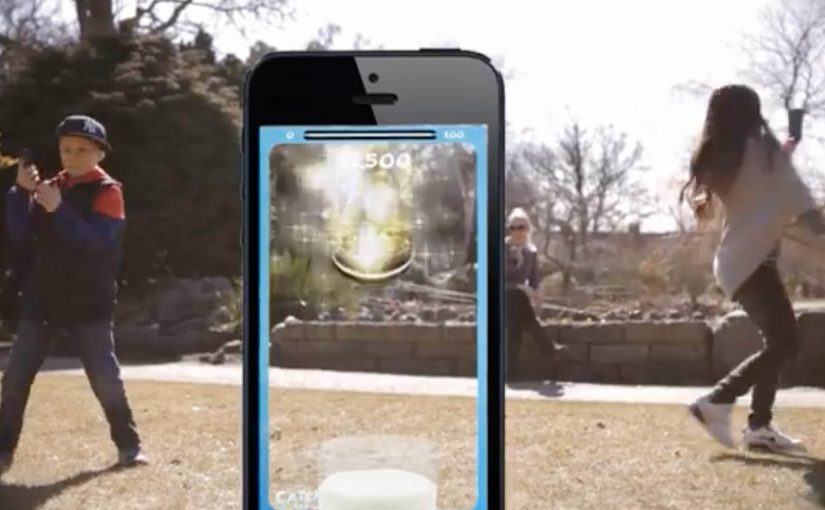
Oreo Cookies, to commemorate the first video game created by Ralph H. Baer, used modern day technology to create an augmented reality game called “Catch the Oreo”. The game is available on Android and iOS devices.

Here, augmented reality means the phone camera view overlays virtual Oreos onto the live scene, so you catch them in your space.

People living in Norway and Denmark are automatically entered into a sweepstake competition by just playing and uploading their high score. There are weekly prizes and the winners are decided by drawing lots.

Competition lasts from 8 April to 28 July 2013 (both dates included). So start playing.

Why AR is a good fit for a simple, repeatable game

The charm of “Catch the Oreo” is that it takes a basic arcade mechanic and gives it a physical feeling. AR turns “tap on a screen” into “catch it in your space”, which makes the game feel more immediate and more shareable.

Extractable takeaway: When the core action is instantly understandable, AR can add physicality and shareability without adding rule complexity.

AR works best here as a thin layer of delight over a simple arcade loop, not as the loop itself.

  • Instant understanding. Catch the cookie. Score points. Improve your high score.
  • AR adds novelty without complexity. The camera layer makes it feel new, but the rules stay simple.
  • Replays are built in. High scores naturally invite repeated attempts.

In European FMCG marketing, lightweight mobile games like this can be a practical way to turn momentary attention into repeatable engagement.

The sweepstake mechanic reduces pressure and increases participation

Weekly prizes and winners drawn by lots change the psychology. You do not have to be the absolute best player to feel you have a chance. You just have to play and upload.

The real question is whether your mechanic can motivate repeat play without making most participants feel they have already lost.

That is a smart way to broaden participation, especially in markets where you want scale quickly.

A random-draw sweepstake can reward participation rather than skill, which can widen the funnel while still benefiting from weekly prize cadence.

Why Norway and Denmark focus matters

By making the sweepstake specific to Norway and Denmark, Oreo can concentrate buzz, prize logistics, and local relevance. It also allows them to measure adoption and participation within a defined footprint.

What to take from this if you run mobile engagement campaigns

  1. Keep the core mechanic simple. AR is the layer. The game rules should be obvious.
  2. Reward participation, not only skill. Lot-based prizes can widen the funnel.
  3. Use time-boxed windows. Fixed dates create urgency and repeat visits.
  4. Make sharing part of the flow. High-score uploads naturally create a distribution loop.

A few fast answers before you act

What is “Catch the Oreo”?

It is an augmented reality mobile game created by Oreo, available on Android and iOS, where players catch Oreos to achieve a high score.

Where was the sweepstake promotion available?

For people living in Norway and Denmark, who were entered automatically by playing and uploading their high score.

How were winners selected?

There were weekly prizes and winners were decided by drawing lots, not purely by highest score.

What were the competition dates?

It ran from 8 April to 28 July 2013, with both dates included.

What is the main lesson for AR marketing?

Use AR to add delight, but keep the underlying mechanic simple and repeatable, then attach incentives that drive replays and sharing.