
The Day Shazam Forgot

Alzheimer’s Research UK partners with Shazam and does something deliberately uncomfortable. It gives the app the symptoms of Alzheimer’s. You use Shazam as you normally would, but the experience starts to break in ways that mirror memory loss. It is a hard-hitting way to feel, in a small moment, what daily struggle can look like.

The insight behind the campaign is about who needs to be reached. Most people associate Alzheimer’s with late life, but the disease can affect people as young as 40. The post cites over 40,000 people under 65 living with dementia in the UK.

The point is education through friction

This does not try to persuade with claims or statistics alone. It turns education into a lived interaction. Shazam is familiar and fast. Making it unreliable becomes the message.

The real question is how to make a misunderstood condition felt in a way that stays with people after the interaction ends.

This is a strong use of product behaviour because the disruption teaches rather than distracts. The intent here is public education, not app utility.

Why the Shazam choice is strategic

Shazam already sits in a high-frequency behaviour loop. By behaviour loop, this means a repeated habit people perform in real-life moments with very little effort or planning. That makes it a powerful carrier for a message about everyday disruption, because it arrives inside everyday life rather than as a separate awareness film.

Extractable takeaway: If you want people to understand a condition that is easy to distance or abstract away, place the message inside a familiar action so the disruption explains the reality better than a claim alone.

In consumer-facing digital experiences, familiar habits are often the best place to make a hard message land because the contrast is felt immediately.

What to take from this if you build digital experiences

  • Simulate a small part of the experience, not just the outcome, when the condition itself is hard to explain.
  • Put the message inside a familiar behaviour, so the contrast is instantly felt.
  • Use disruption sparingly and intentionally, so the discomfort has a purpose and does not turn into irritation.

A few fast answers before you act

What is “The Day Shazam Forgot”?

A Shazam partnership campaign that simulates Alzheimer’s symptoms to give users a direct, hard-hitting insight into memory loss.

Who is the campaign trying to educate?

A younger audience that may assume Alzheimer’s only affects people in late life.

What key fact reframes the audience assumption?

The disease can affect people as young as 40. The post cites over 40,000 people under 65 living with dementia in the UK.

What is the core creative technique?

Turning a familiar app experience into a controlled failure state, so the message is felt rather than only read.

Why use Shazam instead of a separate awareness film?

Because Shazam already lives inside everyday moments, the disruption arrives where memory lapses would feel personally relevant rather than abstract.

James Ready: Billboard coupon savings

James Ready beer and Leo Burnett Toronto are back with another campaign built around the same consumer truth. People want to afford more beer.

To help, James Ready introduced “billboard coupons,” a way to save money on life necessities like food, dry cleaning, and grooming. The idea is simple. If you save money elsewhere, you have more money left for beer.

By partnering with local retailers, the program lets people take a picture of a billboard and show the photo at the corresponding retailer to receive savings on selected products and services.

A billboard that behaves like a coupon book

This flips the billboard role. Instead of being pure awareness, it becomes a utility object you can “carry” with you via a phone photo. That change matters because it extends the life of the message beyond the moment you drive past it.

Extractable takeaway: The best OOH-led promotions create a portable proof-of-value, meaning a saved artifact the customer can show later to claim the benefit. If the audience can store it in their camera roll, the media becomes a tool, not just a reminder.

The mechanism: proof without printing

Traditionally, coupon programs rely on physical handouts or codes people forget. This uses a behaviour people already do without thinking. Photograph something. The photo becomes the redemption token.

The real question is whether your promotion can turn a photo into proof without adding steps.

The retailer partnership layer is what turns it from gimmick to program. It gives the billboard a reason to exist in specific neighbourhoods and creates a story local businesses can also talk about.

In promotion-heavy categories, photo-as-proof mechanics scale because they turn an everyday phone habit into redemption.

Why it works for a beer brand

James Ready positions itself around everyday value and a slightly cheeky, practical tone. Saving on dry cleaning and food is not glamorous, but that is the point. It makes the brand feel like it is on the consumer’s side.

There is also a subtle psychological move here. The “more beer money” framing makes saving feel like a win, not a sacrifice.

Mechanics to copy from billboard coupons

  • Use a universal behaviour as the trigger. Photos, texts, taps. Avoid anything that needs training.
  • Make redemption low-friction. “Show the photo” is simpler than entering codes or printing.
  • Partner for legitimacy. Retail partners turn a brand stunt into a usable savings program.
  • Design for memory. A billboard must communicate the entire mechanic in seconds.
  • Keep the value proposition honest. Small, real savings beat big, unbelievable promises.

A few fast answers before you act

What are “billboard coupons” in this James Ready campaign?

They are offers displayed on billboards that people photograph on their phones and then redeem by showing the photo at participating local retailers.

Why use photos instead of QR codes or SMS?

Because it reduces friction and works with basic phones and habits. Taking a photo is fast, familiar, and the image becomes a simple proof token.

What makes this more than a one-off stunt?

The retailer partnership network. When multiple local businesses honour the offers, the campaign becomes an ongoing utility rather than a single execution.

What is the biggest risk operationally?

Inconsistent redemption. If staff are not trained or offers are unclear, customers feel embarrassed and the brand takes the blame. Execution discipline matters.

How could a brand adapt this pattern today?

Keep the “portable proof” principle, but use a clearer redemption mechanism where appropriate. A scannable image or an in-wallet pass can preserve simplicity while improving tracking.

Starbucks: Pledge

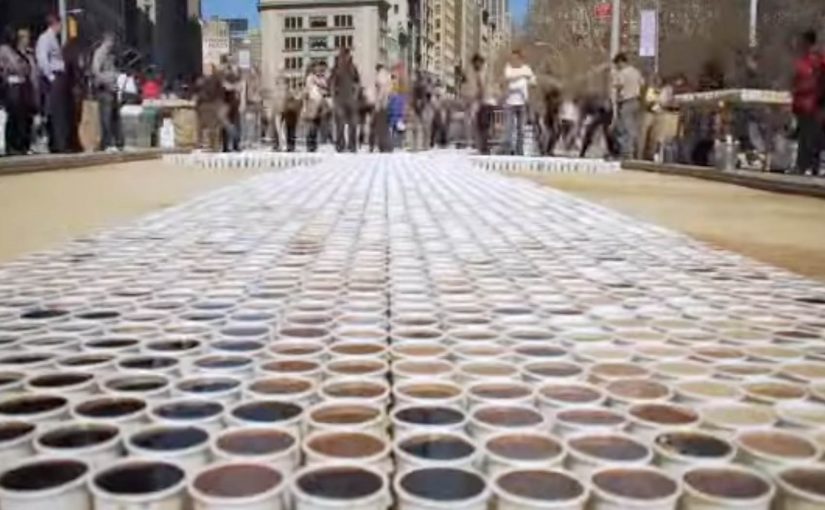
One person can save trees, together we can save forests! For the good of the planet, Starbucks encouraged everyone to switch from paper cups to reusable travel mugs and get free brewed coffee. So on April 15th thousands of New Yorkers made the switch…

Why this worked as a real-world nudge

The execution is straightforward. Bring a reusable travel mug. Get free brewed coffee. That simple exchange removes excuses and turns a “good intention” into an immediate, rewarding action. By a “nudge” here, I mean the campaign changes the choice context so the desired action is the easiest option in the moment. In a small habit switch like this, an incentive-led swap beats awareness messaging. The real question is whether you are designing behavior change as a one-step value exchange, or as a message people can ignore.

Extractable takeaway: If you want a repeatable habit, make the first repetition feel like a win, not a sacrifice.

  • Clear incentive. The reward is easy to understand and feels fair.
  • Low friction. The behavior change is small, and the benefit is instant.
  • Social proof at scale. “Thousands of New Yorkers” makes the switch feel normal, not niche.

In city-scale consumer campaigns, the fastest way to shift a default is to pair a tiny effort with an immediate payoff.

What to take from it

If you want people to adopt a repeatable habit, design the first step to be obvious and satisfying. The goal is not to lecture. The goal is to make the better choice feel easier in the moment it matters.

  • Start with an obvious first step. Make the initial action easy to understand and satisfying to complete.
  • Turn values into an exchange. Convert “good intentions” into a clear trade that removes excuses at the point of choice.
  • Let participation show. Visible uptake helps the new behavior feel normal instead of niche.

A few fast answers before you act

What did Starbucks ask people to do?

Switch from paper cups to reusable travel mugs, with free brewed coffee used as the incentive to prompt the change.

Why does a free coffee mechanic help?

It turns sustainability into an immediate value exchange, which increases participation and makes the first behavior change feel rewarding.

What is the core behavior-change pattern here?

Remove friction, add a clear reward, and make participation visible so people feel part of something larger than themselves.

How does this become more than a one-day stunt?

By making the first switch easy and positive, the campaign increases the chance that the reusable mug becomes the default habit afterwards.