
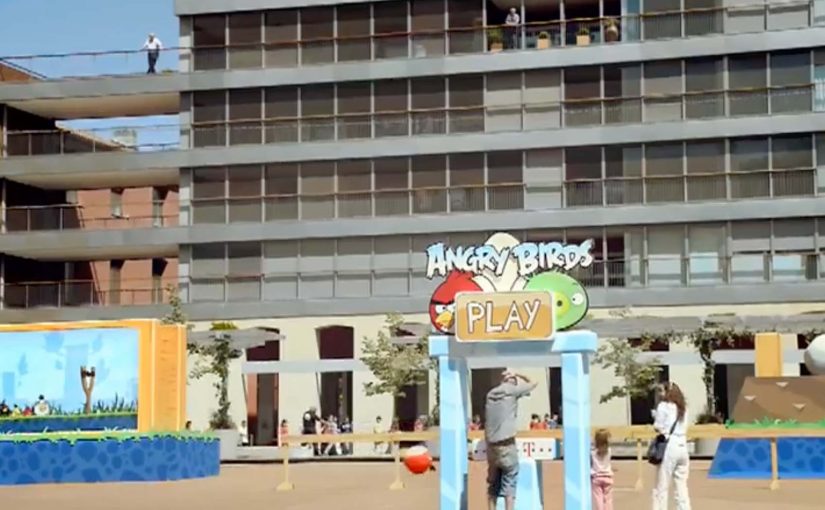
T-Mobile: Angry Birds Live

Angry Birds, rebuilt at human scale

The strongest activations often take a screen-based behavior and make it public, physical, and shareable. T-Mobile’s Angry Birds Live is a clean example of that move.

Here, a live activation means an in-person brand experience designed to create a moment people want to film and share.

T-Mobile, together with Saatchi & Saatchi, capitalized on the Angry Birds fever with a viral video titled Angry Birds Live.

They built a human-scaled mockup of Angry Birds in a square in Barcelona. Lucky participants used the game on a smartphone to launch birds on their castle-smashing journey. The experience included authentic sound effects and exploding pigs, and the size of the crowd made it clear the spectacle worked.

How the smartphone became the controller for a real set

The mechanism was simple and instantly legible. The smartphone stayed the input device, but the output moved into the real world.

That pairing did two things at once. It kept the interaction familiar for participants, and it made the result visible for everyone watching. One person played. Everyone else experienced the payoff. Because the outcome was public, each tap created social proof in real time.

In mobile-first consumer marketing, keeping the input private but the payoff public is a fast way to turn play into social proof.

The real question is how you turn one person’s private input into a public payoff that many people can watch.

This pattern is worth copying when your interaction is familiar and the outcome is visibly consequential without extra explanation.

Why the spectacle pulled a crowd

People do not gather around an app. They gather around consequences.

Extractable takeaway: When you want a crowd, make the consequence public and immediate, not private and delayed.

Angry Birds already trained players to anticipate impact. By scaling the environment up and making destruction physical, the activation delivered the same emotional beat as the game, but with stronger social proof because it happened in front of a crowd.

What T-Mobile was really buying with this idea

The business intent was to borrow cultural momentum and convert it into attention that looked earned, not bought.

The activation created a story people wanted to film, share, and talk about. The brand got reach through the crowd, the recordings, and the viral video itself, rather than relying on a traditional media push alone.

What to steal for your next live activation

  • Move the payoff into public view. One participant can drive the action, but the outcome should entertain many.
  • Keep the interaction familiar. When the input is already known, more people are willing to step in.
  • Design for consequence. Sound, impact, and visible change make an experience watchable, not just playable.
  • Build for filming. If the best moments are obvious on camera, distribution happens naturally.

A few fast answers before you act

What was T-Mobile’s Angry Birds Live?

A live brand activation in Barcelona that recreated Angry Birds at human scale, with participants using a smartphone to launch birds at a physical set.

What was the core mechanism?

A familiar mobile game interaction controlled real-world outcomes, turning individual play into a public spectacle.

Why did it attract such a large crowd?

Because the results were physical, loud, and visible. People gathered around impact and consequence, not a screen.

What business goal did this support?

Capturing cultural momentum and converting it into earned attention, shareable content, and viral reach.

What is the main takeaway for brands?

Make one person’s action entertaining for many, and design the payoff to be obvious, physical, and easy to record.

Budweiser: Poolball, football on a pool table

Coming to a Buenos Aires pub near you is the newly minted sport of Poolball, created by Ogilvy Argentina for Budweiser.

Two teams meet on a giant 7×3 meter pool table. Fifteen soccer balls are reskinned to look like pool balls. The competitors use their feet instead of cues to score.

A new bar sport with a brand stitched into it

Poolball takes two things that already belong in the same evening. Football and beer. Then it adds a third. The “I could play that” simplicity of pool. The result feels less like a stunt and more like a playable product.

Extractable takeaway: Poolball is a brand activation that fuses two familiar games into one instantly understandable format, so people stop watching and start participating without needing instructions.

The mechanic: one rulebook, two rituals

The mechanic is the entire idea. A pool table scaled up to human size. Pool-ball visuals on footballs. Pool rules translated into foot play. When the mechanic is this legible, the content is self-explaining and the crowd becomes the amplification layer.

BTL is often used as shorthand for below-the-line activity. In practice, it means a brand experience designed to be felt in the real world, then shared because it is worth retelling.

In busy city bars and event spaces, the formats that spread fastest are the ones everyone can read at a glance.

Why it works in a pub

Bar-friendly activations win when they create quick status moments. You either played it, you watched someone nail a shot, or you filmed the chaos. Poolball naturally creates all three, because every “pocket” attempt is a mini highlight.

It also lowers the risk of participation. You are not learning a new sport. You are remixing two you already know, with rules you can copy by watching one play.

The intent behind the fun

The real question is whether your activation is a game people still want to play when the camera is off.

Budweiser is not selling a feature here. It is selling association. Big-game energy. Competitive banter. Social proof that the brand belongs in the centre of group nights out.

When the game is branded but not fragile, the brand becomes the host of the experience rather than the interruption inside it.

Poolball patterns worth stealing

  • Fuse, don’t invent. Combine two known behaviours so the audience understands the format instantly.
  • Make the object the media. A giant playable artefact beats a screen when your goal is participation.
  • Design for highlights. Build in repeatable “shot” moments people want to film and replay.
  • Keep rules visible. If someone can learn it by watching one round, you have the right complexity level.
  • Let branding be structural. Brand the experience itself, not every surface area with logos.

A few fast answers before you act

What is Poolball?

Poolball is a branded game format that combines football and pool. Players kick footballs designed like pool balls on a giant pool table and score using pool-style goals.

Why does this kind of activation travel well across venues?

Because it is easy to understand, easy to spectate, and it produces repeatable highlight moments. Venues like it because it creates crowd energy. Brands like it because the crowd documents it.

What makes the mechanic “shareable” without forcing sharing?

The visual contrast does the work. A human-scale pool table and “pool ball” footballs create an immediate “what is that” reaction, so filming feels natural rather than incentivised.

How do you keep a branded game from feeling like a gimmick?

Make it genuinely playable. Simple rules. Clear scoring. Quick rounds. If the experience is fun without the brand name, the brand credit comes for free.

What’s the minimum viable version of this idea?

A single hybrid rule, one striking physical cue, and one repeatable scoring moment. If people can explain it in one sentence, you have the right foundation.

Renault Wind Roadster: 12 Second Strip

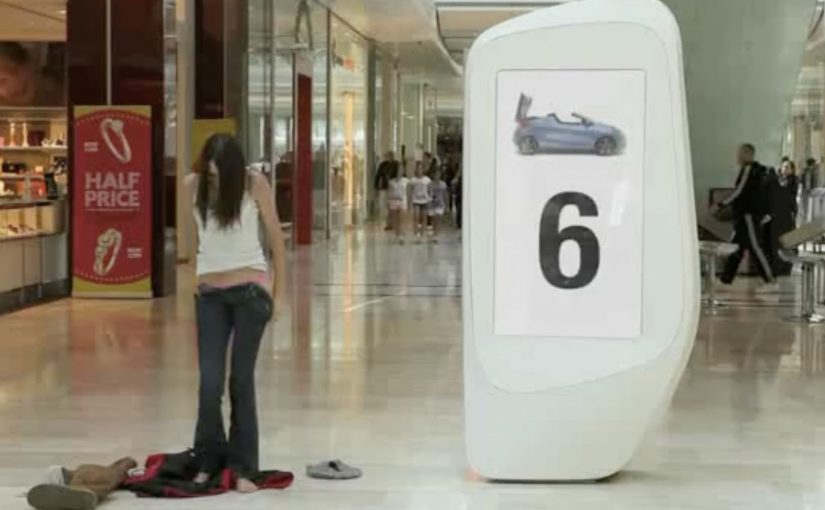
Renault UK and ad agency Publicis London set up “12 Second Strip”, a challenge that asks people to strip down to one layer of clothing in 12 seconds in the hope of winning the brand new Renault Wind Roadster.

The challenge involves people stripping down to one layer of clothing in just 12 seconds, which is the same amount of time it takes Renault’s new Wind Roadster to drop its top. To participate, people post their fun and tasteful strip videos on YouTube.

A product demo turned into a timed dare

The execution takes a single, memorable product fact. The roof moves in 12 seconds. Then it builds a challenge around that exact number, so the “proof” of the car becomes the rule of the game.

The mechanic: match the roof with your own 12 seconds

It is straightforward. Record a short clip where you race the clock to get down to one layer. Upload it. The format is repeatable, the constraint is clear, and the brand’s key claim stays embedded in every entry.

In UK automotive launches, time-based challenges work best when they translate a feature into something the audience can perform, share, and compare without needing a long explanation.

Why this lands as shareable UGC

The concept is light, competitive, and easy to understand at a glance. The “one layer” rule keeps it positioned as playful rather than explicit, while the 12-second constraint gives it a built-in hook that makes clips watchable and easy to forward.

Extractable takeaway: If you have one standout feature, convert it into a public constraint. Constraints create format. Format creates volume. Volume creates recall.

What Renault is really buying

The real question is whether a product claim can be turned into a repeatable public behavior without losing the brand point.

This is attention that carries product memory. Every participant repeats the roof story through action, and every viewer gets the same message without feeling like they are watching a conventional car ad.

What to steal for your next challenge-based campaign

  • Start with one sharp product truth. The best UGC formats begin with a single claim people can repeat.
  • Make the rule the message. If the rule changes, the brand meaning should not disappear.
  • Keep it simple to enter. Short clips, one constraint, one destination.
  • Write safety and tastefulness into the brief. Clear boundaries protect both the audience and the brand.

A few fast answers before you act

What is 12 Second Strip?

It is a Renault UK challenge that asks people to strip down to one layer of clothing in 12 seconds, mirroring the time it takes the Renault Wind Roadster’s roof to drop.

Why anchor the challenge to “12 seconds”?

Because it turns a feature into a format. The number becomes a rule that forces every entry to carry the same product story.

What makes this a strong user-generated format?

It is easy to understand, fast to produce, and inherently comparable. Viewers can instantly judge attempts and share the best ones.

How do you keep a provocative mechanic brand-safe?

Set a clear boundary inside the format. Here, the one-layer rule keeps the participation playful and recognizable without pushing it into something more explicit.

What is the main brand lesson here?

Make your most distinctive proof point performable. When the audience can reenact a claim, it travels further than a slogan.