
Ariel Actilift: Facebook-Controlled Shoot

Procter & Gamble Nordics, in collaboration with Saatchi & Saatchi Stockholm, B-Reel and Atomgruppen, creates an interactive campaign centered on a specially built glass installation in Stockholm Central Station, Sweden.

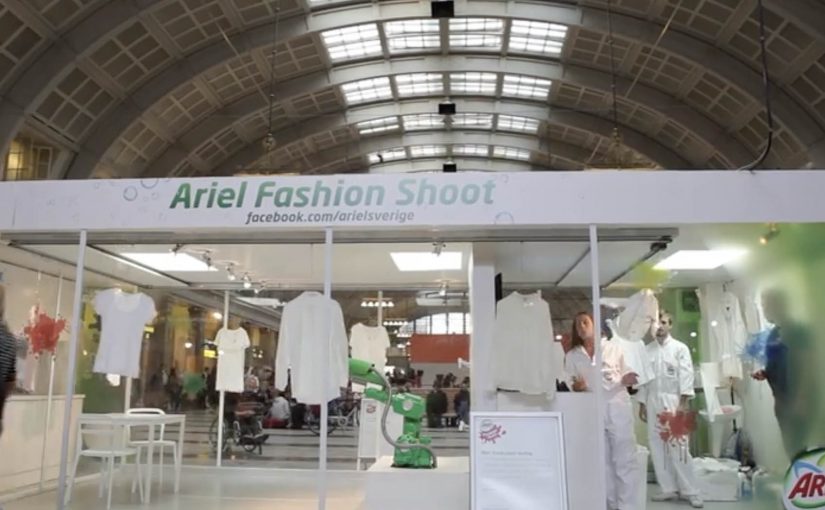
For one week, passers-by at Stockholm Central Station can watch designer clothes hung on a washing line being soiled by ketchup, drinking chocolate and lingonberry jam via fans on the Ariel Sweden Facebook page (or Denmark, Norway, Finland equivalents).

The mechanic: stain it from Facebook, then win it back clean

In order to win the designer clothes, Ariel fans use a Facebook-controlled industrial robot cannon to soil them. The stained clothes are then sent in the post after being washed on-site with regular Ariel Actilift.

In high-traffic European transit hubs, the strongest “social media” ideas are the ones that visibly change the physical world in front of everyone, not just the feed.

Why it lands: it makes participation feel consequential

This is a neat reversal of how most product demos work. Instead of the brand creating a controlled “before and after”, it invites the audience to create the mess themselves, then proves the wash result under public scrutiny.

Extractable takeaway: If you want participation that people remember, make the audience’s input irreversible in the moment, then let your product do the recovery. The contrast between “I caused this” and “it still comes out” is stronger than any claim line.

The glass box is doing strategic work. It turns a Facebook click into a visible event for commuters, which makes the campaign feel bigger than the people who are actually playing.

What the campaign is really selling

At a surface level it is a stunt to win clothes. At a deeper level it is reassurance. The mess is extreme and deliberately unglamorous, so the cleanliness result reads as confidence, not a carefully staged demo.

The real question is whether a Facebook click creates enough public consequence to make the cleaning proof feel worth watching.

What to steal for your next social-plus-physical idea

  • Let the audience create the proof: user-generated “inputs” that change the outcome are more persuasive than brand-controlled setups.
  • Use a public stage: a transparent environment creates trust because the product has nowhere to hide.
  • Keep the control surface simple: one clear action. One obvious effect. No complicated UI.
  • Design a real reward path: the prize should be operationally credible, not a vague “chance to win”.
  • Make the brand step undeniable: show the product moment on-site so the claim is witnessed, not narrated.

A few fast answers before you act

What is the core idea of this Ariel activation?

A Facebook interface controls a robot cannon that stains designer clothes in a glass installation. Ariel then washes the clothes on-site, and participants can win the cleaned items.

Why combine Facebook with a physical installation?

Because it turns digital participation into a public spectacle. The online action has a visible consequence in the real world, which makes it more engaging and more shareable.

What product truth is being demonstrated?

That Ariel can handle tough, visible stains. The audience creates the stains, and the brand shows the wash outcome under observation.

What makes this different from a normal product demo?

The brand gives up control of the “mess creation” to the public. That makes the demonstration feel less scripted and more credible.

What should you measure if you run something like this?

Participation rate, dwell time at the installation, social engagement tied to the control interface, earned media pickup, and any lift in product consideration during the activation window.
Coca-Cola: Wallet of Happiness Honesty Test

An honesty test on a crowded Lima street

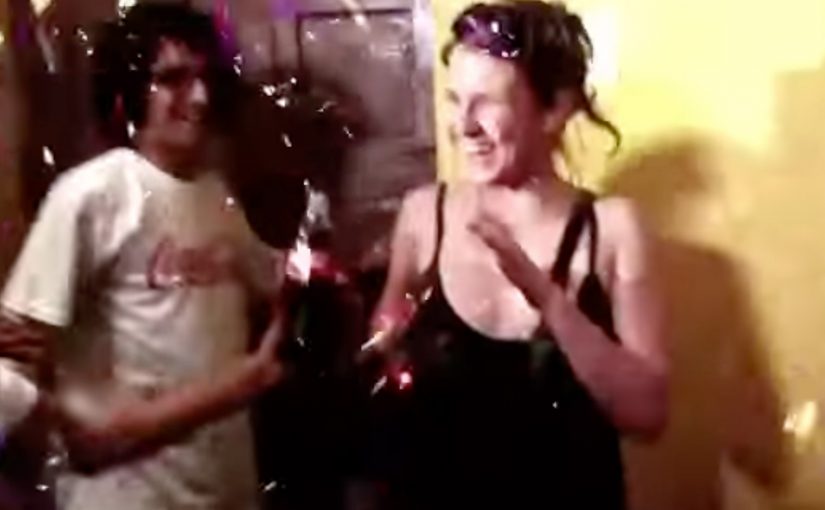
As part of an experiment in a very crowded Lima district in Peru, Coca-Cola with their agency McCann Erickson deliberately left a wallet containing $100 on the street. With it they tested people’s honesty.

A $100 question, asked in public

The brilliance is how quickly the situation reads. Find the wallet. Notice the money. Decide what kind of person you want to be, with nobody asking you anything.

In social experiment storytelling, a simple moral trigger creates instant comprehension and invites viewers to project themselves into the decision. Here, a moral trigger means a moment that forces a right-versus-wrong choice without explanation.

In global FMCG brand storytelling, street-level honesty tests like this travel because they turn a private value into a public, watchable moment.

Why you keep watching

You are not just judging strangers. You are quietly measuring yourself against what you hope you would do. The real question is what you do when the right choice is clear, but no one is holding you accountable. That internal comparison is the engine of the film. Because the choice is legible and unprompted, viewers can run the same decision in their own head, which keeps them watching.

Extractable takeaway: If your mechanic makes viewers instantly ask “what would I do,” the story carries itself without narration.

What the experiment is trying to reveal

People’s honesty, observed in a real public setting through a simple, high-stakes trigger.

What to borrow from a public honesty test

  • Choose a mechanic that is universal and legible without narration. In this context, “mechanic” means the simple rule that generates the behavior you want to capture.
  • Keep production minimal so human reaction stays central.
  • Let the audience do the interpreting. A good social test creates its own debate.

A few fast answers before you act

What did Coca-Cola do in Lima?

They left a wallet containing $100 on the street in a crowded district to test people’s honesty.

Where did this take place?

In a crowded district of Lima, Peru.

Who created the campaign?

The post credits Coca-Cola and McCann Erickson.

Why does the film hook people so fast?

Because the dilemma is instantly legible: you see the wallet, notice the money, and immediately imagine what you would do.

What was the point of the experiment?

To observe how people would react when they found a wallet with money in a real-world public setting.

Burger King: The Whopper Lust Challenge

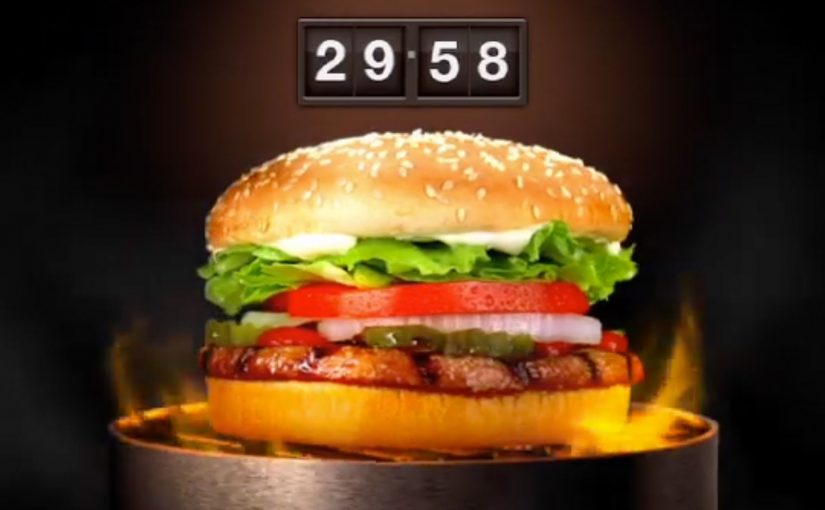
Stare at a picture of a Whopper long enough and you win one. That’s the premise of an interactive TV campaign from Burger King. What looks like a never-ending ad is actually a dedicated TV channel on DirecTV channel 111, built around a spinning flame-grilled burger and a timer.

To win, you tune in and activate the Whopper Lust challenge. A five-minute countdown starts, and you have to keep watching the rotating Whopper for the full duration. Make it to five minutes and you earn one free burger. Keep going for another ten and you earn two. Keep going and the rewards scale. The longer you last, the more you unlock.

The catch is that the channel occasionally prompts you to hit buttons on your remote. Miss one and the clock resets, so you lose the reward you were building toward. Complete the challenge and you can claim the free burger directly on the TV.

How the mechanic turns attention into currency

This is “watch time” treated like a loyalty program. Here, “watch time” means the viewer’s sustained, verified attention, not just a channel left on in the background. The spinning Whopper is deliberately hypnotic, the timer makes the commitment explicit, and the remote prompts prevent passive cheating. It is simple, but it forces real engagement rather than background viewing.

That works because the timer defines the commitment, the remote prompts verify attention, and the visible progress makes the reward feel earned rather than handed out.

In US quick-service marketing, converting a passive channel into a participation loop can buy disproportionate attention without buying proportional media.

Why this lands

It works because it is a dare, not a discount. The reward feels earned, and the friction is oddly satisfying because it creates tension. Will you slip and reset. The interaction also turns a solitary act. Watching TV. Into a game you can talk about immediately.

Extractable takeaway: If you want people to stay with a message, make the “cost” a clear, timed commitment and add periodic interaction checks, so attention becomes an active choice rather than a passive exposure.

What Burger King is really optimizing

This is not just a giveaway. It is a retention play. The real question is how to turn passive media time into a branded challenge people willingly stay with. The channel trains repeat viewing, creates a habit loop, and attaches the brand to a measurable “I lasted” story. Reported campaign figures describe large volumes of burgers given away and large volumes of watch minutes generated over the week.

What to steal from attention-for-reward mechanics

  • Make the rule instantly legible. “Watch X minutes. Win Y.” is frictionless to understand.
  • Prevent passive participation. Add simple interaction prompts to keep it honest.
  • Let rewards compound. Escalation keeps people in the loop longer than a single prize.
  • Turn viewing into a game. A timer and resets create stakes without complex tech.

A few fast answers before you act

What is the Whopper Lust Challenge?

It’s an interactive TV activation where viewers watch a dedicated Burger King channel and earn free Whoppers based on how long they stay engaged.

How do you win a free Whopper?

You activate the challenge, watch the spinning Whopper for five minutes, and respond correctly to occasional remote-control prompts so the timer does not reset.

Why add remote button prompts?

To ensure people are actually watching and interacting, not leaving the channel on in the background.

What makes this different from a normal TV ad?

The ad is the channel, and the viewer is part of the mechanic. Time and interaction directly determine the reward.

What’s the main risk with this format?

If the interaction prompts feel unfair, too frequent, or glitchy, frustration overwhelms the fun and people drop out.