
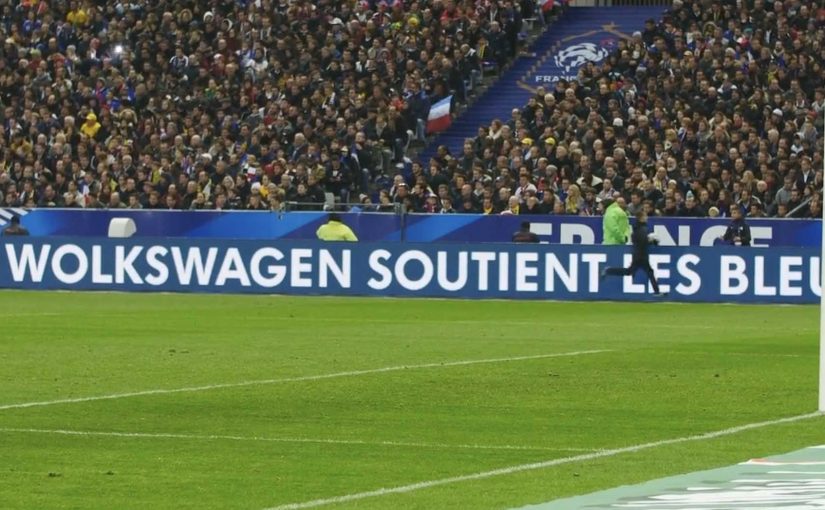
Volkswagen: Wolkswagen

During a France vs Brazil football match in Paris, the LED boards around the pitch display a brand name that looks wrong. “Wolkswagen.”

Volkswagen leans into a simple human impulse. People love being the first to notice a mistake. So the campaign plants one at maximum scale and lets the crowd do what it always does. Point it out, correct it, and spread it.

The mechanism is the typo itself. A deliberate misspelling placed where 80,000 spectators and millions of TV viewers will see it, creating a wave of “they got it wrong” conversations that carries the real message. Volkswagen is present, watching, and ready to announce itself as a major partner of French football.

The psychology of a “correctable” brand moment

This works because correcting a visible public error lets people display attention and share the fix. Here, a “correctable” moment means a public cue that looks wrong but is safe and easy for the audience to fix. Noticing a typo feels like competence. Sharing it feels like helping others notice. The stunt converts that impulse into earned distribution, and it does it without asking anyone to watch a film or click a banner.

Extractable takeaway: If you want mass attention in a high-noise moment, design a safe, obvious “error” people can correct in public, then attach your actual announcement to the moment they point out and share the correction.

In live sports broadcasts, audiences are primed to scan for anomalies, and correcting them is a social reflex that spreads faster than the original message.

What the partnership announcement is really buying

The stated goal is awareness of a new relationship with French football. This is stronger than a standard sponsorship reveal because the audience helps distribute the news. The real question is how to make a routine partnership announcement impossible to ignore. The deeper goal is memorability. Sponsorship news is usually forgettable. A planted mistake is sticky, because people remember the moment they noticed it.

What to steal from this stadium-board stunt

  • Use one unmistakable deviation. The “wrongness” must be instantly readable from far away.
  • Make the correction harmless. The audience should feel clever, not manipulated or misled.
  • Deploy where attention is already concentrated. Stadium boards and live broadcast moments amplify small creative moves.
  • Ensure the reveal is clean. The moment must resolve quickly into the intended message, or it stays a gimmick.

A few fast answers before you act

What is the Wolkswagen idea?

A live stadium-board stunt that intentionally misspells “Volkswagen” as “Wolkswagen” to trigger public correction and attention, then uses that attention to support a football partnership announcement.

Why does an intentional typo generate more attention than a normal logo placement?

Because it activates a correction reflex. People engage to point out the “mistake,” and that engagement becomes the distribution channel.

What makes this feel like a live moment instead of an ad?

Placement and timing. It appears inside the live match environment, where audiences treat what they see as real-time context, not preplanned messaging.

What is the main risk with this pattern?

If the audience believes the brand genuinely made an error, the story can turn into ridicule. The execution needs a clear resolution so it reads as deliberate.

When should you use a “deliberate mistake” stunt?

When you have a time-bound announcement, a high-attention venue, and a brand that can credibly play with perception without damaging trust.
Hyundai Genesis: A Message to Space

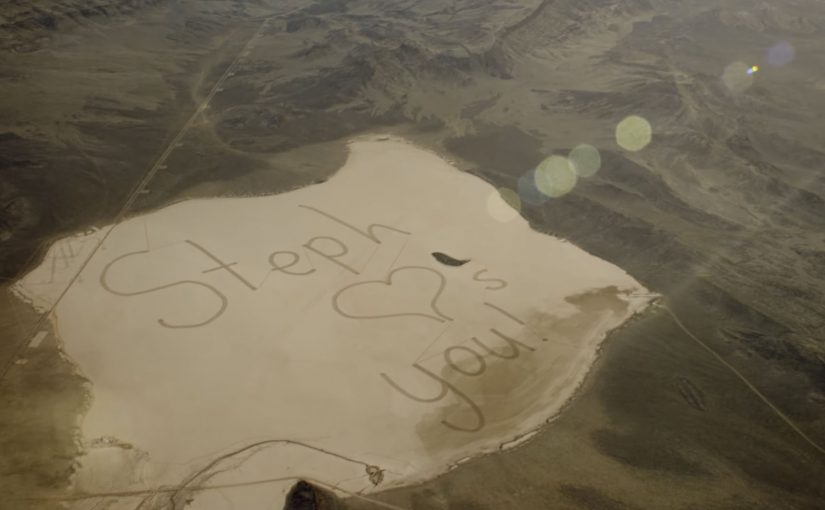
Eleven Hyundai Genesis sedans drive in formation across Nevada’s Delamar Dry Lake, not to show handling, but to write a sentence.

A 13-year-old girl from Houston, Stephanie, misses her astronaut father as he works aboard the International Space Station. Hyundai turns that human truth into a brand-scale gesture. The cars “draw” “Steph loves U” in tire tracks across the dry lake bed. The result is described as larger than one and a half Central Parks. It is also described as being certified by Guinness World Records as the world’s largest tire track image.

From choreography to a message you cannot ignore

The mechanism is straightforward and bold. Take a blank natural canvas. Assign each car a path. Choreograph the movement so the negative space becomes handwriting at a gigantic scale. Then validate the scale with a record body so the stunt becomes a fact people repeat, not just a film people watch.

In global automotive marketing, where products often feel interchangeable in feed-based media, a physical proof stunt creates memorability by turning precision into a story people can retell.

Why it lands

It works because the brand is not asking for attention. It is earning attention by doing something that only coordinated engineering and serious planning can pull off. The emotional hook is intimate, and the execution is absurdly large. That contrast creates instant share value, and it gives the Genesis name a halo of control and capability without needing to say it out loud.

Extractable takeaway: If you need breakthrough, build a single, verifiable act that scales a private human moment into a public artifact, and make the artifact the headline, not your messaging.

What the stunt is really selling

The real question is how to turn a private emotion into a public proof of brand capability without making the brand feel like the hero.

This is one of the rare brand stunts where scale sharpens the emotion instead of burying it.

On the surface, it is a daughter sending a message. Underneath, it is Hyundai demonstrating disciplined coordination. Eleven vehicles behaving like one pen. The brand promise becomes “we can execute the impossible precisely”, which is a stronger feeling than another round of luxury feature claims.

What to borrow from this precision stunt

  • Start with a real relationship. One clear human story beats a composite “target audience”.
  • Make the action the media. A physical artifact outlives the launch window and travels as proof.
  • Engineer a repeatable headline. A record, a scale comparison, or a singular first can carry the story.
  • Let meaning come from constraints. Fewer words. Bigger commitment. Higher credibility.

A few fast answers before you act

What is “A Message to Space”?

It is a Hyundai Genesis marketing stunt where 11 cars drive in formation to create a massive tire track message, “Steph loves U”, intended to be visible to a father on the International Space Station.

What is the core mechanism that makes it shareable?

A simple sentence rendered at extreme scale through choreographed driving, then amplified by third-party validation and a short film that captures the creation.

Why use a Guinness World Records angle?

Records reduce skepticism. They turn “big” into a named achievement people can cite, which helps the story travel beyond advertising audiences.

What is the biggest risk with this style of stunt?

If the human story feels manufactured, the spectacle becomes empty. The emotional truth has to lead, or the record becomes the only thing people remember.

What is one modern adaptation of the same pattern?

Create a single, verifiable public artifact that embodies your brand promise, then design the content around documenting the artifact, not explaining it.

Mercedes-Benz F-CELL: The Invisible Drive

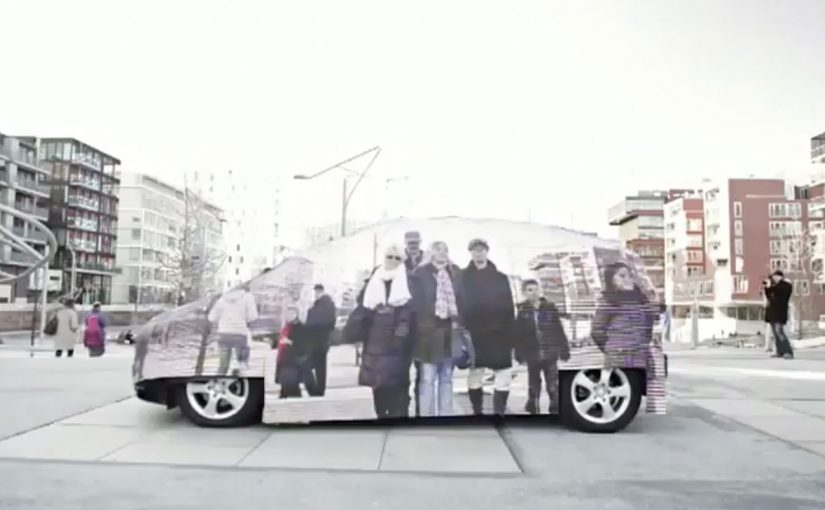
To demonstrate the claimed low impact of its new fuel cell vehicle, Mercedes-Benz has created an “invisible” car that blends into its surroundings.

The trick is a simple, showable hack. One side of the car is covered with LEDs. A camera captures what is on the opposite side, then the LED side displays that live feed so the vehicle appears to disappear from a specific viewpoint.

Stunts like this turn abstract emissions claims into a single, watchable proof-of-idea.

The mechanism that makes the metaphor work

This is not magic and it does not need to be. It is optical camouflage framed as a brand statement. Optical camouflage here means using a camera view and a display surface to mimic the background from a chosen angle. If the vehicle’s impact is close to “nothing,” the car should look like “nothing.” The LED-and-camera setup makes that metaphor instantly legible, even to someone who has never heard the term “fuel cell.” Because the illusion happens live on the car, the metaphor reads as evidence instead of post-production.

In enterprise automotive and mobility marketing, visual proof beats technical proof when the audience is not willing to parse specs.

The real question is whether your claim can be understood and repeated from a single viewpoint without the brochure. This is a strong sustainability communication move when the trick is honest and the metaphor stays tighter than the explanation.

Why it lands

It creates a physical moment people can point at. Sustainability messaging often lives in numbers, claims, and fine print. Here, the message is experiential. You see the effect with your own eyes, and you can describe it in one sentence.

Extractable takeaway: When your product promise is invisible, build a demonstration that makes the promise visible in under five seconds, using a single repeatable rule people can explain to someone else.

Steal the invisibility demo pattern

  • Pick one metaphor and commit to it. The entire execution serves one idea. That focus is why it travels.
  • Use real-world physics, not post-production. Even when the audience knows it is a trick, they trust it more when it is happening live.
  • Design for the shareable angle. Viewpoint-dependent illusions work because they are built for cameras and spectators, not just participants.
  • Make the explanation part of the experience. The best stunts include a built-in “how it works” story that spreads with the clip.

A few fast answers before you act

How does the “invisible car” effect work?

LED panels on one side of the car display a live video feed captured from the opposite side, creating a camouflage illusion from a particular viewpoint.

What is the brand point of using invisibility here?

It turns an environmental claim into a visual metaphor. If the impact is minimal, the car is presented as visually minimal within the scene.

Why do these technology stunts get attention when product specs do not?

They compress the story into a single moment people can see, record, and retell. That makes the promise easier to believe and easier to share.

What is the main risk when copying this approach?

Overcomplicating the trick. If the audience needs a long explanation to understand the effect, the stunt stops being a stunt and becomes a demo.

How do you keep a metaphor stunt from feeling like greenwashing theater?

Keep the claim narrow, make the trick transparent, and ensure the metaphor points to a product attribute you can substantiate elsewhere, even if most people never read the detail.