
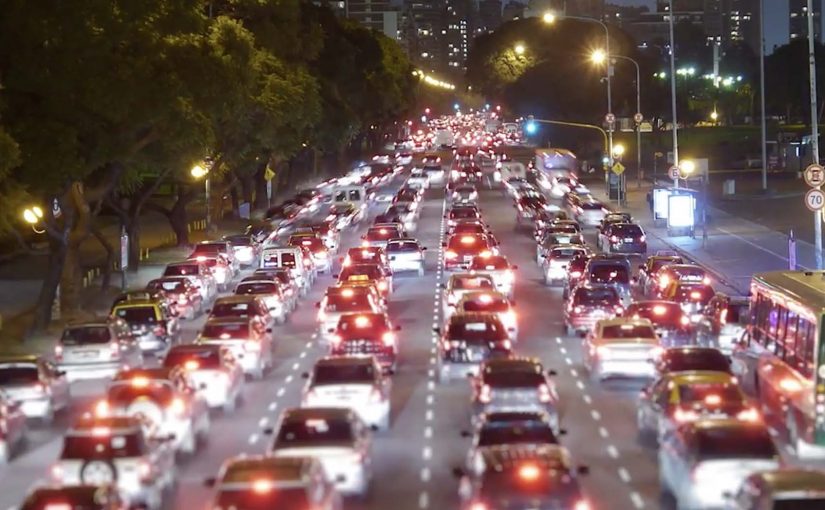
Microsoft: Big Data to Predict Traffic Jams

Big Data is increasingly being used to find solutions to problems around the world. In this latest example, Microsoft partnered with the Federal University of Minas Gerais, one of Brazil’s largest universities, to undertake research that helps predict traffic jams up to an hour in advance.

With access to traffic data, including historical numbers where available, road cameras, Bing traffic maps, and drivers’ social networks, Microsoft and the research team set out to establish patterns that help foresee traffic jams 15 to 60 minutes before they happen.

What “big data” means in this context

Here, “big data” is not a buzzword. It means combining multiple high-volume signals that each describe traffic from a different angle. Flow and speed data. Camera feeds. Map-layer congestion indicators. And sometimes social or incident signals that explain why conditions change.

How the prediction model is positioned

The mechanism is short-horizon forecasting. Aggregate live and historical traffic conditions. Detect repeating patterns and transitions. Then output a probability that a segment will shift from free-flowing to congested within the next 15 to 60 minutes. The goal is not perfect certainty. It is an early warning that is useful enough to reroute, rebalance signals, or advise drivers.

In urban mobility programs, 15 to 60 minute congestion prediction is a practical layer between raw telemetry and real-world operational decisions.

Why it lands

This works because it targets a time window people actually feel. Short-horizon forecasting matters because it aligns the prediction with the moment when routes, signals, and departures can still change. The real question is whether earlier warning is reliable enough to trigger better decisions before congestion locks in. Useful prediction beats perfect prediction in operational systems.

Extractable takeaway: When a prediction is delivered inside the decision window, it creates value even if it is not perfect. The win is earlier choices, not flawless foresight.

What to steal for traffic prediction

  • Design for actionability: pick a forecast horizon that matches real decisions, not academic elegance.
  • Blend signals carefully: combine steady signals, like flow data, with explanatory signals, like incidents or events, when available.
  • Communicate confidence: a probability and a time window often beats a single definitive “will happen” claim.
  • Validate across cities: portability matters, because traffic behaviors vary by road network and culture.
  • Measure the right outcome: accuracy matters, but reduced delay and better routing outcomes are the real business KPIs.

A few fast answers before you act

What is Microsoft trying to do here?

The project aims to predict traffic jams 15 to 60 minutes ahead by combining traffic flow data, map signals, cameras, and other contextual inputs to spot patterns before congestion forms.

Why is 15 to 60 minutes the useful range?

It is long enough to change routes, adjust signal timing, or delay a departure. It is short enough that conditions have not completely changed since the forecast was generated.

What data sources matter most?

Traffic flow and speed data usually provide the core signal. Cameras, incidents, events, and social signals can add context that improves timing and explains sudden changes.

What does “80% accuracy” actually mean?

It is typically reported as the share of correct predictions under a defined test setup. The real value depends on how accuracy is measured, what baseline is used, and how the prediction is turned into driver or city actions.

Where does this approach fit in a smart-city stack?

It sits between sensing and intervention. Sensors and maps detect current conditions. Prediction estimates near-future conditions. Then routing, signaling, and traveler information systems act on that forecast.
Quilmes: Mitigol

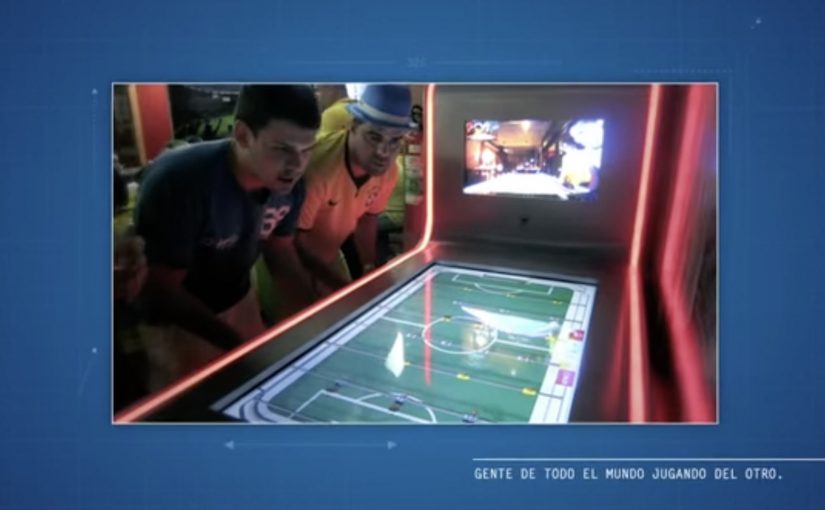
Quilmes and their agency +Castro reinvented the classic game of foosball. In its new version they enabled Argentinians and Brazilians to play each other in real time through a custom made digital foosball table.

Dubbed “Mitigol”, the activation turns foosball into a cross-border live match. One half of the table was placed in Argentina and the other half in Brazil. During the game, players could see their opponent via special in-built video cameras that further enhanced the real time experience of the game. As a prize, Quilmes gave away free beer.

How Mitigol works

The mechanism is a physical game with a digital bridge. A custom table syncs the ball and player movement across distance, while embedded cameras add face-to-face presence so it feels like a real match rather than a remote demo.

In sports and event-led marketing, shared-play installations can turn rivalry into participation because they give fans something to do together, not just something to watch.

Why it lands

This works because it makes a national rivalry tangible without needing a screen-first experience. Foosball already has competitive tension built in, so the cross-border connection raises the stakes instantly. The cameras then do the emotional work by proving the opponent is real, right now, reacting in real time.

Extractable takeaway: When you want “real time” to feel meaningful, do not rely on the word. Add one physical interaction that people already understand, then layer in live presence so the distance becomes the headline.

What Quilmes is really buying

The real question is how to turn passive rivalry into a shared act people want to join.

Beyond novelty, Mitigol is a closeness story. It borrows the energy of an event moment and converts it into a branded experience where the fan is the performer, not the spectator. The prize is just the nudge that keeps the line moving and the competition sharp.

What to steal from Mitigol

  • Start with a familiar game. If the rules are known, participation spikes.
  • Make distance visible. The split-table concept is the idea. Do not hide it.
  • Add live presence. Cameras or live feedback make “remote” feel human.
  • Reward the behavior you want. Small, immediate prizes keep throughput high.

A few fast answers before you act

What is Mitigol?

It is a custom foosball table experience that connects two locations so players in different countries can play the same match in real time.

Why split the table across Argentina and Brazil?

Because the physical split makes the cross-border rivalry concrete. It is instantly legible as “we are playing each other right now”.

What role do the built-in cameras play?

They add live presence and reaction, which makes the experience feel like a real opponent rather than a remote simulation.

What is the simplest way to copy the principle?

Take a familiar physical activity, connect it across distance with tight synchronization, then add a live human layer so the interaction feels personal.

What should you measure for an activation like this?

Participation volume, repeat play, dwell time, and how often spectators convert into players once they see it in action.

Drone-vertising: Wokker and Cup Noodles

Unmanned aircraft have been used to carry out military strikes, to film weddings, and are also being explored for product delivery from companies like Amazon, Netflix, Francesco’s Pizzeria and Flower Delivery Express.

Until the legalities of commercial use are cleared up by local governments, companies in Russia and Brazil go ahead with what are described as early drone-vertising campaigns. Drone-vertising is using drones as moving media, either by flying banners through high-attention locations or by staging a delivery moment that doubles as a filmed ad.

Airspace as a new media channel

The mechanism is straightforward. Put a message or a product on a drone. Fly it where the audience is already looking. Capture the moment on video so the stunt can travel beyond the people who witnessed it live. Because the drone enters an uninvited sightline, it creates surprise, which is why the filmed moment gets retold and replayed.

In dense urban districts where attention is scarce, brands keep searching for formats that create surprise without requiring new screen time.

The real question is whether the brand promise stays clear when the novelty fades, or whether the drone becomes the headline and the product becomes the footnote.

Russia

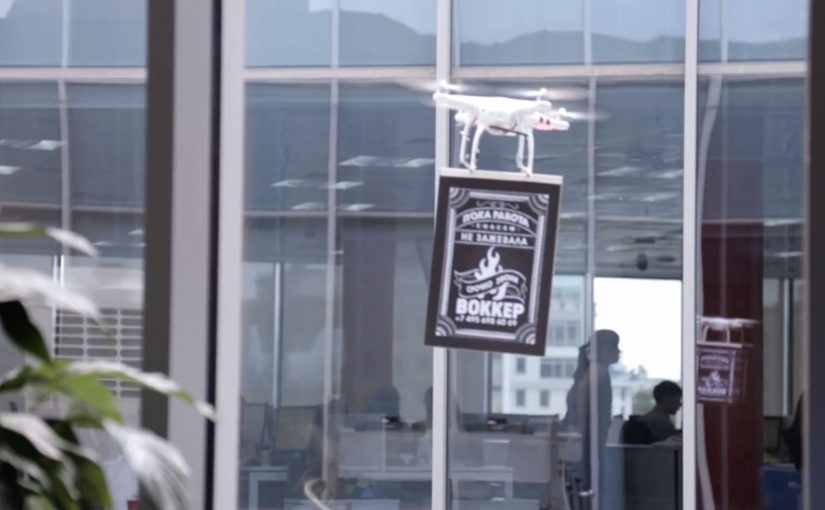
As ordinary advertising channels continue to be congested, Russian creative agency Hungry Boys uses drones to advertise noodle company Wokker.

Wokker banners are attached to drones and flown around high-rise business buildings in Moscow’s financial district, drawing the attention of office workers as the drones pass windows. The campaign is described as driving deliveries in the targeted area up by 40%.

Brazil

Cup Noodles, the instant ramen noodles snack from Nissin-Ajinomoto, is promoted in Brazil with drones dressed as cows, chickens, corn cobs and shrimps. A two-and-a-half minute film created for the brand’s online campaign uses drones to take Cup Noodles to surfers, skateboarders and highline walkers as they practise their sport.

Why drone-vertising gets noticed

This format works because it breaks the normal media contract. People do not expect ads to appear outside their window, and they do not expect “delivery” to arrive from above. The novelty is doing most of the work. The brand then benefits from the retelling, because the story is easy to summarise and the footage is inherently watchable. Drone-vertising is only worth doing when the brand meaning is unmistakable and the safety story is boring.

Extractable takeaway: If you are betting on a new attention surface, make the idea legible in one glance and one sentence. The stunt must communicate the category benefit instantly, otherwise the drone becomes the headline and the brand becomes a footnote.

Rules worth stealing before you fly ads

  • Target a context with a clear “why now”. Wokker links to lunch-time office hunger. Cup Noodles links to being hungry while out doing sport.
  • Design for cameras as well as eyeballs. You need a clean visual read at distance, plus a story that survives reposting.
  • Keep the stunt safe and bounded. The moment you look reckless, the conversation turns from clever to irresponsible.
  • Prove impact carefully. If you cite uplift, be ready to explain what changed, where, and for how long.

A few fast answers before you act

What is drone-vertising?

It is using drones as moving media. Either by flying banners through high-attention locations or by staging a delivery moment that doubles as a filmed ad.

Why does it work particularly well near offices or public hotspots?

Because the audience is concentrated and the environment is predictable. A drone appearing in a controlled corridor creates surprise without needing people to opt in.

What is the biggest brand risk?

Safety and permission. If the flight looks uncontrolled or disruptive, attention quickly becomes negative and the brand is blamed for the intrusion.

How do you keep the idea from becoming “tech for tech’s sake”?

Tie the drone to a simple product truth that the audience recognises instantly, like lunch delivery urgency or on-the-go convenience, then make that truth the focus of the footage.

What should you measure before you claim “uplift”?

Define the exact area and time window the stunt covered, choose a baseline for comparison, and separate what changed because of the flight itself versus what changed because the filmed story spread online.