
Burger King: Anti Pre-Roll Pre-Roll

Burger King: Anti Pre-Roll Pre-Roll

Turning the internet’s biggest annoyance into the idea

The smartest digital work often starts with a blunt truth the audience already feels. Burger King’s take on pre-roll irritation is a clean example of that approach.

Pre-rolls on YouTube are considered as one of the most annoying things on the internet. Here, “pre-roll” means the ad that plays before a video starts.

It is a fact that even Burger King acknowledges, even though they profit enormously from them.

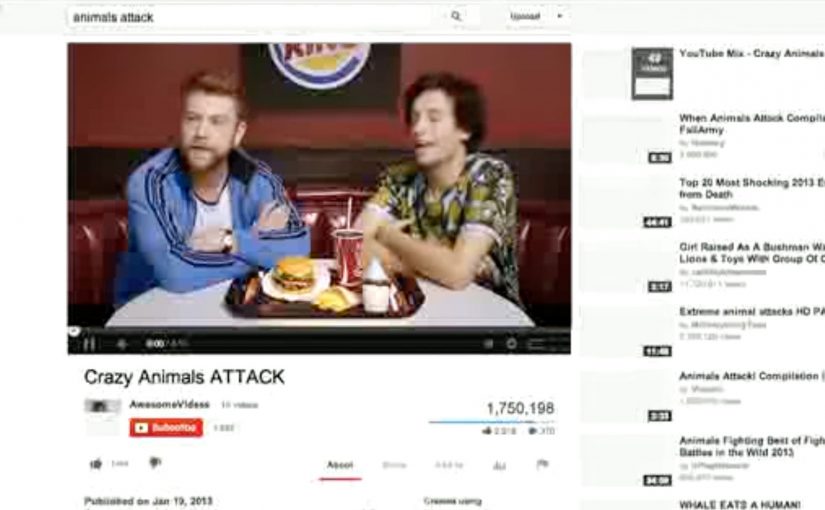
So for their campaign in New Zealand they decided to take a slightly different approach. They created 64 videos that made fun of the annoying pre-rolls and then tailored it to the video that was about to be watched.

How 64 tailored pre-rolls made interruption feel relevant

The mechanism was contextual creative at scale.

Instead of running one generic pre-roll, Burger King produced a library of short spots designed to match the viewer’s intent. The pre-roll referenced the type of content about to play, making the interruption feel less random and more like a commentary on the moment. By “contextual creative,” I mean variants that change based on the content about to be watched.

That shift matters because it changes the viewer’s question from “how fast can I skip?” to “what are they going to say about this one?”

The real question is: can you turn the skip reflex into a moment of curiosity.

In global consumer brands buying always-on video, contextual creative is the simplest way to make paid interruption feel earned.

Why self-aware interruption can win attention

Pre-roll is hated because it steals time and breaks flow.

Extractable takeaway: If you cannot remove an interruption, acknowledge it and pay it back with relevance.

This idea reduced that emotional tax by acknowledging the annoyance and using humor to create alignment with the viewer. When a brand says what people are already thinking, it earns a small amount of trust. Tailoring the message to the next video adds a second reward: relevance.

In other words, it does not remove the interruption. It makes the interruption entertaining enough to tolerate.

The business intent behind mocking the format

The intent was to keep the media advantage of pre-roll while reducing the brand penalty that comes with it.

By turning the format itself into the joke, Burger King aimed to increase watch time, reduce skip reflex, and improve brand sentiment. The audience still gets interrupted. But they feel understood, and that changes how the brand is remembered.

If you have to run pre-roll, self-aware contextual creative is a cleaner play than pretending the format is not annoying.

What to steal for your next video campaign

  • Start with a shared frustration. If the audience already dislikes the format, acknowledge it instead of pretending it is fine.
  • Make relevance the reward. Contextual tailoring can turn an interruption into a moment of curiosity.
  • Scale with a clear template. A creative system. Many variants. One consistent joke structure.
  • Earn seconds, not impressions. In pre-roll, attention quality is the real KPI.

A few fast answers before you act

What did Burger King do differently with pre-roll in New Zealand?

They created 64 pre-roll videos that mocked the annoyance of pre-roll and tailored the message to the video the viewer was about to watch.

What was the core mechanism?

A library of contextual creative variants designed to match viewer intent, making the interruption feel relevant and humorous.

Why does self-aware humor work in an interruptive format?

Because it aligns the brand with what viewers already feel, reducing irritation and increasing willingness to watch.

What business goal did this support?

Improving attention quality and sentiment while still benefiting from the reach and placement of pre-roll media.

What is the main takeaway for brands?

If you cannot remove an interruption, redesign it so the audience gets a payoff. Relevance and humor are two of the fastest payoffs available.
Burger King: The Whopper Lust Challenge

Burger King: The Whopper Lust Challenge

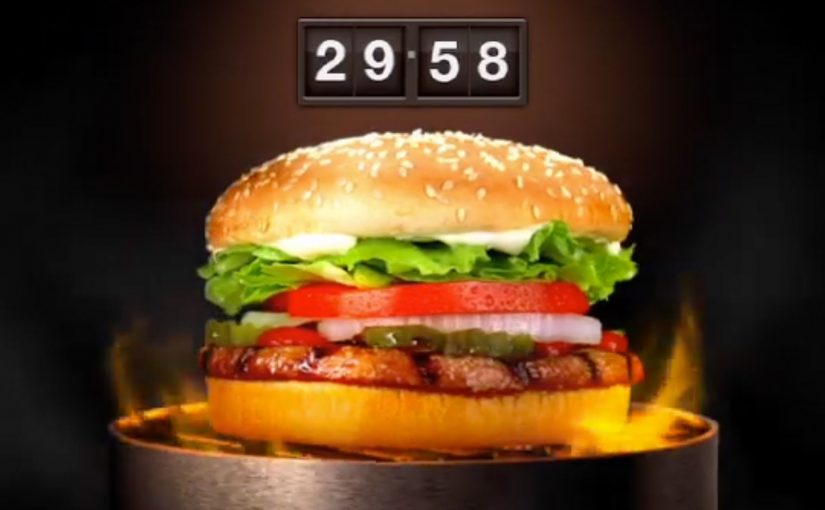
Stare at a picture of a Whopper long enough and you win one. That’s the premise of an interactive TV campaign from Burger King. What looks like a never-ending ad is actually a dedicated TV channel on DirecTV channel 111, built around a spinning flame-grilled burger and a timer.

To win, you tune in and activate the Whopper Lust challenge. A five-minute countdown starts, and you have to keep watching the rotating Whopper for the full duration. Make it to five minutes and you earn one free burger. Keep going for another ten and you earn two. Keep going and the rewards scale. The longer you last, the more you unlock.

The catch is that the channel occasionally prompts you to hit buttons on your remote. Miss one and the clock resets, so you lose the reward you were building toward. Complete the challenge and you can claim the free burger directly on the TV.

How the mechanic turns attention into currency

This is “watch time” treated like a loyalty program. Here, “watch time” means the viewer’s sustained, verified attention, not just a channel left on in the background. The spinning Whopper is deliberately hypnotic, the timer makes the commitment explicit, and the remote prompts prevent passive cheating. It is simple, but it forces real engagement rather than background viewing.

That works because the timer defines the commitment, the remote prompts verify attention, and the visible progress makes the reward feel earned rather than handed out.

In US quick-service marketing, converting a passive channel into a participation loop can buy disproportionate attention without buying proportional media.

Why this lands

It works because it is a dare, not a discount. The reward feels earned, and the friction is oddly satisfying because it creates tension. Will you slip and reset. The interaction also turns a solitary act. Watching TV. Into a game you can talk about immediately.

Extractable takeaway: If you want people to stay with a message, make the “cost” a clear, timed commitment and add periodic interaction checks, so attention becomes an active choice rather than a passive exposure.

What Burger King is really optimizing

This is not just a giveaway. It is a retention play. The real question is how to turn passive media time into a branded challenge people willingly stay with. The channel trains repeat viewing, creates a habit loop, and attaches the brand to a measurable “I lasted” story. Reported campaign figures describe large volumes of burgers given away and large volumes of watch minutes generated over the week.

What to steal from attention-for-reward mechanics

  • Make the rule instantly legible. “Watch X minutes. Win Y.” is frictionless to understand.
  • Prevent passive participation. Add simple interaction prompts to keep it honest.
  • Let rewards compound. Escalation keeps people in the loop longer than a single prize.
  • Turn viewing into a game. A timer and resets create stakes without complex tech.

A few fast answers before you act

What is the Whopper Lust Challenge?

It’s an interactive TV activation where viewers watch a dedicated Burger King channel and earn free Whoppers based on how long they stay engaged.

How do you win a free Whopper?

You activate the challenge, watch the spinning Whopper for five minutes, and respond correctly to occasional remote-control prompts so the timer does not reset.

Why add remote button prompts?

To ensure people are actually watching and interacting, not leaving the channel on in the background.

What makes this different from a normal TV ad?

The ad is the channel, and the viewer is part of the mechanic. Time and interaction directly determine the reward.

What’s the main risk with this format?

If the interaction prompts feel unfair, too frequent, or glitchy, frustration overwhelms the fun and people drop out.

Burger King: Whopperface

Burger King: Whopperface

Proof marketing at the counter, not in a tagline

In fast-food marketing, “fresh” claims are easy to say and hard to believe. Proof marketing means giving customers evidence at the point of purchase, not just a promise. Burger King’s Whopperface is a clean example of turning a claim into visible proof inside the restaurant.

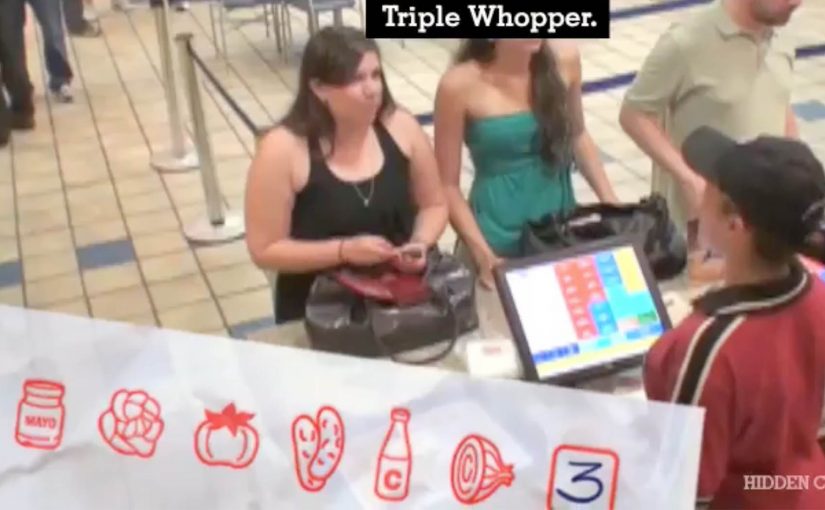
One cashier, one hidden cam, one printer. That is all Ogilvy Brasil needed to prove that Burger King sandwiches are made to order.

When a customer ordered a Whopper, they took a picture without anyone noticing. Then the customer got their freshly made sandwich with their face on it. Burger King proved that each sandwich is unique and made to order for each customer.

How Whopperface created “made to order” evidence

The mechanism is simple. Capture identity at the moment of order, then attach it to the product that comes out of the kitchen.

The hidden camera took the photo. The printer produced the personalized output. The handoff at the counter delivered the proof. The customer did not just hear “we make it fresh”. They received a physical, personalized marker that could only exist if the sandwich was made for them in that moment. Because the print is generated after the order, it converts timing into evidence, which short-circuits the usual “was this pre-made?” doubt.

Why it lands psychologically

In quick-service restaurants, the counter is the trust bottleneck for freshness. People trust what they can verify. Whopperface works because it lets the customer verify “made to order” with a marker tied to their identity.

Extractable takeaway: When skepticism is the barrier, attach a unique, customer-linked artifact to the output so the claim becomes self-evident at the moment of truth.

A customized face print is not a vague reassurance. It is a unique token. It signals individual attention and removes doubt about whether the item was pre-made. It also triggers a social instinct: if you receive something with your identity on it, you are more likely to show it, talk about it, and remember it.

The business intent behind the stunt

The intent was to rebuild credibility around freshness and ordering, using retail experience as the media channel.

The real question is whether your brand can turn its most fragile claim into something customers can verify in the moment.

Instead of spending budget repeating a claim, Burger King invested in a moment that created both belief and shareable content. The proof lived in the customer’s hands, and the story traveled naturally from there.

If trust is the issue, spend on proof at the counter before you spend on more media.

Proof patterns to borrow from Whopperface

  • Turn claims into artifacts. If you want belief, create something physical that acts as evidence.
  • Place proof at the point of truth. The point of truth is the exact moment and place the customer decides whether to believe you.
  • Use personalization as verification. Identity markers make “made for you” tangible.
  • Keep the system minimal. Simple setups scale. One camera, one printer, one process.

A few fast answers before you act

What was Burger King’s Whopperface?

A retail stunt where customers received their freshly made sandwich with their face printed on it, proving the order was unique and made specifically for them.

What was the core mechanism?

A hidden camera captured the customer at order time, and a printer produced a personalized output that was attached to the fresh sandwich at handoff.

Why does this prove “made to order” better than a claim?

Because it creates a unique, verifiable artifact that can only exist if the sandwich was produced for that specific customer in that specific moment.

What business goal did it support?

Increasing trust in freshness and differentiation by turning the restaurant experience into proof and shareable content.

What is the main takeaway for other brands?

If trust is the barrier, design a simple proof mechanism that customers can see, hold, and share.