
McDonald’s Reflective Billboard

You drive past a billboard during the day and see nothing. Then you pass it again at night, your headlights hit the surface, and a message appears. “Open all night.”

The idea. An ad you can only see at night

McDonald’s wanted to target people looking for a late night snack, so Cossette Vancouver created an ad that only showed itself when the audience was most likely to want it.

How reflective tape turns headlights into a reveal

Reflective tape was used to write “Open all night” on the billboard. The message was not visible during the day, but at night, with car headlights, it was revealed.

For late-night retail and roadside food brands, timed visibility like this turns the placement itself into the filter.

Why this works for late-night intent

This is behavioural targeting without data. The medium uses context instead of audience data to decide when the message becomes visible. Because the message only appears when headlights activate it, the reveal feels timely rather than intrusive.

Extractable takeaway: When the environment can decide who sees the message, the creative can stay simple and still feel precise.

What this does for late-night traffic

The real question is whether the medium can do the filtering before the copy has to. In this case, the billboard spends visibility only on people who are out at night, which makes a simple store-hours message feel more useful and more memorable.

This is a stronger OOH move than a generic night-time billboard because the medium itself makes the message feel useful.

What to steal for context-driven OOH

  • Turn an environmental condition into the trigger. Here, light does the targeting without any data.
  • Align message visibility with intent. If the audience can see it, they are already in the right moment to act.
  • Keep the proposition short and literal. The reveal is the effect, so the copy should be instantly readable at speed.
  • Design for repeat exposure. The “I saw nothing. Then I saw it” contrast is what makes it stick.

A few fast answers before you act

What is the McDonald’s Reflective Billboard concept?

It is a billboard that stays visually “blank” in daylight, but reveals the line “Open all night” when car headlights hit reflective tape after dark.

Why is night-only visibility a smart creative constraint?

Because it aligns the message with the moment of need. People out late are more likely to want a snack, so the ad appears when intent is highest.

What is the key production technique here?

Using reflective tape to create a hidden message that only becomes legible under direct light sources like headlights.

Why does this feel less intrusive than normal targeting?

Because the environment does the filtering. The ad only becomes visible in the right condition, so the timing feels useful instead of forced.

What is the broader lesson for outdoor advertising?

Let context do the targeting. When the medium responds to time, light, or location, the message can feel personalised without collecting data.
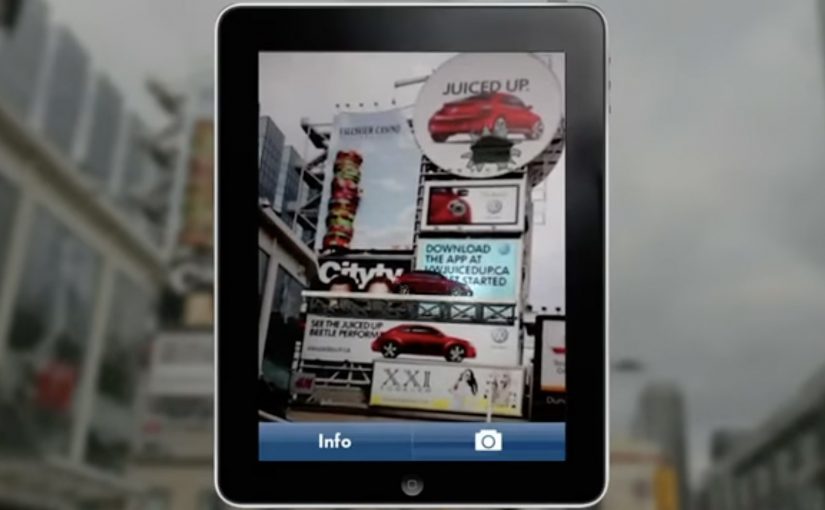
Volkswagen Beetle: Juiced Up

A billboard looks normal until you point your phone at it. Then the Beetle “juices up” into a 3D scene that spills out of the frame, turning a static poster into something you can explore.

That is the twist behind Volkswagen’s Beetle “Juiced Up” launch, created with Red Urban. Traditional out-of-home placements like billboards and bus shelters double as augmented reality markers. Download the custom app, scan the printed ad, and a 3D experience unlocks on your screen.

An AR marker is a printed visual pattern that a camera can recognize. When the app detects it, it anchors digital 3D content to the real-world poster so the animation appears to sit on top of the physical ad.

The best out-of-home work turns “I noticed it” into “I did something with it”, without asking people to learn a new behaviour.

Why AR markers work so well in out-of-home

Out-of-home already has the two things AR needs. Scale and repetition. People pass the same placements multiple times, which makes it easier for curiosity to build. Once someone scans, the experience feels like a hidden layer you only get if you engage. In global consumer brands running large-scale launches, out-of-home works best when it functions as a repeated trigger, not a one-time impression. A revamp is hard to communicate through copy alone. A 3D reveal makes the “newness” feel more tangible, even if the viewer only plays for a few seconds.

Extractable takeaway: Treat the physical placement as the interface. Make the first scan feel like the poster is “unlocking”, and keep the payoff immediate so the viewer control feels effortless.

What this launch is really optimizing for

This is not just about feature education. It is about reframing the Beetle’s personality and making the redesign feel more assertive and contemporary. The real question is whether your out-of-home is only a reminder, or a trigger that rewards interactivity. The app is a proof device, meaning it proves “this is different” by behaving differently than a normal poster campaign. This approach is worth doing only when the interaction reinforces the product story, not when it is novelty for its own sake.

What to steal for your next OOH-led activation

  • Make the trigger obvious. A single prompt, scan here, is enough. Let the payoff do the persuasion.
  • Anchor the interaction to the medium. If it is out-of-home, the phone should feel like a lens on the poster, not a separate experience.
  • Keep the first moment fast. If the 3D reveal does not land immediately, the novelty collapses.
  • Design for “I have to show you”. The best activations create a demo impulse that spreads in person.

A few fast answers before you act

What is “Volkswagen Beetle: Juiced Up”?

It is an out-of-home launch activation where Volkswagen posters and billboards act as AR markers. A dedicated mobile app unlocks a 3D Beetle experience when viewers scan the ads.

Why use AR markers instead of a standard QR code?

Markers make the poster itself the interface. That keeps the experience visually seamless, and it helps the 3D content feel physically attached to the real ad.

What is the main benefit of this approach for a product revamp?

It makes “newness” experiential. A 3D reveal can communicate attitude and redesign energy faster than a feature list.

What is the biggest practical risk with AR OOH?

Friction. If the app install and scan flow is slow, most people will not complete it. The reward has to justify the effort quickly.

What is the simplest way to improve completion rates?

Reduce steps and increase immediate payoff. Clear instruction at the poster, fast recognition, and an instant 3D moment that feels worth showing to someone else.

Volkswagen Canada: The Great Art Heist

They say that beauty is in the eye of the beholder. But if Volkswagen Canada has their say, beauty will be in the hands of the person who’s stealing it. That is the idea behind this ambient-meets-social campaign for the Volkswagen Jetta GLI.

Since the beginning of October, agency Red Urban has created a series of pop-up art galleries across major cities in Canada that feature “light paintings” made by the movement of the Volkswagen Jetta. These light paintings are long-exposure photographs that turn headlight and taillight trails into abstract artwork.

While the frames in the exhibits have been hung for all to admire, they have not been hung that securely, allowing more daring admirers to claim the artwork for themselves. The “thieves” are then asked to share their stolen items via Tweets and Facebook posts. Volkswagen Canada’s Facebook page starts receiving photos from fans decorating homes and offices with the imagery.

When out-of-home becomes a participation prompt

The mechanism is a deliberate temptation loop. By that, I mean the setup places something desirable in public and makes acting on that impulse part of the idea. Place desirable objects in public. Make them easy to take. Then turn the taking into the call to action, with social sharing as the proof layer. The “gallery” is the stage. The heist is the interaction. The reposted photos are the distribution.

In automotive launch marketing, giving people something physical to claim and display can turn attention into advocacy faster than conventional ads.

The real question is how to turn a static display into an action people want to repeat and publicize.

Why it lands

This works because it flips the normal rules of outdoor advertising. Instead of “look at this and move on”, the frame invites a decision and a story. The act of taking the artwork creates instant ownership, and ownership makes people far more likely to post, discuss, and keep the brand in the room. The strongest move here is not the gallery format but the permission to take the media home.

Extractable takeaway: If you can transform a passive medium into a “take it, show it” mechanic, you convert exposure into participation. Participation creates proof, and proof drives organic reach.

What to steal from this activation

  • Make the object desirable on its own: if the item is genuinely display-worthy, people will do the promotion for you.
  • Use a single rule: “take it and share it” is easy to understand and easy to repeat.
  • Build for accumulation: the more stolen pieces show up online, the more the campaign feels real and alive.
  • Let the audience finish the media buy: the repost is the real multiplier, not the initial placement.
  • Manage the ethics upfront: the line between playful permission and real theft must be unambiguous in execution.

A few fast answers before you act

What is the “Great Art Heist” idea?

It is a pop-up street gallery of framed “light painting” photos tied to the Volkswagen Jetta GLI, where passersby are implicitly encouraged to take a frame and share it socially.

What are “light paintings” in this campaign?

They are long-exposure photographs capturing the car’s headlight and taillight trails, producing abstract, art-like images.

Why does encouraging people to take the artwork work?

Because it creates ownership and a personal story. Once someone has the piece, sharing becomes natural and the brand becomes part of their environment.

Is this more out-of-home or more social?

Both. Out-of-home provides the physical trigger and scarcity. Social sharing provides proof and scale.

What is the biggest risk with a “steal it” mechanic?

Misinterpretation. If permission is not clear, the idea can feel irresponsible. The execution must make the intended rules obvious to avoid negative backlash.