
Canadian Tire: Christmas Spirit Tree

Canadian Tire: Christmas Spirit Tree

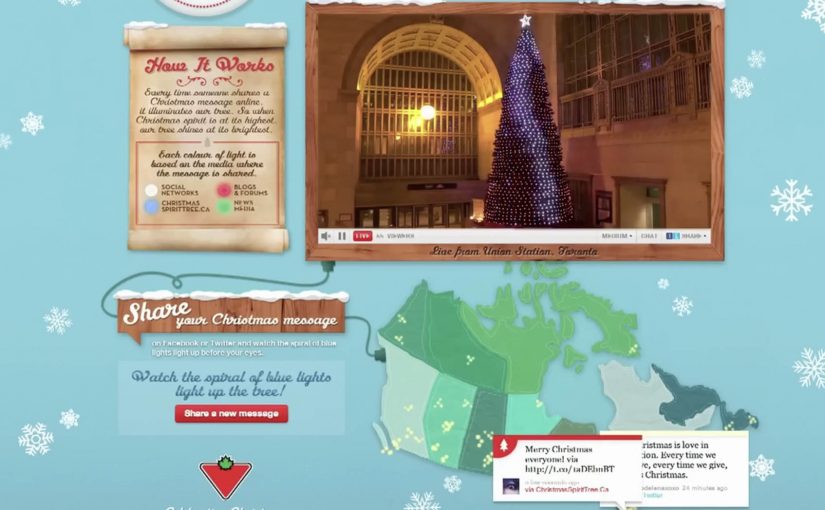
Canadian Tire wanted to re-energize Christmas spirit and reinforce its position as Canada’s leading Christmas store. So they built a public symbol of the season that behaves like a live dashboard for holiday cheer.

The result was a 30-foot Christmas tree wrapped with 3,000 individually programmed LED lights, powered by the nation’s collective online Christmas spirit. Social monitoring tools scanned blogs, forums, social networks, and news sites for Christmas keywords, then software translated that data into real-time light patterns on the tree.

Turning sentiment into a light show

The mechanic is a clean loop. Capture real-world language at scale. Reduce it to signals a system can interpret. Visualize those signals instantly as a physical experience people can gather around. That translation layer is the whole idea, because it makes something intangible, “spirit”, visible and shared. Here, the translation layer is the software bridge that converts online holiday language into visible light behavior.

In large-scale retail brands, public installations like this can turn social chatter into a measurable, collective ritual that reinforces seasonal ownership.

Why it lands

It gives people a role that feels meaningful without feeling like work. You do not have to download an app or learn a new behavior. You just post a message the way you already would, and the tree responds. That cause-and-effect is what makes the story travel, because the installation feels like it is listening, not just broadcasting.

Extractable takeaway: If you want “community” to feel real, build a visible feedback loop where everyday audience behavior directly changes a shared public object. Then make the transformation obvious enough that people can connect their action to the outcome.

What the campaign is really optimizing for

The objective is not only brand warmth. It is reclaiming seasonal leadership by creating a national-scale proof point that Canadian Tire can own, film, and redistribute. The real question is how to make seasonal sentiment visible in a way only Canadian Tire can own. The tree becomes a repeatable centerpiece for earned media, social sharing, and store association without having to lead with price.

What to steal for your own seasonal playbook

  • Make the idea self-explanatory. “Messages make lights” is a one-sentence mechanic people can repeat.
  • Turn digital into physical. Physical experiences feel more “real” than dashboards or microsites, even when the inputs are purely online.
  • Design for spectators and participants. The best public work rewards both the person who posts and the person who just watches.
  • Build a content engine. If the installation produces fresh patterns continuously, you get ongoing footage and reasons to talk about it.

A few fast answers before you act

What is the core idea of the Christmas Spirit Tree?

A large LED Christmas tree that lights up in response to holiday messages detected online, turning seasonal sentiment into a live public experience.

Why use social monitoring as the “power source”?

Because it makes the audience feel like the energy behind the display. The installation becomes a collective mirror, not a one-way broadcast.

What makes this more effective than a standard Christmas film?

The live feedback loop. People can influence the outcome, and that influence creates participation, talk value, and repeat attention.

Why does the physical tree matter more than a digital counter?

Because a public object turns online sentiment into something people can gather around, film, and talk about. The physical response makes the mechanism feel shared rather than abstract.

What is the biggest execution risk?

If the response feels delayed, random, or unconnected to real posts, the magic breaks. The system must feel immediate and believable.
Deutsche Telekom: Hologram Christmas Surprise

Deutsche Telekom: Hologram Christmas Surprise

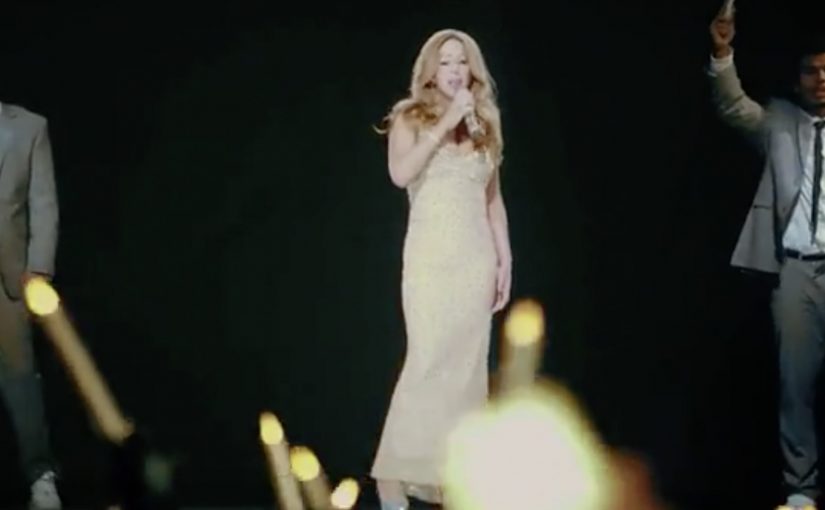
Deutsche Telekom stages a multi-city, multi-media Christmas surprise where people across five countries believe they are seeing Mariah Carey perform live, right in their city square.

The event is described as unfolding simultaneously in Germany, Croatia, Macedonia, Montenegro, and Poland. After roughly 10 minutes, the hologram “breaks” into the sky to reveal the surprise, then reforms to lead the connected crowds through “Silent Night”, finishing with “All I Want for Christmas Is You”.

How the spectacle is engineered

Mechanically, each city is linked live to the others, enabling interaction across locations while the performance plays out on large-scale public screens. Attendees are also given a QR code that takes them to a smartphone experience featuring a candle flame, turning the crowd into a coordinated visual.

In European telecom brand marketing, making the network feel like a shared human experience is a reliable way to give an invisible service a visible emotional payoff.

Why it lands as more than “a stunt”

This works because the surprise is collective, not individual. People do not just watch content. They witness their city being connected to other cities in real time, and that connection is the product truth Deutsche Telekom wants remembered. Because the cities are live-linked, the audience experiences “connection” as something happening to them, which makes the brand promise feel credible. The real question is whether your experience lets people feel the benefit in the moment, not just understand it in hindsight. If your brand sells connectivity, a shared public ritual beats a standalone content drop.

Extractable takeaway: When the benefit is intangible, engineer a shared moment that makes the benefit felt, then let the crowd carry the story.

What the numbers are really doing

The piece is framed with scale metrics. Attendance is described as 12,000 people in total, with an additional 27,000 watching via a live internet stream on lifeisforsharing.tv. Treated as reported figures, the strategic point is clear: the “in person” crowd creates authenticity, and the stream extends reach without losing the feeling of simultaneity.

Stealable patterns for cross-market surprise

  • Build one shared ritual. A carol everyone recognises becomes the simplest multi-language participation layer.
  • Make the reveal part of the story arc. Belief, disruption, then a coordinated finale gives the audience a plot to retell.
  • Link physical and mobile. A QR-driven phone element can turn a crowd into a synchronised visual without complicated instruction.
  • Design for “togetherness at distance”. The emotional payoff comes from knowing other cities are experiencing the same moment at the same time.

A few fast answers before you act

What is the “Hologram Christmas Surprise” in one line?

A simultaneous, five-country public concert that uses a Mariah Carey hologram and live city-to-city links to create a shared Christmas moment at scale.

What is the core mechanism that makes it feel real?

Live-linked public screens across cities, plus on-stage interaction cues and crowd participation elements that play out in real time.

Why add the QR code candle experience?

It gives the crowd a simple coordinated action, visually reinforcing the “connected” theme and making the audience part of the show.

How do you keep it from feeling like a pure tech demo?

Lead with a shared ritual and a simple participation layer so the emotion reads first, and the technology disappears into the experience.

What is the most transferable lesson?

If your brand benefit is intangible, engineer a shared public moment that makes the benefit visible, then let people do the storytelling for you.

Spanair: Unexpected Luggage

Spanair: Unexpected Luggage

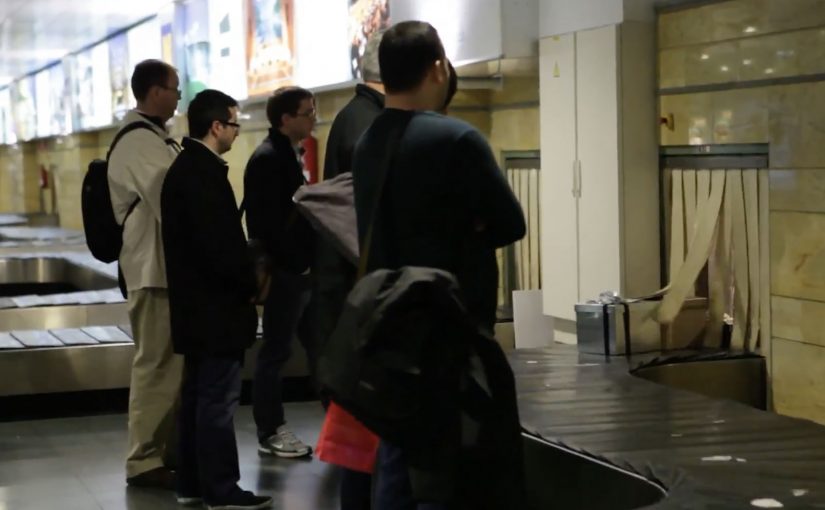
On December 24th the flight from Barcelona to Las Palmas arrived close to midnight. 190 people were flying while everyone else celebrated Christmas Eve. Spanair decided to do something special for those 190 passengers.

Instead of a routine wait at baggage claim, the luggage carousel delivered an unexpected sight. Wrapped gifts came down the belt before the suitcases did, turning a tired, end-of-day moment into a shared surprise.

How the baggage-claim surprise is engineered

The mechanic is as physical as it gets. Move the brand moment to the one place every passenger must stand still. Then use the carousel as the reveal device, with gifts replacing the expected flow of bags long enough for the crowd to realize something has changed.

In European airline marketing, the most memorable “service stories” are often built from small interventions in unavoidable touchpoints, where emotion is already high and attention is captive.

Why it lands

It respects the situation. Christmas Eve travel is already loaded with absence, fatigue, and sacrifice. The surprise works because it does not ask passengers to do anything new. It simply changes what the moment means, and it does so in front of everyone, so the reaction becomes collective rather than private.

Extractable takeaway: If you want a brand moment to feel generous rather than promotional, place it inside an unavoidable friction point, and make the reveal about relief and recognition, not about brand messaging.

What Spanair is really buying

This is “customer experience” as media. The spend is focused on a small number of people, but the output is a story that travels because it is easy to retell and easy to believe. A luggage belt of gifts is visual proof, not a claim.

The real question is how to turn a routine service touchpoint into proof that people will remember and retell.

What to steal for your own service brand

  • Use captive moments. Baggage claim, check-in lines, boarding queues, and waiting rooms are attention-rich environments.
  • Let the environment do the talking. When the space changes, you do not need much copy.
  • Design for group emotion. Collective reactions create social permission to film, share, and talk.
  • Make the proof unmistakable. If the story can be doubted, it will not travel far.

A few fast answers before you act

What is the core idea of Unexpected Luggage?

Surprise passengers at baggage claim by swapping the expected luggage moment for a gift reveal, turning a routine wait into a shared holiday experience.

Why does baggage claim work so well as a stage?

Everyone must be there, everyone is watching the same thing, and the carousel is already a natural reveal device. That makes the surprise instantly legible.

What makes this feel authentic instead of gimmicky?

The gesture fits the context. It acknowledges what it means to travel on Christmas Eve and gives something back without requiring participation or performance from passengers.

What is the biggest risk when copying this approach?

If operations are not tight, the surprise turns into delay and frustration. The moment must feel like relief, not disruption.

Does this only work for airlines?

No. The same pattern can work in any service setting with a captive, shared wait, as long as the intervention fits the moment and does not create extra friction.