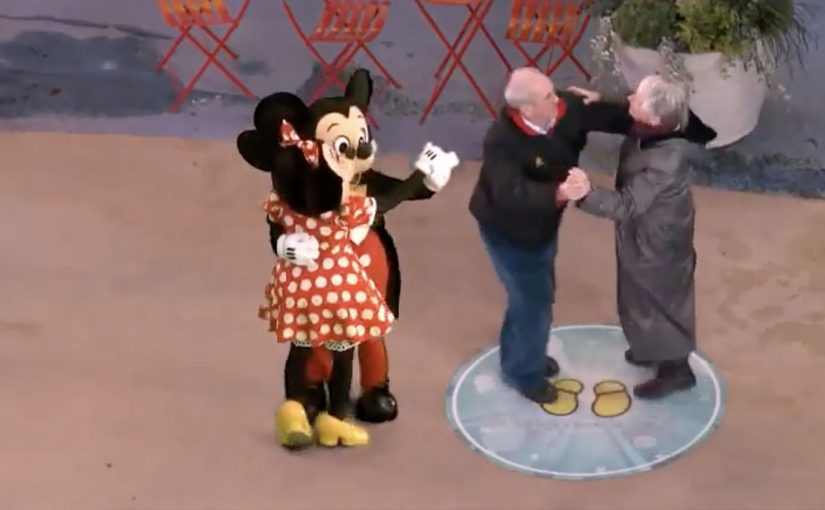
You step into the Disney Store in Times Square and suddenly you are “in” a Disney moment. A live screen blends you into a scene and Mickey appears alongside you, reacting in real time as the crowd watches.
Disney Parks uses the installation to celebrate Mickey Mouse’s 83rd birthday this month, turning a store visit into a small piece of theatre that people naturally photograph and share.
The mechanism is straightforward. A live camera feed captures guests, then an augmented reality layer places Disney characters and effects into the scene so it looks like the magic is happening around you, not only on a separate screen.
In flagship retail environments, live augmented reality installations convert foot traffic into shareable content by making the store itself behave like media.
The real question is whether the experience makes bystanders feel like they are watching a story, or watching a demo.
Disney is also using a Twitter hashtag #DisneyMemories to track the experiences at Times Square and the campaign, so the physical moment has a simple, searchable social trail.
Why this lands in Times Square
Times Square is already a stage. The installation does not fight the noise with more noise. It creates a personal moment inside the noise, where the viewer becomes part of the story. That shift from watching to participating is what earns the stop-and-stare crowd.
Extractable takeaway: In a loud environment, the winning move is not bigger spectacle. It is giving each guest a personal, camera-ready moment the crowd can understand instantly.
Hashtag as a lightweight amplification layer
The hashtag is not the idea. It is the plumbing. It lets Disney connect hundreds of individual “I was there” posts into one visible stream, without asking people to learn a new platform or download anything beyond what they already use.
The same live AR pattern shows up elsewhere
This style of live augmented reality is showing up more often in brand-led events, because it creates instant participation without complex instructions. You have already pointed to similar executions from National Geographic and Lynx, where the screen becomes a “portal” and the audience becomes part of the scene.
What to steal for your own live-event experience
- Make the first second readable. People should understand what is happening from across the room.
- Design for bystanders. The crowd experience matters, because the crowd is the distribution engine.
- Attach one simple social handle. A hashtag or keyword is enough when the moment is already worth sharing.
- Keep the tech invisible. The audience should remember the feeling, not the hardware.
A few fast answers before you act
What is the Mickey Mouse Times Square augmented reality installation?
It is a live in-store experience at the Disney Store in Times Square that places guests into a real-time scene with Disney characters using an augmented reality layer on a live camera feed.
Why does this work as a retail activation?
Because it turns a store visit into a participatory moment. People do not just browse. They become part of a scene worth filming and sharing, which extends reach beyond the store.
What role does #DisneyMemories play?
It creates a single social thread for many individual posts, helping Disney track and aggregate the shared experiences without adding friction to the in-store moment.
How is this different from a typical photo booth?
The difference is live spectacle. The experience is designed to be watched by a crowd in real time, so bystanders become part of the energy and the story travels further.
What is the most common failure mode for live AR event installs?
Confusion and delay. If people cannot instantly understand what to do, or if the experience queues too long, the crowd dissolves and the social output drops sharply.