
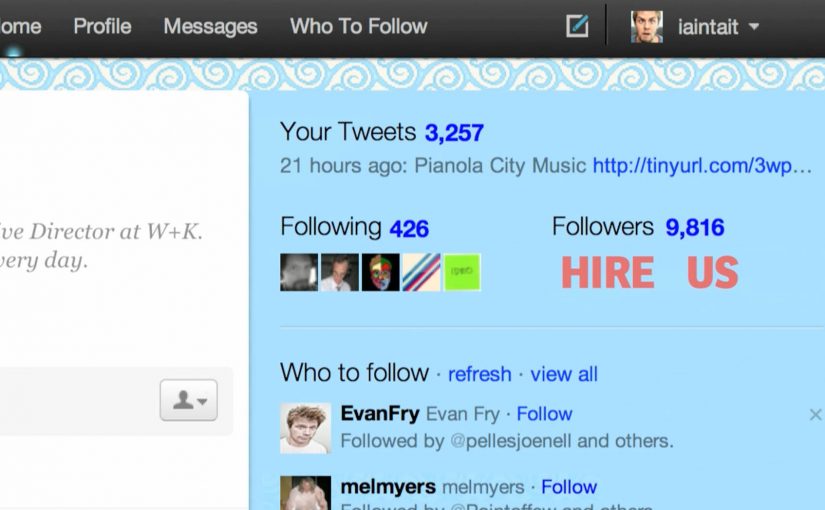
Hire Us: Twitter Follow Stunt Lands a Job

Dutch creative team Bas van de Poel and Daan van Dam set up five separate Twitter accounts and started following various Dutch Creative Directors on Twitter. Their message was simple: HIRE US.

Even though the idea is very similar to the Jeep Twitter Puzzle campaign, the execution is different and innovative. It gets them noticed and finally a job with Boondoggle in Amsterdam.

Why five accounts is the point, not the gimmick

The mechanism is engineered repetition. By “engineered repetition,” I mean deliberately creating multiple small signals that form an obvious pattern in the target’s notifications. One account can be ignored. Five accounts create a pattern. When multiple new followers arrive with the same blunt message, it triggers curiosity and a small sense of social pressure. Someone is doing something intentional, and it is hard not to look.

It is also highly targeted. They do not broadcast “hire us” into the void. They place it directly in the attention stream of the people who can change their outcome.

In creative hiring markets, attention is scarce, so using a platform’s native behaviours to deliver an instantly legible message is often the fastest way to get noticed.

Why it lands: interruption plus clarity

This works because it is instantly legible. No clever puzzle to decode. No long portfolio pitch. The call to action is the entire creative idea. That clarity is what makes it feel confident. And because it happens inside Twitter’s native behaviours, following, notifications, profile clicks, it does not require extra friction. The recipient can react in seconds.

Extractable takeaway: When you need attention from specific decision-makers, create a small pattern using the platform’s native behaviours that communicates the ask in one glance and makes the next step easy.

The intent: turn hiring into a creative brief

The business intent is obvious. Get hired. But the deeper intent is to reframe the hiring process. Instead of asking for a meeting, they create a live demonstration of how they think. Targeted, lightweight, and culturally fluent in the medium.

The real question is how you create an impossible-to-ignore signal for the right people without turning the medium into spam.

Done with tight targeting and restraint, this approach is a legitimate creative proof point. Done broadly or repeatedly, it backfires as noise.

Borrow this for your own career marketing

  • Be specific about who you want. Target decision-makers, not “everyone”.
  • Design an interruption that fits the platform. Use native behaviours, not extra hoops.
  • Make the message instantly legible. One idea. One line. No explanation required.
  • Turn the ask into proof. Show your creativity in the method, not in a PDF pitch.
  • Keep it respectful and reversible. Clever is good. Spammy is not.

A few fast answers before you act

What did Bas van de Poel and Daan van Dam actually do?

They created five Twitter accounts and followed Dutch Creative Directors with a single message: “HIRE US”.

Why did using multiple accounts matter?

It created a noticeable pattern and a stronger interruption than a single follow, prompting curiosity and profile clicks.

How is this different from the Jeep Twitter Puzzle?

It is similar in spirit, but the execution is simpler and more direct. A single clear call to action rather than a puzzle mechanic.

What made it effective as self-promotion?

High targeting, low friction, and a message that communicates confidence in one second.

What is the main takeaway for personal branding?

If you want attention from decision-makers, design a small, platform-native experience that demonstrates how you think and makes the next step easy.
KLM: Surprise

KLM launched a social media customer engagement idea that starts with a simple observation: waiting to board is boring, and “price messages” do not help anyone in that moment. So the brand looks for passengers who check in on Foursquare for flights or tweet about waiting to board a KLM service, then surprises a few of them to see how happiness spreads.

From check-in signal to gate-side surprise

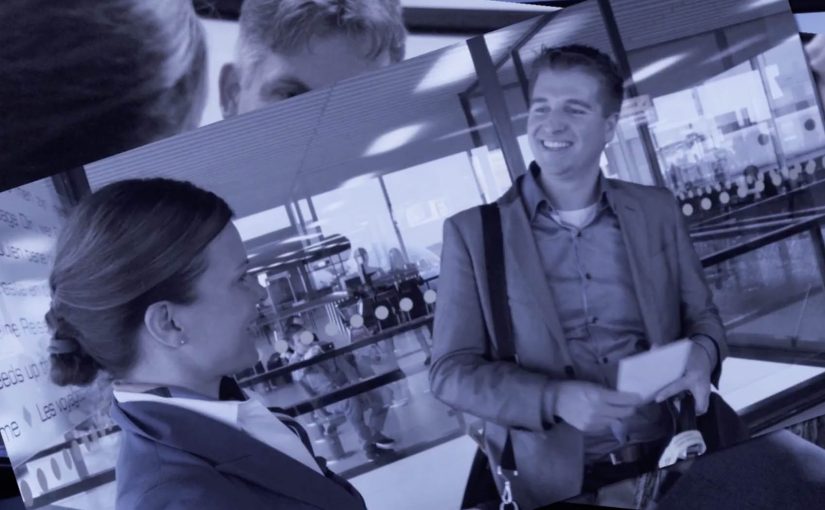
The mechanic is straightforward. Someone publicly signals they are flying KLM or waiting at the gate. The team selects a passenger, scans what that person has publicly shared across social profiles, and chooses a small, relevant gift. Then they hand-deliver it at the airport gates.

In airline customer experience, social signals can be converted into small, high-salience service moments that strengthen loyalty without changing the core product.

Why this beats generic “engagement”

Many brands greet customers after a check-in, and that is already a best practice on location platforms. KLM Surprise goes further because it moves from acknowledgement to action. Because the team delivers the surprise at the gate while the passenger is waiting, the gesture lands as relief, not advertising. The passenger gets something real, in real time, in the same physical context where frustration often accumulates.

Extractable takeaway: When you can act on an intent signal in the same moment and place it was expressed, the interaction reads as service and earns talk value without needing a big reward.

The real question is whether public intent signals can trigger timely, human service moments that customers will retell.

Brands should treat public social signals as service triggers, not engagement bait.

The personal touch is the product

The gift is intentionally small. The point is that it is specific. That specificity tells the passenger the brand paid attention, not that the brand spent money. It also turns the interaction into a shareable story because it feels improbable. Someone noticed me. Someone acted on it. Someone found me.

What the brand is really testing

Beyond the feel-good moment, this functions as a live experiment in social CRM: can public signals help identify passengers worth surprising, and can a human-scale intervention create disproportionate talk value? Here, “social CRM” means using public social signals to choose and personalize service actions for known customers. The campaign also quietly reframes “social media” as a service channel, not only a marketing channel.

Stealable moves from KLM Surprise

  • Trigger on clear intent signals. Check-ins and “waiting to board” posts are unambiguous moments where help or delight is welcome.
  • Keep the benefit small but specific. Relevance beats value. A perfect small gift travels further than a generic large one.
  • Deliver in the same context as the pain. Airport gates are where waiting is felt. That is why the gesture matters.
  • Make it operationally repeatable. A lightweight process and a small budget lets the idea run more than once without becoming theatre.

A few fast answers before you act

What is KLM Surprise in one line?

A real-time airport activation where KLM monitors public check-ins and tweets, selects passengers, then delivers small personalized gifts at the gate.

Why does it work better than simply replying on social?

Because it converts acknowledgement into action in the physical world, creating a stronger memory and a more shareable story.

Is the gift the main value?

No. The main value is the signal of attention and timing: “you were noticed” and “it happened right now when waiting felt longest”.

What is the transferable lesson for other brands?

Use public intent signals to trigger small, context-relevant service moments that are easy to repeat and easy for customers to retell.

What needs to be true to run this more than once?

A lightweight workflow for monitoring signals, selecting passengers, choosing small relevant gifts, and delivering them at the gate, plus a modest budget and clear staffing ownership.