

Goodyear Eagle F1 Test Drive

Goodyear Eagle F1 Test Drive

Goodyear does not try to “tell” you that a tire grips better. They stage a test drive that makes you feel it.

A customer walks into a Goodyear retail store expecting the usual sales conversation. Instead, a salesperson offers a test drive. The customer gets into a performance car with what looks like a normal driver. Then the drive turns into a controlled, choreographed, Hollywood-grade demonstration. The driver is a disguised stunt professional. The “test route” includes conditions that exaggerate what traction and control actually mean when things get unpredictable.

That single choice is the unlock. The product story is no longer a brochure. It is an experience.

Goodyear describes this execution as entertainment built around retail-store proof for its Eagle F1 Asymmetric All-Season line, often referred to as “Control Freak”. The point is not the stunt. The point is that grip becomes a felt outcome, not a claim.

The core move

Goodyear turns a retail test drive into entertainment that proves performance.

The real question is: how do you turn an “invisible” performance claim into belief at the moment intent is forming.

How the proof is staged

The stunt is engineered as a sequence of “proof moments” that escalate. The customer starts in a familiar retail context, then the driver introduces controlled chaos where traction and handling show up as outcomes you can feel. Because the demo is structured around cause and effect, the viewer does not need tire expertise to understand what is being proven.

In enterprise marketing organizations where retail, brand, and performance teams operate in different rhythms, retail-first proof content is one of the fastest ways to shorten the distance between awareness and intent.

Why this works so well

Most tire marketing struggles with the same problem. Performance is hard to visualize until you are already in a situation where you need it. “Better grip” sounds like every other claim until something slips.

Extractable takeaway: When a benefit is hard to evaluate in everyday life, do not buy more media to repeat the claim. Engineer one credible moment where the benefit becomes undeniable, then scale that moment through video.

This activation removes that abstraction by doing three things at once. Here, “activation” means a real-world, point-of-sale experience designed to prove one product claim with live human reaction and camera-ready structure.

  1. It makes proof visible.
    The story is designed around moments where traction and handling show up as a physical result. You do not need to understand tread compounds to understand what you just felt.
  2. It creates real human reaction.
    A staged product demo can feel like a stunt. A real customer reaction makes it believable, and shareable, at the same time.
  3. It anchors the brand in the point of sale.
    This is not a distant TV spot. The narrative starts inside the tire store. The purchase context is baked into the content, so the jump from awareness to intent is shorter.

The “retail first” storytelling pattern

A lot of experiential marketing starts with spectacle, then tries to connect it back to the product.

This one starts with the most ordinary commercial moment. A customer is about to buy tires. Then the experience expands outward. That sequencing keeps the brand motive clear. This is not adrenaline for its own sake. It is a dramatic way to demonstrate a benefit that is otherwise invisible.

If your category is dominated by price and familiarity, you win by making functional proof unignorable. You do not win by shouting “better” louder.

The deeper point

This is a category where functional proof usually loses to price promotions and familiarity. Goodyear flips that by turning functional proof into an event.

It is a reminder that “performance marketing” does not always mean dashboards and retargeting. Sometimes it means engineering a moment where the product benefit cannot be unseen.

What to borrow if you run marketing or commerce

  • Design for “proof moments,” not messages. Write down the one thing a customer must believe for your product to win. Then define the single moment they would need to see, feel, or experience for that belief to become non-negotiable.
  • Build the experience around the buying context. Placing the opening scene in a retail outlet removes friction. The story is already where the decision happens. For many categories, that is the most underrated advantage.
  • Treat the camera as a distribution strategy. The activation is designed to be filmed. Multiple angles. Real people. A sequence that escalates. In practice, the video becomes the scalable media layer on top of a physical stunt.
  • Make the customer the hero, not the brand. The most memorable part is not a feature list. It is the reaction. The brand earns attention by giving the customer an experience worth talking about.

A few fast answers before you act

What is the campaign actually demonstrating?

It demonstrates traction and handling by forcing controlled situations where grip and stability show up as physical outcomes, not claims.

Why stage it in a retail store instead of a track?

Because the purchase decision lives in retail. The story starts where intent is highest, so the proof is already in the buying context.

What makes this feel credible instead of gimmicky?

Real customer reactions plus a clear cause-and-effect link between the stunts and the product promise. The entertainment serves the proof.

What is the repeatable lesson for other categories?

Find your “invisible benefit,” create a safe way to make it visible through one engineered proof moment, then film it so it scales beyond the physical experience.

When does this approach fail?

When the experience is spectacle with no causal link to a product benefit. If you cannot explain what is being proven in one sentence, you are buying attention, not belief.
LEGO: Builders of Sound barrel organ

LEGO: Builders of Sound barrel organ

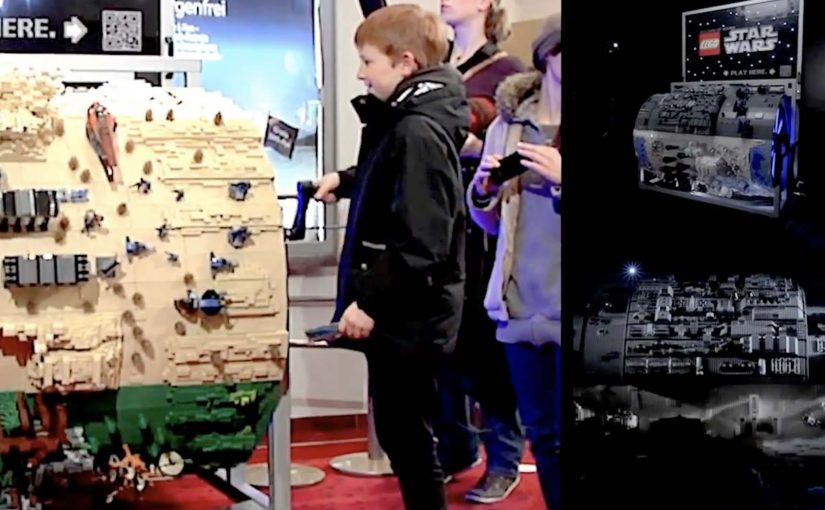
The 3D premiere of Star Wars Episode 1 in early 2012 was a cinematographic milestone for the Star Wars saga. To celebrate it, LEGO and Serviceplan Munich created a unique LEGO sound installation that actually plays the Star Wars main theme.

The installation is a huge barrel organ built from over 20,000 LEGO pieces. Four Star Wars worlds (Hoth, Tatooine, Endor and the Death Star) are constructed on the turning barrel. As it rotates, LEGO elements trigger mechanical sensors that strike the keys of a built-in keyboard, playing the tune.

A Star Wars theme you can crank with your hands

The most effective detail is the constraint. There is no “press play” button. You have to turn the organ. That one decision makes the experience feel earned. The song arrives as a result of your motion, not as background audio triggered by a screen.

How bricks become music

This is not a metaphor. It is a mechanical translation. LEGO pieces are arranged to behave like pins on a traditional barrel organ. The rotation sequence becomes a score, and the score becomes the melody via real key strikes. The four worlds on the barrel are not just decoration. They turn product and story into one continuous surface.

In European entertainment and toy launches, the strongest activations turn fandom into something people can physically operate, not just watch.

Why it lands as a cinema activation

Star Wars fans already love collectibles and craft. This installation rewards that mindset with a live proof of “impossible build meets real output.” It also gives the audience a clean social script, meaning a simple sequence people can follow without instructions. Stop. Watch someone crank it. Step in. Try it yourself. Film it. Share it.

Extractable takeaway: When a brand idea is about “bringing something into a new dimension,” the fastest route is to convert a familiar object into a physical interface and let the audience generate the outcome.

What the launch is really doing for LEGO

The real question is whether your launch gives people one obvious action that produces a repeatable, shareable payoff.

It positions LEGO Star Wars sets as more than toys. It frames them as a medium. Something that can build worlds, build machines, and even build music. That is a stronger proposition than “new sets available now,” especially around a film re-release where attention is already concentrated in cinemas.

Steal-worthy moves from Builders of Sound

  • Make the mechanism the message. The build itself should prove the claim, not just support it.
  • Use one obvious action. Turning a crank is universally understood, and it invites participation.
  • Design for bystanders. The experience should be readable from a distance, even before someone tries it.
  • Let sound do the heavy lifting. A recognisable theme turns a mechanical demo into an emotional moment.
  • Extend the experience online without changing the core gesture. If the physical version is “crank,” the digital version should feel similarly tactile.

A few fast answers before you act

What is LEGO “Builders of Sound”?

It is a LEGO Star Wars activation built around a giant barrel organ made from over 20,000 LEGO pieces. When the barrel is turned, the mechanism triggers keys to play the Star Wars main theme.

Why a barrel organ for a Star Wars release?

Because it turns a familiar, physical music machine into a participatory interface. The audience does not just hear the theme. They generate it, which makes the moment feel personal and shareable.

What makes this more than a sculpture?

Mechanical output. The build produces a real, repeatable result. That cause-and-effect shifts it from “impressive object” to “experience people line up to try.”

How do you translate a physical installation like this into an online experience?

Keep the core gesture and the immediacy. In this case, the online version is described as playable via a simple control input that mimics the physical turning action.

What should a brand measure for an installation like this?

Participation rate, repeat interactions, dwell time, the volume of user-recorded video, and any downstream actions tied to the product, such as set interest or ordering intent.

Fantastic Delites: Delite-O-Matic

Fantastic Delites: Delite-O-Matic

In this latest example, ad agency Clemenger BBDO Adelaide set out to see how far people will go for a free pack of Fantastic Delites.

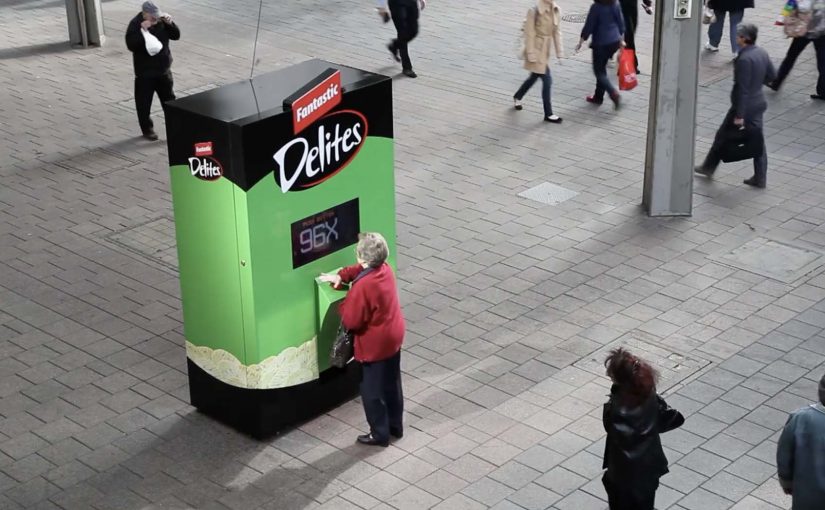
So a machine dubbed the “Delite-O-Matic” was created that gave people a free pack of Fantastic Delites by means of pushing a button hundreds of times or performing challenges. It was then put out on the streets to prove that because Fantastic Delites taste so good, people would go to incredible lengths to get them.

Sampling that people choose to earn

Interactive vending machines are a great way to get consumer participation and engagement on the ground. There are tons of examples out there, of which some have been covered here.

The mechanic that makes it watchable

The mechanism is effort-based reward. The machine sets an instruction, the participant complies, and the prize is dispensed only after the effort is visible. The escalating “work” becomes the entertainment, and the entertainment becomes the message.

In FMCG sampling and retail activations, interactive vending machines are a repeatable way to exchange effort for product trial.

That structure works because visible effort gives the crowd a simple story to follow before the product appears.

Why it lands

This works because it turns sampling into a story people can instantly judge. The point is not only “free snack”. The real question is what kind of visible effort makes a simple product feel worth watching and worth wanting. Each extra button press or challenge makes the product feel more desirable, and the crowd becomes a built-in audience.

Extractable takeaway: When you make the cost of entry visible, you turn a giveaway into a social moment. That moment carries the brand further than a silent handout ever could.

What to steal from Delite-O-Matic

  • Make the exchange legible: people should understand the rule in one glance, and the effort should be obvious on camera.
  • Escalate, then release: tension comes from “will they do it”. Satisfaction comes from the dispense moment.
  • Keep the prize simple: the product is the hero. The machine is the stage.
  • Design for bystanders: the best sampling stunts recruit a crowd even before the first pack comes out.
  • Let participation become proof: the more people comply, the stronger the implicit claim becomes.

A few fast answers before you act

What is the Delite-O-Matic?

It is an interactive vending machine activation that dispenses a free pack of Fantastic Delites after people complete button-mashing or challenge-style tasks.

Why use effort instead of a simple giveaway?

Effort creates a story. It increases attention, pulls in bystanders, and makes the reward moment feel earned, which boosts recall and sharing.

What’s the key behavioral trick?

Visible commitment. When people publicly invest effort, the product feels more “worth it”, and the scene becomes entertainment for everyone around.

Where does this work outside snacks?

Anywhere trial is the goal and the product is easy to dispense or unlock. Beauty samples, quick-service food, entertainment promos, and event activations.

What’s the main risk?

If the tasks feel humiliating or unfair, the tone can flip. The sweet spot is playful challenge with a clear, quick payoff.