
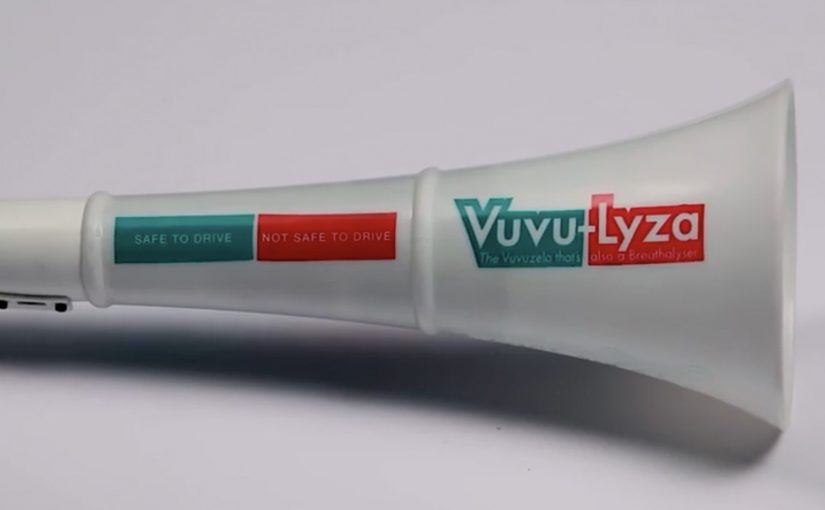
Castrol: Vuvu Lyza

The breathalyser test is one of the most common ways to check alcohol levels, and it is also one of the most disliked. Castrol takes that friction point and fuses it with something fans actually enjoy using. The vuvuzela. The result is the Castrol Vuvu Lyza.

Positioned as a first-of-its-kind twist for South African drivers, the idea lets people enjoy the game and still make a safer call about getting home afterwards.

A safety tool disguised as fan gear

The core move is deliberately simple. Merge the breathalyser everybody hates with the vuvuzela everybody loves. The campaign turns a compliance moment into a ritual moment, by putting the test inside an object that already belongs in the match-day experience.

How the Vuvu Lyza works

After the game, drivers blow into the Vuvu Lyza like a normal vuvuzela. The breathalyser element then indicates whether they are above the legal drinking limit, described through an easy colour cue. Green means go. Red means no.

In road-safety communications, attaching a serious decision to a familiar social ritual can reduce resistance and increase follow-through.

Why this lands

This works because it removes the moral lecture and replaces it with a usable object. People do not feel policed. They feel equipped. The “hate” of a breath test is softened by the playfulness of fan culture, and the decision point becomes immediate, visible, and hard to rationalise away.

Extractable takeaway: If your message depends on behaviour change, hide the “compliance” inside an object people already want to use, then make the outcome binary and instantly readable.

What Castrol is really doing

Beyond awareness, this positions Castrol as a brand that shows up in everyday driving consequences, not just in engine performance claims. It also borrows the cultural loudness of football fandom to give road safety a shareable, talkable form.

The real question is how to get fans to self-check at the exact moment match-day emotion can override judgment.

What behaviour-change campaigns can steal

  • Merge pain with pleasure. Put the disliked behaviour inside a loved object or ritual.
  • Make the decision binary. One clear signal beats a nuanced message at the point of action.
  • Design for post-event reality. Build for the moment people actually make risky choices.
  • Let the object carry the story. A physical device is easier to demonstrate, film, and retell than a warning.

A few fast answers before you act

What is the Castrol Vuvu Lyza?

It is a vuvuzela adapted to include a breathalyser, intended to help drivers make a safer decision about driving after drinking.

How does it tell you if you should drive?

You blow into it, and the device indicates whether you are above the legal drinking limit using a simple colour signal described as green for go and red for no.

Why combine a breathalyser with a vuvuzela?

Because the vuvuzela is culturally familiar and fun, which lowers resistance to the breath test moment and makes the safety behaviour easier to adopt.

What’s the core campaign message?

Enjoy the game, then make a clear, safer call before getting behind the wheel.

What’s the biggest risk with this kind of activation?

If the device is not trusted, or the signal is unclear, the behavioural promise collapses. The tool has to feel reliable and instantly understandable.
Nike: República Popular do Corinthians

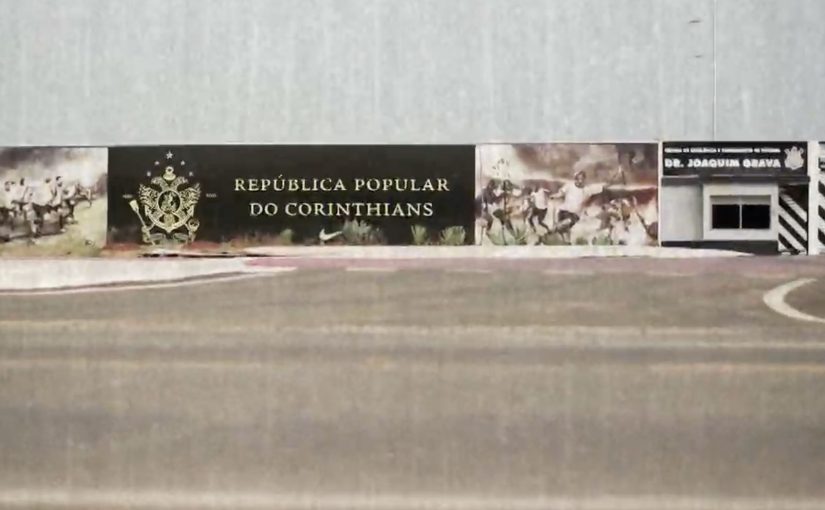
Corinthians celebrated its 100th anniversary in 2010. Nike’s response is not a one-off jersey drop or a polite tribute film. It is a whole new country.

“República Popular do Corinthians” reframes the club’s fanbase as a nation. With supporters reported in the tens of millions, the campaign leans into the idea that this “country” would outsize many real ones by population, and treats that as the brief.

Building a nation, not a slogan

The mechanism is full institutional cosplay. That is, a deliberately official-looking build-out of symbols, rules, and institutions, executed with enough detail that it feels official. F/Nazca Saatchi & Saatchi São Paulo designs the assets a nation “needs”. A coat of arms. A flag. Documents. Legislation. Currency. Heroes. An embassy. Even a president.

In fan-led sports cultures, identity symbols and rituals often travel further than product messages because supporters use them to perform belonging in public.

Why it lands with 30 million people watching

This is a campaign that gives fans something to do, not just something to admire. The “country” frame turns fandom into citizenship, and citizenship invites participation. Collect the documents. Fly the flag. Use the language. Carry the identity. The real question is whether you have a community identity people already perform, or just an audience that only consumes.

Extractable takeaway: When your audience already behaves like a community, stop treating them like a segment. Give them a shared “operating system”. Symbols, rules, roles, and artifacts that let them express membership without needing the brand in the room.

It also sidesteps the usual anniversary trap. Instead of nostalgia-first storytelling, it builds a living structure fans can inhabit, which makes the celebration feel ongoing rather than commemorative.

The commercial intent hiding inside the romance

The emotional story is belonging. The business outcome is demand. A nation needs uniforms, badges, and visible markers of identity, and the campaign makes those markers socially meaningful.

The legacy write-up around the work describes substantial earned attention, including a reported figure of $7,800,000 in free media coverage. Separate from that media value claim, the campaign is also publicly associated with industry recognition, including being named “Idea of the Year” by the Saatchi & Saatchi network’s Worldwide Creative Board.

Stealable moves from the Corinthians “nation”

  • Build an identity kit. Go beyond a logo. Create artifacts people can carry, collect, and display.
  • Make participation the message. If it only works when watched, it is fragile. If it works when used, it spreads.
  • Design for self-propagation. Fans should be able to recruit other fans without a brand explanation deck.
  • Let the world “recognize” it. Embassies, documents, and rituals create the feeling of legitimacy, which is what turns a joke into a movement.

A few fast answers before you act

What is “República Popular do Corinthians”?

It is a Nike campaign that frames Corinthians supporters as citizens of a fictional nation, complete with national symbols and official-seeming artifacts, created to celebrate the club’s centenary.

What is the key mechanism that makes it memorable?

Completeness. Instead of one hero asset, it builds an entire identity system. Flag, documents, currency, roles, and an “embassy” that makes the nation feel legitimate enough to participate in.

Why does the “nation” metaphor work so well for sports fans?

Because fandom already behaves like identity. The nation frame gives supporters a structured way to express belonging, recruit others, and turn private loyalty into public signals.

How can a non-sports brand use this pattern without forcing it?

Start with a real community behavior you can amplify, then design a small set of artifacts and rituals that make participation easy. If people will not use it without you promoting it, simplify the kit until they do.

What is the smallest version of this you can ship?

Make one role feel real, then give it one symbol and one usable artifact. If people can adopt it without instructions, you have something that can spread without constant brand narration.

TyC Sports: Argentinos

As the 2010 World Cup kicks off, this TyC Sports film by Young & Rubicam Buenos Aires is built to do one thing fast: stir up Argentine fans everywhere with a burst of identity, memory, and belief.

A World Cup rally film is a piece of sports storytelling designed to compress national pride into a repeatable emotional cue. It is less about information and more about turning viewers into a synchronized audience.

A simple mechanism: recognition, then escalation

The structure is familiar and effective. Start with the small details only insiders recognize. Then scale up into a collective “we”. The film keeps pulling the viewer from personal belonging into shared momentum, so the emotion arrives before the rational brain asks what is being sold.

In global sports media and broadcaster marketing, pre-tournament films like this work best when they feel like culture, not advertising.

Why it lands for Argentine fans worldwide

The spot trades on lived cues. The way people speak about football. The intensity. The inevitability of hope. You do not need to explain Argentina’s relationship with the game. You only need to trigger it, and let the audience do the rest. That is also why the film travels. Fans abroad are exactly the audience most hungry for a cultural tether during a tournament, so the message plays as connection as much as hype.

Extractable takeaway: If you can trigger a specific shared-identity cue, the audience will supply the meaning and momentum without you having to over-explain it.

The business intent behind the emotion

For TyC Sports, the goal is not to educate. It is to concentrate attention and loyalty at the moment the tournament starts, when viewing habits and media choices are being formed. The film frames the channel as the emotional home for the campaign, not just the place that carries matches.

The real question is whether you can earn the role of emotional home at kickoff, not just distribute the content.

Steal the rally structure for your next fan-led campaign

  • Build from insider truth. Specificity creates belonging faster than generic patriotism.
  • Make it chantable. The best sports films reduce to a line or feeling people can repeat.
  • Escalate from personal to collective. Start in the individual, end in the crowd.
  • Keep the brand role clean. If you are a broadcaster, act like a rally point, not a sponsor.

A few fast answers before you act

What is this film doing in one sentence?

It rallies Argentine fans worldwide by turning cultural recognition into shared tournament momentum for TyC Sports.

Why do pre-tournament films outperform match promos?

They create emotional commitment before viewing decisions harden. They make people choose a “home” for the tournament.

What makes sports patriotism feel authentic instead of generic?

Specific cultural cues and language that insiders recognize. The more precise the truth, the less it feels like advertising.

Who is the most valuable audience for this type of spot?

Fans who are not physically in the country. They are most likely to share, and most likely to use the film as a cultural tether.

What is the biggest creative risk with rally films?

Drifting into clichés. If the cues are too broad, it becomes interchangeable with any other team’s hype video.