
AXA: Crazy Driver

AXA: Crazy Driver

A market-day shock that makes the point instantly

The fastest way to explain risk is to make people feel the cost of it. AXA’s stunt is a clean example of that principle.

To raise people’s awareness and make them realize that nobody wants to pay for bad drivers, AXA decided to play a trick on people with the help of a little old lady.

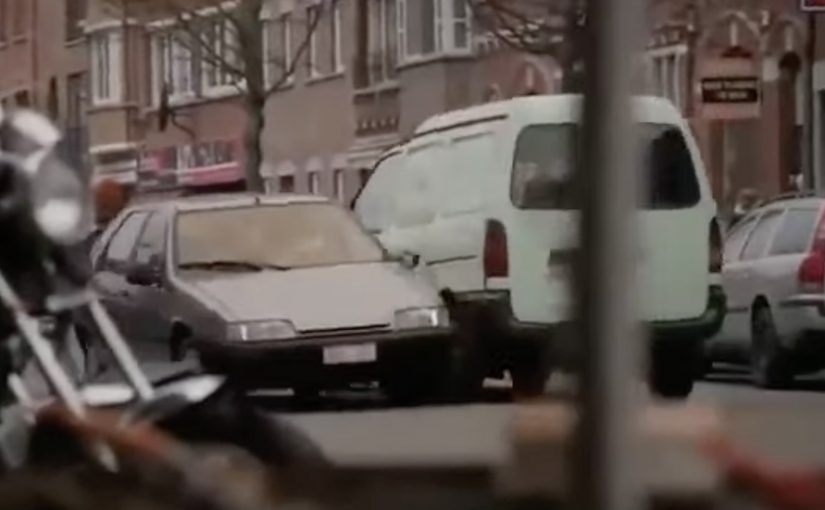
On an ordinary market day in a small, tranquil French town, an old lady was seen getting out of her parking space. In the process she knocked almost everything in her way before crashing into a line of market stalls. With the reveal being that it was staged to make the point.

How the “bad driver” setup delivers the message

The mechanism is staged reality in a real environment. By staged reality, AXA controls the trigger and the reveal, while the setting and bystander reactions stay real.

AXA uses a familiar public setting and a believable trigger. A driver leaving a parking space. Then it escalates into visible damage that bystanders can immediately judge as “this is what we do not want on the road.” The trick creates attention first, then makes space for the reveal and the point. Because the incident unfolds in public, the fairness judgment forms before anyone asks for an explanation.

In European insurance categories, public-safety messages land faster when consequences are visible and socially agreed, not only described.

Why it lands in the moment

It works because it activates two instincts at once. Concern and fairness. Nobody wants to see people hurt or property damaged, and once people witness reckless behavior, the idea of everyone else paying for it feels wrong.

Extractable takeaway: If you can make the cost of a behavior feel public and unfair in under ten seconds, you do not need to over-explain the risk.

The business intent behind the stunt

The intent is to turn an abstract insurance argument into a shared social judgment.

The real question is whether your message can become a shared verdict before people have time to tune out.

Bad driving creates costs. The campaign pushes viewers and bystanders toward the same conclusion. Pricing and consequences should reflect behavior. By making that conclusion feel obvious, AXA strengthens its positioning around responsibility and risk.

Steal this structure for risk awareness activations

  • Start with a situation everyone understands. A simple parking maneuver needs no context.
  • Make the consequence visible. People react to outcomes they can see, not statistics they cannot.
  • Use escalation to earn attention. Build from normal to shocking so the message arrives when focus is highest.
  • Let the audience reach the conclusion. The most persuasive line is the one people say to themselves first.

A few fast answers before you act

What was AXA’s “Crazy Driver” trying to change?

It aims to reduce risky driving by confronting people with an exaggerated version of everyday bad driving, making “normal” shortcuts feel unacceptable in the moment.

What is the core mechanic?

Stage a believable incident in a real public setting, then escalate visible consequences fast so bystanders form an immediate social judgment before the reveal.

What is the emotional sequence the stunt triggers?

Concern first, then fairness. Once people witness reckless behavior, the idea that everyone else pays for it starts to feel wrong, which makes the message stick.

What business intent does this serve for an insurer?

It turns an insurance argument into a shared conclusion. Risky behavior creates costs, and consequences should reflect behavior. The stunt makes that conclusion feel obvious.

What should brands steal from this approach?

Make the behavior the content. Start with a situation everyone understands, show consequences people can see, and let the audience reach the conclusion themselves.

What is the key risk with prank-style public activations?

If it feels unsafe, humiliating, or too punitive, attention can flip into distrust. The line is whether the reveal resolves tension quickly and respectfully.
Bradesco Seguros: The Fake iPad Ad

Bradesco Seguros: The Fake iPad Ad

A fake ad that behaves like a real crash

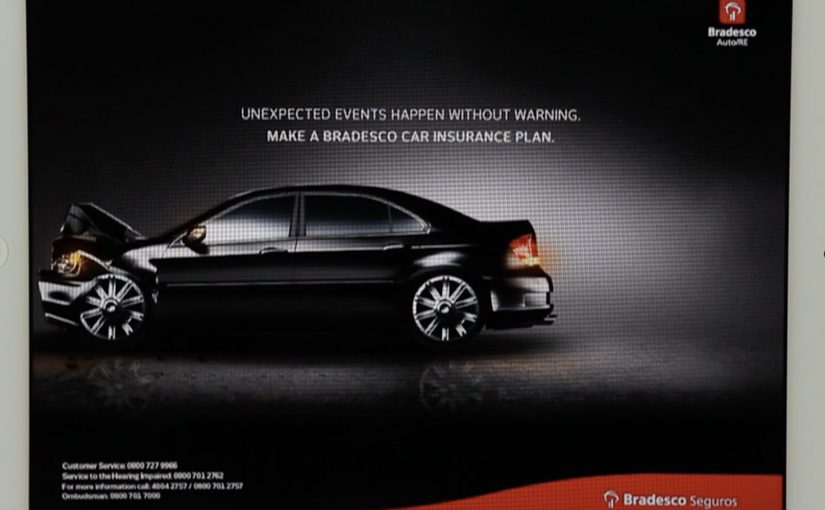
Bradesco Seguros created a cheeky ad in the iPad version of Quatro Rodas, a Brazilian car magazine. When readers swipe the “page,” the car in the ad follows the direction of the gesture and crashes into the side of the screen, unveiling the message: “Unexpected events happen without warning. Make an insurance plan.”

The mechanic: one native gesture, one irreversible consequence

The entire idea is built on the most common tablet behavior: swiping to move on. Instead of letting the user escape the ad, the ad “obeys” the swipe and turns it into the cause of an accident. The crash is the reveal. It is also the proof that the format is touch-native, not a print layout copied onto glass. Here, touch-native means the idea only works because the swipe directly causes the outcome on the screen.

In touch-first publishing, a single gesture-driven interaction can turn an ad into a micro-experience that earns attention the way content does.

Why it lands

It creates a moment of surprise without requiring explanation. The user thinks they are performing a routine action, then the ad responds in a way that feels physical and slightly alarming. Because the message is revealed by the crash itself, the brand does not need to overclaim. The interaction makes the point. The real question is whether the gesture itself makes the risk message feel immediate, inevitable, and brand-relevant. This is a strong use of tablet media because the interaction and the message are inseparable.

Extractable takeaway: If your message is about risk or unpredictability, make the audience cause a small, safe “unexpected event” through a familiar action, then reveal the message as the consequence.

What touch-first ad teams should steal

  • Exploit a default gesture. Build on what people already do, not what you wish they would do.
  • Make the payoff immediate. The interaction must resolve within a second or two, or it feels like a gimmick.
  • Let the mechanic carry the copy. If the interaction proves the point, the line can stay simple and memorable.
  • Keep it brand-safe. Use surprise, not fear. The crash is symbolic, not distressing.

A few fast answers before you act

What is Bradesco Seguros’ “Fake Ad” in Quatro Rodas?

It is an interactive iPad magazine ad where a swiping gesture makes the car in the ad move and crash into the screen, revealing the insurance message about unexpected events.

What is the core creative mechanic?

Gesture mirroring. The ad responds to the swipe like content would, then turns that response into a surprising consequence that delivers the message.

Why is this better than a standard banner or full-page ad?

It uses the tablet’s native behavior, so the attention is earned through interaction, not demanded through interruption.

What is the key lesson for touch-first advertising?

Design around one familiar gesture and make the output feel inevitable and meaningful, not decorative.

What is the most common way this approach fails?

When the interaction is slow, unclear, or unrelated to the message. The mechanic must be the argument.

AXA: iPhone App for Car Accidents

AXA: iPhone App for Car Accidents

AXA is Belgium’s first insurance company to launch an iPhone app. Their free application helps and guides you through some basic steps when you have a car accident.

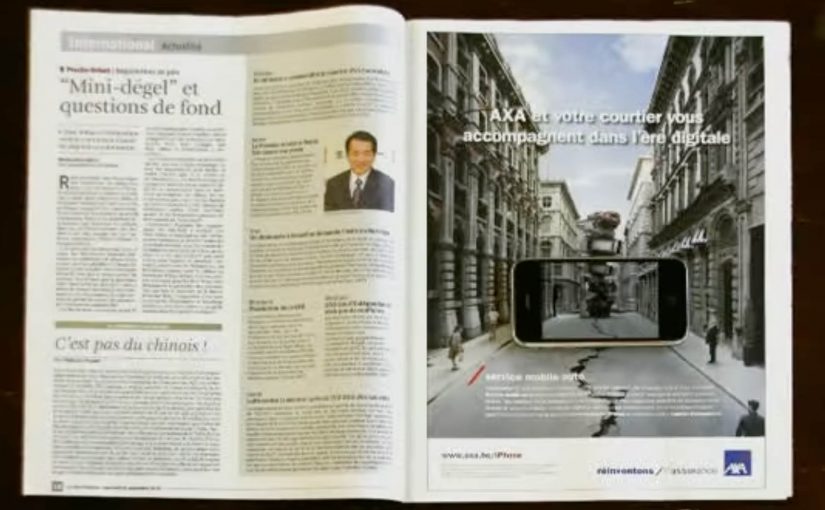
To launch this new app Duval Guillaume Antwerp / Modem from Belgium created an innovative print ad that required your iPhone to complete the message.

Why the print idea is a smart match

The product promise is practical. Help me when I am stressed and do not know what to do next. The launch mirrors that by making the iPhone essential to “finishing” the ad, so the viewer experiences the role of the phone immediately. Because the viewer has to use their own device to complete the message, the concept is remembered as help in the moment, not a feature claim. In European insurance marketing, the first interaction needs to make crisis guidance feel tangible.

Extractable takeaway: If your product is built for high-stress moments, design the launch so people experience the first step, not a promise about steps.

  • Device as the missing piece. The iPhone is not just where the app lives. It is how the message becomes complete.
  • Low barrier to understanding. You do one simple action and the concept clicks.
  • Print-to-mobile bridge. The campaign uses print to trigger a mobile behavior, instead of treating print as a dead end.

What to reuse from this approach

The real question is whether your launch makes someone feel guided before they have to believe you.

If the utility of your app is “guidance in a critical moment”, your launch should demonstrate guidance, not describe it. By “guidance”, I mean a few clear, step-by-step prompts that reduce decision load when people are stressed. A small, tangible interaction can do that faster than any list of features.

  • Start with one action. Give people a single, low-friction step that mirrors the moment your app is built for.
  • Make the device essential. Let the phone complete the story so the product role is experienced, not inferred.
  • Bridge media into behavior. Use the channel to trigger the next step, not just to carry copy.

A few fast answers before you act

What does the AXA Belgium iPhone app do?

It helps guide drivers through basic steps after a car accident, providing practical assistance when they need it most.

Who created the print launch ad?

Duval Guillaume Antwerp / Modem (Belgium) created the print execution to launch the app.

What made the print launch ad innovative?

The print execution required the viewer’s iPhone to complete the message, turning the phone into an active part of the ad rather than a separate channel.

Why is this a strong launch mechanic for an insurance app?

It demonstrates the phone’s role as a helper in-the-moment, which aligns directly with the app’s accident-assistance promise.

What is the transferable pattern?

Design a simple physical or media trigger that forces a first interaction with the device. Then let that interaction explain the product in seconds.