
Duracell Moments of Warmth: Heated bus shelter

Duracell Moments of Warmth: Heated bus shelter

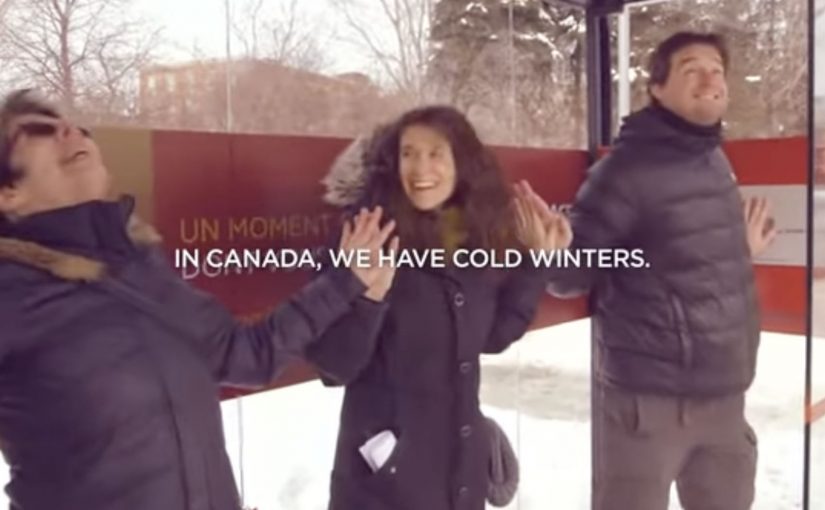
In a winter of ice storms and a polar vortex, moments of warmth are few and far between. So to change that, Duracell Quantum batteries in Canada retrofit a bus shelter with heaters, but the only way to get the heat to work is through a human connection, people joining their hands.

The shelter is set up so warmth only kicks in when two or more commuters complete a simple circuit by touching the contact points and holding hands in the middle.

Why “warmth you earn together” is the right mechanism

This idea works because the product promise is experienced, not explained. Because the heaters only turn on when strangers complete the circuit together, “power” turns into instant relief you can literally feel while you wait. This is the right pattern when you can prove your claim with a sensory payoff in under a minute.

Extractable takeaway: An ambient activation, meaning a brand experience built into the environment, lands fastest when the reward is physical and only unlocks through simple cooperation.

In cold-weather urban transit, small prompts that reward cooperation can turn waiting time into a shared moment, and into a brand story.

The real question is whether your interaction rule makes strangers coordinate in seconds without a staffer, a screen tutorial, or a social script.

What makes the interaction memorable

  • Clear rule in seconds. No app, no signup, no instructions beyond the physical cues.
  • Instant feedback. The reward is heat, right now, right where you are standing.
  • Social proof built in. Every new person who walks up sees the behavior and understands what to do.

Steal the cooperation trigger

  • Make the benefit tangible. If your claim is about performance, choose an output people can sense.
  • Use a cooperative trigger. Shared actions create a story people retell without prompting.
  • Keep the loop short. If it takes more than one minute to understand, street attention disappears.
  • Let the environment do the explaining. Physical design beats copy when you only have a few seconds.

A few fast answers before you act

What is “Duracell Moments of Warmth”?

It is an ambient bus shelter activation where heaters only activate when commuters connect physically, turning “power” into a felt experience.

How does the bus shelter get activated?

Two or more people complete a simple circuit by touching the shelter’s contact points while joining hands, which triggers the heating system.

Why does the hand-holding mechanic matter?

Because it forces cooperation. The brand benefit is delivered through a human moment, which makes the warmth feel earned and memorable.

What is the brand message in one sentence?

In cold winters you need power, and sometimes the best power comes from connecting with other people.

What is the main lesson for experiential marketing?

If you want people to remember a claim, make them participate in a mechanism that behaves like the claim.

WestJet: Christmas Miracle

WestJet: Christmas Miracle

A Christmas moment built for the worst part of travel

Airports during the holiday season are generally filled with tired, disgruntled people facing delays, lost luggage, and a long list of small mishaps. WestJet uses that exact setting to deliver a Christmas miracle at the point where people least expect anything good to happen. The baggage belt.

With the help of a virtual Santa Claus, the airline asks unsuspecting passengers waiting to board flights to Calgary from Toronto and Hamilton International Airports what is on their Christmas wishlists.

Then more than 150 WestJet employees play Santa’s elves, gathering personalized presents and delivering them to the Calgary airport before the passengers land. At baggage claim, the carousel brings the surprise to life and the travelers receive their holiday miracle.

The mechanic that turns “nice idea” into a real surprise

The work is not the Santa screen. The work is the fulfillment race. Capture wishes at the departure gate, buy the gifts immediately, clear logistics fast enough to beat a flight, and make the reveal happen at a single shared moment where everyone is already looking in the same direction.

That last detail matters. Baggage claim is a forced wait with a fixed focal point. When the surprise arrives there, the reaction is collective, contagious, and easy to film without feeling staged.

In service brands, the fastest way to earn trust is to transform a routine pain point into a visibly human act of care.

Why it lands

It respects the viewer’s skepticism. People are used to holiday messages. They are not used to holiday logistics that actually deliver. The story also stays legible even if you miss the setup. You see gifts on a baggage belt, you see genuine reactions, and you instantly understand the promise being made about the brand. The real question is not whether a holiday message can feel warm, but whether the brand can operationalize that warmth in a way people instantly believe.

Extractable takeaway: If you want surprise-and-delight to travel, design the reveal around a shared focal point, then make the fulfillment real enough that people would talk about it even without a camera.

Not their first airport Christmas

This is not WestJet’s first attempt at spreading airport Christmas cheer. The year before, the airline created a Christmas-themed flash mob, complete with dancing elves, right in the middle of an airport.

A final note to close the year

And with that, a very Merry Christmas and a Happy New Year. Here is a lovely remake of “Little Drummer Boy” by Pentatonix to bring this last Ramble of the year to a close.

What service brands should steal from WestJet’s reveal

  • Pick a moment everyone already shares. The best reveal locations are places where attention naturally converges.
  • Make the operational proof the message. The buying, wrapping, and delivery speed is the real differentiator.
  • Engineer one clean narrative arc. Ask. Fulfill. Reveal. React. Do not clutter it with subplots.
  • Let the audience do the advocacy. When people feel genuinely seen, they narrate it for you.

A few fast answers before you act

What is WestJet’s “Christmas Miracle” execution?

Passengers share their Christmas wishlists with a virtual Santa at the departure airport, then those gifts appear for them at baggage claim after landing, turning a routine airport wait into a shared surprise moment.

Why does baggage claim work as the reveal location?

It is a forced wait with a single focal point. Everyone is already watching the same place, so the surprise becomes collective and instantly memorable.

What is the core mechanic behind the campaign?

Real-time fulfillment. Capturing wishes is easy. Buying, wrapping, transporting, and staging gifts before the flight lands is the proof that makes the story credible.

What makes this more shareable than a typical holiday ad?

The reactions read as unmistakably real, and the narrative is simple enough to retell in one sentence without explanation.

What is the main lesson for other brands?

Transform a predictable pain point into a visible act of care, then design the reveal so it happens in a shared moment people naturally witness together.

Volkswagen Canada: The Great Art Heist

Volkswagen Canada: The Great Art Heist

They say that beauty is in the eye of the beholder. But if Volkswagen Canada has their say, beauty will be in the hands of the person who’s stealing it. That is the idea behind this ambient-meets-social campaign for the Volkswagen Jetta GLI.

Since the beginning of October, agency Red Urban has created a series of pop-up art galleries across major cities in Canada that feature “light paintings” made by the movement of the Volkswagen Jetta. These light paintings are long-exposure photographs that turn headlight and taillight trails into abstract artwork.

While the frames in the exhibits have been hung for all to admire, they have not been hung that securely, allowing more daring admirers to claim the artwork for themselves. The “thieves” are then asked to share their stolen items via Tweets and Facebook posts. Volkswagen Canada’s Facebook page starts receiving photos from fans decorating homes and offices with the imagery.

When out-of-home becomes a participation prompt

The mechanism is a deliberate temptation loop. By that, I mean the setup places something desirable in public and makes acting on that impulse part of the idea. Place desirable objects in public. Make them easy to take. Then turn the taking into the call to action, with social sharing as the proof layer. The “gallery” is the stage. The heist is the interaction. The reposted photos are the distribution.

In automotive launch marketing, giving people something physical to claim and display can turn attention into advocacy faster than conventional ads.

The real question is how to turn a static display into an action people want to repeat and publicize.

Why it lands

This works because it flips the normal rules of outdoor advertising. Instead of “look at this and move on”, the frame invites a decision and a story. The act of taking the artwork creates instant ownership, and ownership makes people far more likely to post, discuss, and keep the brand in the room. The strongest move here is not the gallery format but the permission to take the media home.

Extractable takeaway: If you can transform a passive medium into a “take it, show it” mechanic, you convert exposure into participation. Participation creates proof, and proof drives organic reach.

What to steal from this activation

  • Make the object desirable on its own: if the item is genuinely display-worthy, people will do the promotion for you.
  • Use a single rule: “take it and share it” is easy to understand and easy to repeat.
  • Build for accumulation: the more stolen pieces show up online, the more the campaign feels real and alive.
  • Let the audience finish the media buy: the repost is the real multiplier, not the initial placement.
  • Manage the ethics upfront: the line between playful permission and real theft must be unambiguous in execution.

A few fast answers before you act

What is the “Great Art Heist” idea?

It is a pop-up street gallery of framed “light painting” photos tied to the Volkswagen Jetta GLI, where passersby are implicitly encouraged to take a frame and share it socially.

What are “light paintings” in this campaign?

They are long-exposure photographs capturing the car’s headlight and taillight trails, producing abstract, art-like images.

Why does encouraging people to take the artwork work?

Because it creates ownership and a personal story. Once someone has the piece, sharing becomes natural and the brand becomes part of their environment.

Is this more out-of-home or more social?

Both. Out-of-home provides the physical trigger and scarcity. Social sharing provides proof and scale.

What is the biggest risk with a “steal it” mechanic?

Misinterpretation. If permission is not clear, the idea can feel irresponsible. The execution must make the intended rules obvious to avoid negative backlash.