
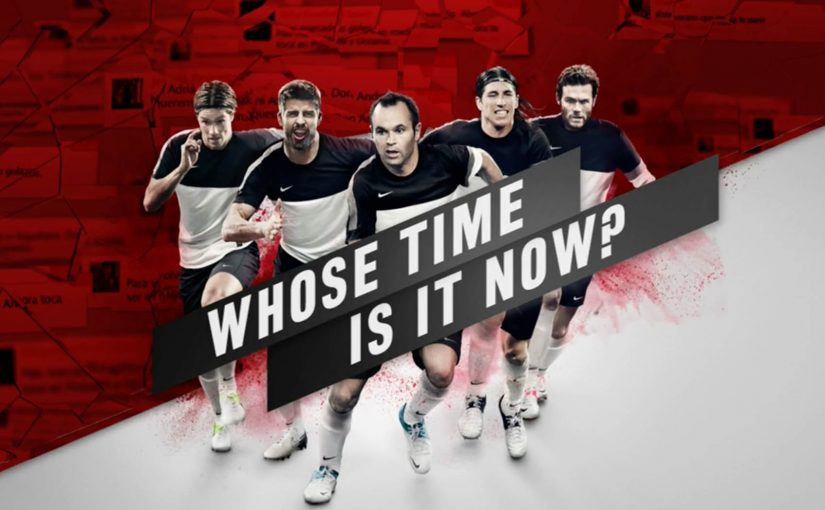
Nike Football “My time is now”

Nike Football “My time is now”

In Puerta del Sol, Madrid’s epicenter, a huge Nike “static” banner behaves like a live scoreboard. As Euro 2012 conversations spike, the face on the banner changes. Each day, the Spanish player who dominates social chatter becomes the protagonist on the canvas. Two fan messages appear alongside him, selected from submissions flowing in through Nike’s Facebook experience.

What the campaign does in public

Turn real-time social conversation into real-world status. Then make “My Time Is Now” visible, in public, every day.

What Nike and DoubleYou build during Euro 2012

Nike works with DoubleYou on a real-time social media monitoring campaign focused on Spanish national-team players. The system tracks mentions and engagement across Facebook and Twitter, then turns that data into a live ranking.

Fans see the leaderboard through a custom Facebook app integrated into Nike Football Spain. The ranking updates continuously, creating a daily “who owns the moment” race that mirrors what is happening on the pitch.

How it works

Step 1. Capture the conversation in real time

The activation monitors references to players across Twitter and Facebook.

Step 2. Translate the conversation into a live ranking

Inside the Facebook experience, the campaign visualizes comments and produces an automatically updated ranking of who is generating the most conversation, refreshed minute by minute.

Step 3. Publish the result into the physical world

Each day, the player who attracts the most social conversation becomes the ambassador of Nike’s message “My Time Is Now” on the large-format placement in Puerta del Sol. A static billboard turns into an interactive billboard because it is connected to the live social pulse.

Step 4. Let fans write onto the execution

From the app, fans also submit messages linked to the player of the day. Nike selects two of those messages and publishes them next to the player on the banner.

In sports sponsorship, the scalable advantage is not just hearing fan momentum, but turning it into a public signal people can rally around.

Why this is more than “social listening”

The real question is how to make live conversation feel consequential while the event is still unfolding. This is not monitoring for reporting. It is monitoring as a publishing engine. Nike turns fan conversation into a daily public decision about who carries the brand line. That mechanism works because it converts abstract buzz into visible status, giving fans a reason to watch, react, and return.

Extractable takeaway: Real-time marketing gets more powerful when the signal changes something public, visible, and easy to argue about, not when it just updates a dashboard.

The business intent is to keep fans returning to Nike’s owned experience during the tournament, while tying that repeat attention back to sponsored players and the brand line.

  • The social layer has consequence. The ranking determines who gets featured publicly.
  • The physical layer gives the digital behavior weight. People do not just see a number in an app. They see a player crowned in the center of Madrid.
  • The loop is fast enough to feel like sport. The leaderboard updates continuously, so fans experience momentum, not a static end-of-day recap.

The line that makes the whole thing sticky

At the end, the leading player is set to bear Nike’s message of “My Time Is Now”.

And the player is…

What to steal from Nike’s live ranking billboard

  • Turn chatter into a scoreboard: Convert real-time conversation into points people can instantly understand and debate.
  • Reward the behaviour you want repeated: Make fans check back by updating standings during the event, not after it.
  • Use sponsorship as a story engine: Anchor the mechanic to the athletes you sponsor so the brand connection stays tight.
  • Make the output social by default: Put the ranking in a format that is easy to share and argue about inside the platform.
  • End with a single “hero moment”: Let one clear winner carry the slogan so the campaign lands as a climax, not a dashboard.

A few fast answers before you act

What is the campaign in one sentence?

A real-time social monitoring system ranks Spanish players by conversation volume and makes the top player the daily face of a live billboard in Puerta del Sol.

Where do fans see the ranking?

Fans see the ranking in a custom Facebook app integrated into Nike Football Spain.

What makes this different from a normal “second screen” mechanic?

The data output is not just a dashboard. It changes a public, real-world media placement and publishes user messages alongside the hero player.

Why does the billboard matter more than the app alone?

The billboard turns digital attention into visible public status, so the campaign feels culturally present rather than trapped inside a social feed.

What is the repeatable pattern for brands?

If you can connect live signals to live publishing, you turn attention into status. That is how real-time becomes culturally meaningful.
TBWA Lisbon: Windows become Twitter billboard

TBWA Lisbon: Windows become Twitter billboard

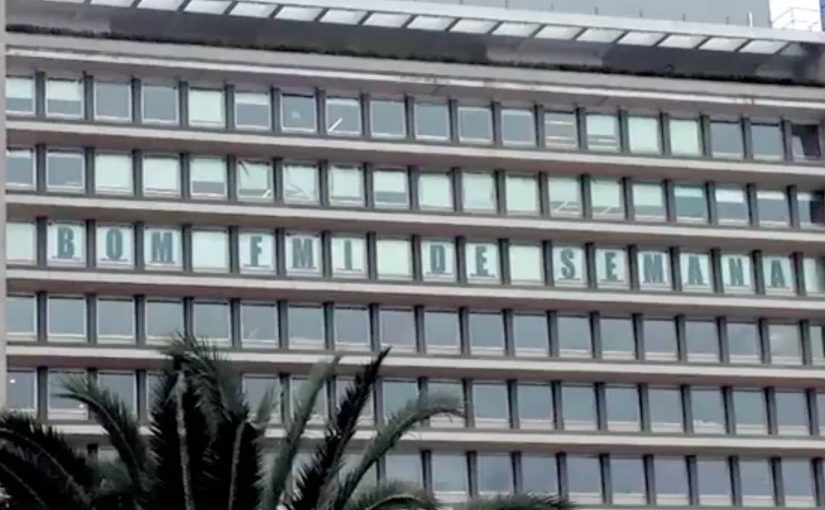
TBWA was the last agency to move to Lisbon’s advertising district. With their top competitors already there, they decided to showcase their creativity by turning 19 windows of their office into a 36m long Twitter billboard.

The stunt is simple in concept and bold in execution. The office becomes the medium. Instead of hiding behind a reception desk and a logo, the agency uses its own facade as a live publishing surface for the public street.

Turning an address into a live channel

The mechanism is real-time social content made physical. Tweets appear across the windows, transforming an office building into a public conversation layer. It is not “social amplification” in the usual sense. It is a direct translation from a digital feed into a street-level display.

In dense urban environments, public-facing digital surfaces work best when they make participation visible, immediate, and shared by everyone on the street.

The real question is whether your brand can turn participation into a public signal, not just another message people scroll past.

The video does not explain exactly how people were encouraged to send in their tweets, but it does show the breadth of what people shared. Tweets touch politics, taxes, Europe, Merkel’s visit, and more. That range matters because it signals that the billboard is not a branded script. It behaves like a live civic wall, meaning an open public message board where anyone can add a line and everyone on the street sees it.

Why it lands in an ad district full of competitors

When agencies cluster, sameness is the enemy. This activation works because it creates a visible signature at the point of competition. People do not have to be invited inside to experience TBWA. The building itself is performing in public, and the audience can participate without crossing a threshold.

Extractable takeaway: In a competitive cluster, your best differentiator is a street-level interface that makes participation visible to everyone nearby.

It also carries a little risk. Real-time public messages can be messy. That tension is part of the attention engine. It feels alive because it is not perfectly controlled.

The intent: differentiate through public participation

The business intent is positioning. TBWA is signalling modernity, openness, and confidence in real-time ideas. The agency is also using the street as a distribution channel to generate talk, foot traffic, and press interest.

A live, participatory facade is a stronger differentiator here than another logo on glass, because people can experience the idea without being invited in.

And it worked. In the end, all the window tweeting created quite a stir in the local media.

Practical moves from the Twitter window billboard

  • Use your own real estate. If you have a facade, treat it as media, not architecture.
  • Make digital physical. The jump from screen to street creates instant novelty.
  • Design for participation. People engage more when they can see themselves appear in public space.
  • Accept a little mess. Real-time content feels credible because it is not overly polished.
  • Build for earned media. A visible public installation gives journalists something to film, not just to quote.

A few fast answers before you act

What is the TBWA Lisbon Twitter billboard?

It is a facade activation that turned 19 office windows into a 36m long display showing tweets in public, effectively making the building a live billboard.

Why does turning tweets into a window display work?

Because it makes online conversation visible in a shared physical space, which creates surprise, participation, and social proof.

How did it create attention beyond the street?

The visibility and real-time nature made it easy for people and local media to capture and share, turning a building into a story.

Is this more about branding or engagement?

Both. The engagement mechanic is participation, but the branding outcome is differentiation and positioning in a competitive district.

What is the key takeaway for agencies and brands?

If you want to stand out locally, build a public interface that lets people contribute and be seen. It creates talk faster than self-promotion.

Fiat 500 America: TwitBid Twitter Auction

Fiat 500 America: TwitBid Twitter Auction

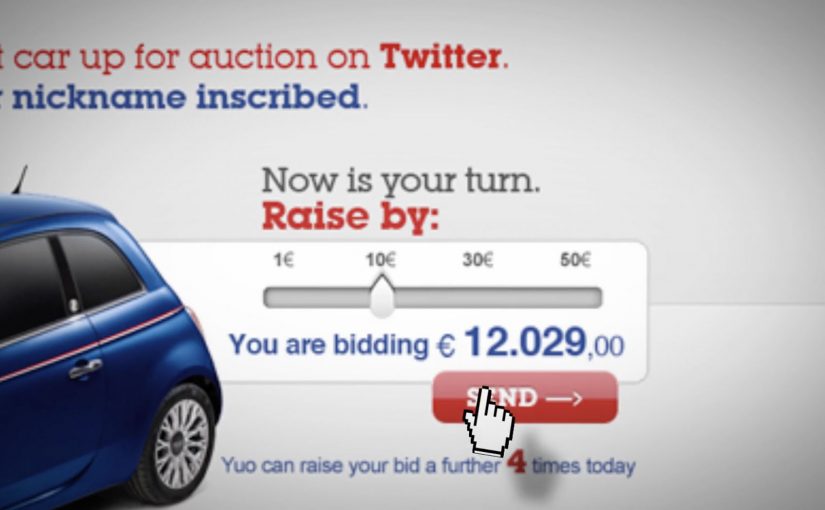
Fiat unveiled an exclusive limited edition run of 500 cars inspired by U.S. style at the Geneva Motor Show. Then, through a Twitter based auction, they made it possible to win the “number one” car (distinguished by a badge on the external pillar bearing the serial number 1/500 and the winner’s Twitter nickname) starting from a bid of €1.

To win the Fiat, participants were directed to follow @fiatontheweb on Twitter and then place a bid at www.500America.fiat500.com using their Twitter account. As a result, Fiat received 700 bids from 293 users, across 11 countries. A Twitter follower with a bid of €15,165 was declared the winner of the limited edition Fiat 500 America.

TwitBid turns a car launch into a public scoreboard

TwitBid is a Twitter-linked auction mechanic where each bid is tied to a visible handle. The smartest part is not the auction itself. It is the visibility layer. A bid is not a private transaction step. It becomes a social signal tied to an identity, which encourages escalation and turns the bidding ladder into content other people can watch unfold.

In brand launches with collector energy, mechanics that let fans compete in public create more momentum than mechanics that keep participation hidden.

What the mechanism is really doing

  • Make entry frictionless. The opening bid starts at €1, which makes “having a go” feel low risk.
  • Use identity as fuel. Bids are placed via Twitter, so the participant’s handle becomes part of the story.
  • Turn the object into proof. The “number one” car carries a visible 1/500 marker and the winner’s nickname, which makes the win feel permanent and collectible.

In global consumer launches where scarcity is real, a public scoreboard can turn a product drop into shared entertainment.

Why it lands

The real question is whether your launch mechanic turns every participant move into something other people can see. Most automotive launches ask people to admire. This one asks people to compete. The auction format creates scarcity pressure, and the Twitter layer adds social proof. Even if you do not bid, you can still follow the narrative of who is winning and how high it goes.

Extractable takeaway: If you want real participation, attach identity to action and make progress public. People engage longer when their move is visible, comparable, and tied to status.

What Fiat is really buying with this

The obvious outcome is a high price for the first car. The deeper outcome is attention that behaves like earned media. Each bid acts like a micro-broadcast, and the “number one” badge ties the online moment back to a physical artifact. That is a clean bridge between social platforms and product storytelling.

Launch moves to copy from TwitBid

  • Pick one scarce artifact. A single “first off the line” item is easier to explain than multiple prizes.
  • Make the ladder visible. Competition needs a scoreboard, not a form.
  • Build identity into the reward. A name, handle, or serialisation marker increases perceived ownership value.
  • Engineer the minimum increment. Small step sizes keep the contest active and make it feel winnable.

A few fast answers before you act

What is TwitBid in plain terms?

It is a Twitter-linked online auction where people place bids using their Twitter account to compete for a specific limited-edition item.

Why tie bidding to Twitter instead of a normal auction site?

Because every bid is tied to an identity and can become visible in the social stream, which increases reach and reinforces the competition dynamic.

What makes the “number one” car feel more valuable than the other 499?

It is positioned as the first unit off the line and visibly marked with serial number 1/500 plus the winner’s nickname, which makes it a one-off collectible.

What is the biggest risk with social auctions?

Friction and trust. If sign-in, bidding, or confirmation steps are unclear, participation drops. If rules feel opaque, the brand takes reputational damage.

What should you measure if you run a similar mechanic?

Unique bidders, bids per bidder, bid velocity over time, conversion from followers to registrants, and how much incremental reach the bidding activity creates versus paid media.