
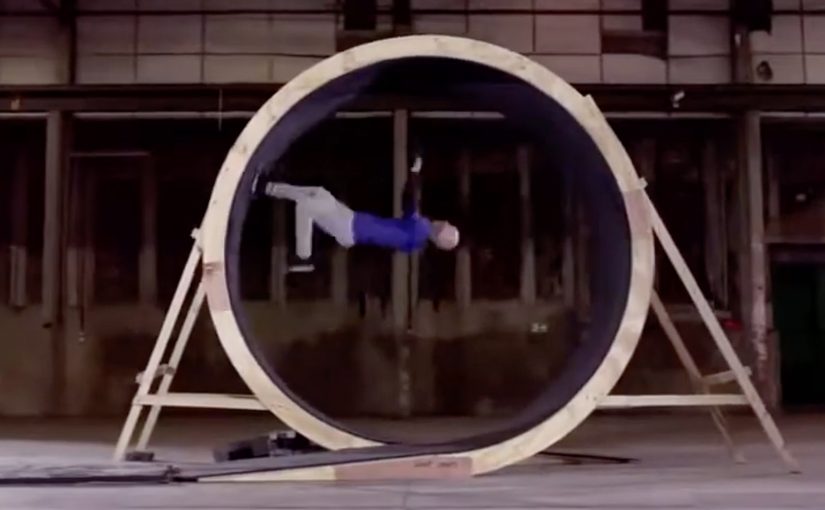
Pepsi Max: Human Loop

Last year, Pepsi Max for its ongoing #LiveForNow campaign created an unbelievable bus levitation stunt. Now continuing this “unbelievable feats and experiences” brand positioning, they challenged daredevil stuntman, Damien Walters to do another unbelievable stunt for them. Here, positioning means the single promise the brand wants people to remember and retell.

Pepsi Max provided Damien with a human-sized loop-the-loop in an abandoned warehouse and then got him to defy gravity for them…

In global FMCG marketing, stunts like this earn value when they reinforce an existing brand platform, not when they try to create one from scratch.

Why this stunt fits the brand

The mechanism is simple. A clearly defined physical challenge, executed by credible talent, makes the “unbelievable” promise feel real because the payoff is visible without narration.

Extractable takeaway: If your positioning is a claim, design one repeatable moment that functions as proof, then film it so the viewer can verify it without explanation.

  • It commits to the promise. “Unbelievable” is not a line here. It is the product.
  • It is instantly legible. You understand the challenge in one second, then you watch to see if it is possible.
  • It is built for replay. Stunts invite rewatching, pausing, and sharing because people want to verify what they saw.

How to make the stunt behave like proof

The real question is whether your brand promise can be proven in one obvious moment on camera.

This kind of spectacle earns its keep only when it is a direct proof point for an ongoing platform, not a disconnected attempt at “random viral”.

If your positioning is about experiences, you need executions that behave like proof. This kind of spectacle works when the idea is simple, the talent is credible, and the payoff is visible without explanation.

  • Make the promise behave like proof. If positioning is about experiences, the execution should demonstrate it, not describe it.
  • Keep the idea simple and the payoff visible. The viewer should understand the challenge instantly and see the outcome without explanation.
  • Use credible talent, then shoot for replay. Stunts invite rewatching, pausing, and sharing when people want to verify what they saw.

A few fast answers before you act

What is Pepsi Max “Human Loop”?

It is a Pepsi Max #LiveForNow stunt featuring Damien Walters attempting a human-sized loop-the-loop setup inside an abandoned warehouse.

Why does a loop-the-loop stunt perform so well in video?

The challenge is obvious, the risk feels real, and the outcome is visually conclusive, which makes it highly shareable.

What is the core pattern behind this kind of campaign?

Make the brand promise measurable in one moment, then capture it cleanly so the viewer does not need context to understand it.

How do you keep stunts from feeling like “random viral”?

Anchor them to an ongoing brand platform, use consistent talent and tone, and make each execution feel like a credible next chapter.

When should you avoid a stunt-led proof moment?

Avoid it when the idea cannot be understood instantly, the talent is not credible, or the execution does not ladder up to an ongoing brand platform.

Bud Light: Ian Up for Whatever

Super Bowl ads are the miniature version of the film industry. There is huge money involved and brands are torn between creating something new and noteworthy or falling back on established formulas.

So for its 2014 Super Bowl commercial, Bud Light throws in a stack of famous faces including Arnold Schwarzenegger, Don Cheadle, and Minka Kelly, plus one unsuspecting “normal guy” called Ian Rappaport. The story is built as a rapid escalation. One small choice becomes a night that keeps getting stranger, bigger, and more unbelievable.

A stunt disguised as a spot

The mechanism is simple and ruthless. A regular guy is offered a Bud Light and asked if he is “up for whatever’s next”. Then the ad turns into a filmed chain reaction of increasingly absurd moments, reported as captured with hidden-camera choreography rather than traditional performance. The celebrity cameos are not decoration. They are the accelerant that keeps raising the stakes.

In US mass-reach advertising, Super Bowl spots act as high-budget cultural moments where brands compete on surprise, talk value, and rewatchability.

Why it lands

This works because it behaves like a dare the viewer can imagine accepting. The idea is not “Bud Light tastes better”. The idea is “your night can go anywhere”. Ian is the audience proxy, so every escalation feels like it is happening to you, not to a paid spokesperson.

Extractable takeaway: When you want a broad audience to share your story, give them a single, relatable choice at the start, then let that choice trigger visible escalation. The audience should understand the rule in one sentence and predict the next beat, then still be surprised by the size of the payoff.

What Bud Light is buying with this format

The real objective is platform reset, meaning one mass-reach moment that makes a positioning line feel newly believable. The real question is whether the brand feels like the trigger for spontaneity or just the label attached to it. Bud Light gets this right because the brand behaves like the trigger for the entire experience, not a sponsor bolted on afterward. “Up for Whatever” is a positioning line that needs proof, not repetition. This spot supplies proof by turning the brand into the permission slip for spontaneity, and by using celebrity not as endorsement but as narrative fuel.

What to steal from Bud Light’s escalation playbook

  • Cast the audience, not a hero. Use an everyperson lead so the fantasy feels attainable.
  • Make escalation the structure. A clear upward curve keeps attention better than a clever line alone.
  • Use fame as a plot device. Cameos should change the situation, not just decorate the frame.
  • Anchor the brand to the first decision. If the brand is the trigger, it earns credit for the whole ride.

A few fast answers before you act

What is “Ian Up for Whatever”?

It is Bud Light’s 2014 Super Bowl commercial built around a regular guy, Ian Rappaport, who gets pulled into a celebrity-filled night after agreeing to be “up for whatever’s next”.

What is the core creative mechanism?

Hidden-camera style escalation. One small choice triggers a chain of increasingly surprising moments, reinforced by celebrity cameos.

Why does the “normal guy” casting matter?

It makes the audience project themselves into the situation. The fantasy becomes “this could happen to me”, not “this is happening to a spokesperson”.

What does the ad actually sell?

Positioning. Bud Light as the beer that fits whatever happens, rather than a functional product claim.

How can a brand replicate the pattern without copying the stunt?

Start with one relatable choice, design a clear escalation curve, and ensure each beat is a consequence of the choice, not a random sequence of gags.

WestJet: Christmas Miracle

A Christmas moment built for the worst part of travel

Airports during the holiday season are generally filled with tired, disgruntled people facing delays, lost luggage, and a long list of small mishaps. WestJet uses that exact setting to deliver a Christmas miracle at the point where people least expect anything good to happen. The baggage belt.

With the help of a virtual Santa Claus, the airline asks unsuspecting passengers waiting to board flights to Calgary from Toronto and Hamilton International Airports what is on their Christmas wishlists.

Then more than 150 WestJet employees play Santa’s elves, gathering personalized presents and delivering them to the Calgary airport before the passengers land. At baggage claim, the carousel brings the surprise to life and the travelers receive their holiday miracle.

The mechanic that turns “nice idea” into a real surprise

The work is not the Santa screen. The work is the fulfillment race. Capture wishes at the departure gate, buy the gifts immediately, clear logistics fast enough to beat a flight, and make the reveal happen at a single shared moment where everyone is already looking in the same direction.

That last detail matters. Baggage claim is a forced wait with a fixed focal point. When the surprise arrives there, the reaction is collective, contagious, and easy to film without feeling staged.

In service brands, the fastest way to earn trust is to transform a routine pain point into a visibly human act of care.

Why it lands

It respects the viewer’s skepticism. People are used to holiday messages. They are not used to holiday logistics that actually deliver. The story also stays legible even if you miss the setup. You see gifts on a baggage belt, you see genuine reactions, and you instantly understand the promise being made about the brand. The real question is not whether a holiday message can feel warm, but whether the brand can operationalize that warmth in a way people instantly believe.

Extractable takeaway: If you want surprise-and-delight to travel, design the reveal around a shared focal point, then make the fulfillment real enough that people would talk about it even without a camera.

Not their first airport Christmas

This is not WestJet’s first attempt at spreading airport Christmas cheer. The year before, the airline created a Christmas-themed flash mob, complete with dancing elves, right in the middle of an airport.

A final note to close the year

And with that, a very Merry Christmas and a Happy New Year. Here is a lovely remake of “Little Drummer Boy” by Pentatonix to bring this last Ramble of the year to a close.

What service brands should steal from WestJet’s reveal

  • Pick a moment everyone already shares. The best reveal locations are places where attention naturally converges.
  • Make the operational proof the message. The buying, wrapping, and delivery speed is the real differentiator.
  • Engineer one clean narrative arc. Ask. Fulfill. Reveal. React. Do not clutter it with subplots.
  • Let the audience do the advocacy. When people feel genuinely seen, they narrate it for you.

A few fast answers before you act

What is WestJet’s “Christmas Miracle” execution?

Passengers share their Christmas wishlists with a virtual Santa at the departure airport, then those gifts appear for them at baggage claim after landing, turning a routine airport wait into a shared surprise moment.

Why does baggage claim work as the reveal location?

It is a forced wait with a single focal point. Everyone is already watching the same place, so the surprise becomes collective and instantly memorable.

What is the core mechanic behind the campaign?

Real-time fulfillment. Capturing wishes is easy. Buying, wrapping, transporting, and staging gifts before the flight lands is the proof that makes the story credible.

What makes this more shareable than a typical holiday ad?

The reactions read as unmistakably real, and the narrative is simple enough to retell in one sentence without explanation.

What is the main lesson for other brands?

Transform a predictable pain point into a visible act of care, then design the reveal so it happens in a shared moment people naturally witness together.