
Ford C-Max Augmented Reality

Ford C-Max Augmented Reality

A shopper walks past a JCDecaux Innovate mall “six-sheet” screen (poster-format) and stops. Instead of watching a looped video, they raise their hands and the Ford Grand C-MAX responds. They spin the car 360 degrees, open the doors, fold the seats flat, and flip through feature demos like Active Park Assist. No printed marker. No “scan this” prompt. Just gesture and immediate feedback.

What makes this outdoor AR execution different

This is where augmented reality in advertising moves from a cool, branded desktop experience to a marker-less, educational interaction in public space. Marker-less here means the experience does not need a printed marker or “scan this” prompt to start. The campaign, created by Ogilvy & Mather with London production partner Grand Visual, runs on JCDecaux Innovate’s mall digital screens in UK shopping centres and invites passers-by to explore the product, not just admire it.

The interaction model, in plain terms

Instead of asking people to download an app or scan a code, the screen behaves like a “walk-up showroom.”

  • Hands up. The interface recognises the user and their gestures.
  • Virtual buttons. On-screen controls let people change colour, open doors, fold seats, rotate the car, and trigger feature demos.
  • Learning by doing. The experience is less about spectacle and more about understanding what the 7-seat Grand C-MAX offers in a few seconds.

How the marker-less AR works here

The technical leap is the move away from printed markers or symbols as the anchor for interaction. The interface is based on natural movement and hand gestures, so any passer-by can start immediately without instructions.

Under the hood, a Panasonic D-Imager camera measures real-time spatial depth, and Inition’s augmented reality software merges the live footage with a 3D, photo-real model of the Grand C-MAX on screen.

Because the interface responds to natural hand movement, the interaction starts without instruction and keeps the focus on learning the product, not learning the UI.

In retail and out-of-home environments, interactive screens win when they eliminate setup friction and teach the product in seconds.

The real question is whether your outdoor screen is a passive impression machine or a walk-up product experience that teaches in under 30 seconds.

Why this matters for outdoor digital

If you care about outdoor and retail-media screens as more than “digital posters,” this is a strong pattern. This pattern is worth copying: design for viewer control and fast product education, not just looping impressions.

Extractable takeaway: Remove setup friction first, then use a small set of high-value interactions to teach one product truth quickly.

  • Lower friction beats novelty. The magic is not AR itself. The magic is that the user does not need to learn anything first.
  • Gesture makes the screen feel “alive.” The moment the passer-by sees the car respond, the display stops being media and becomes a product interface.
  • Education scales in public space. Showing how seats fold, how doors open, or what a feature demo looks like is hard to compress into a static ad. Interaction solves that.

Practical takeaways if you want to build something like this

  • Design for instant comprehension. Assume 3 seconds of attention before you earn more. Lead with one obvious gesture and one obvious payoff.
  • Keep the control set small. Colour, rotate, open, fold. A few high-value actions beat a deep menu.
  • Treat it like product UX, not campaign UX. The success metric is “did I understand the car better,” not “did I watch longer.”
  • Instrument it. Track starts, completions, feature selections, and drop-offs. Outdoor can behave like a funnel if you design it that way.

A few fast answers before you act

What is the core innovation here?

Marker-less, gesture-driven AR on mall digital screens that lets passers-by explore product features without scanning a code or using a printed marker.

What does the user actually do?

They raise their hands to start, then use on-screen controls to change colour, open doors, fold seats, rotate the car, and trigger feature demos like Active Park Assist.

What technology enables it?

A depth-imaging camera measures real-time spatial depth, and AR software merges live footage with a 3D model of the vehicle.

Why does “marker-less” matter in public spaces?

Because it removes setup friction. Anyone walking by can immediately interact through natural movement and gestures.

What should you measure to know it worked?

Track starts, completions, feature selections, and drop-offs so you can see which interactions people choose and where they bail out.
Honda Jazz Interactive TV Ad

Honda Jazz Interactive TV Ad

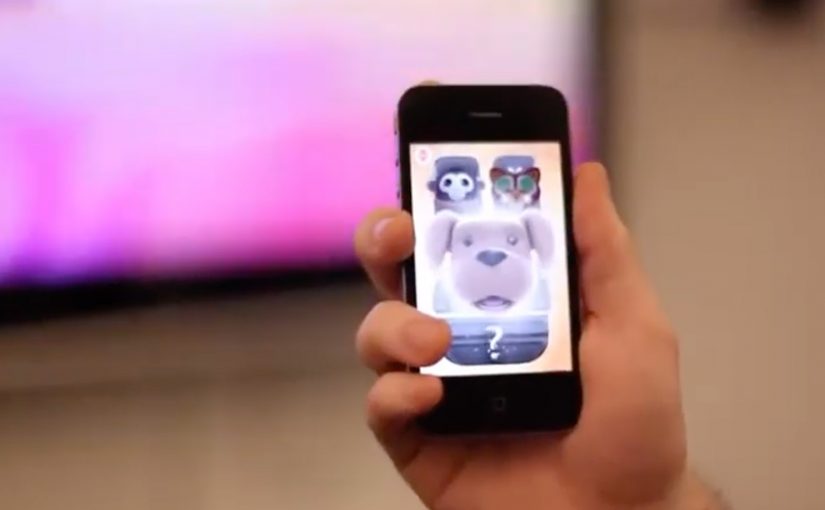
You watch the Honda Jazz “This Unpredictable Life” TV spot. At the same time, you open a companion iPhone app and literally “grab” what is happening in the ad. A character jumps onto your phone in the exact moment it appears on TV. Then you take that character with you and keep playing after the commercial ends.

Wieden + Kennedy London is behind this interactive TV campaign for the new Honda Jazz. The idea is simple and sharp. Use the iPhone as a second screen that syncs to the broadcast and turns a passive spot into a real-time experience. Here, “second screen” means the phone becomes the companion interface while TV stays the primary video canvas.

What the iPhone app does while the ad plays

The mechanic is “screen hopping.” The iPhone app recognises the sound from the TV ad and matches it to predefined audio fingerprints. That timing tells the app exactly which character or moment is live in the commercial, so it can surface the right interactive content on your phone in real time. Because the sync is driven by the ad’s audio, the handoff can happen on the exact beat the viewer sees on TV, which is what makes the interaction feel seamless.

In European consumer-brand marketing teams, this pattern matters most when broadcast reach and mobile engagement are owned and designed as one experience.

The real question is whether your second-screen sync can stay instant and obvious enough to feel like part of the spot, not a separate product.

What happens after you “grab” a character

Once a character lands on your iPhone, you interact with it away from the TV. You can trigger behaviours and mini-interactions, including singing into the phone to make characters react and dance. The TV spot becomes the gateway. The mobile experience becomes the engagement layer you keep.

Why this matters for interactive advertising

This is a clear step toward campaigns that treat broadcast as the launchpad and mobile as the control surface. When the second screen is tightly synchronised, you can design moments that feel native to the content people are already watching, rather than forcing a separate “go online later” call-to-action. This is worth doing when the sync is instant and the post-spot interaction is fun enough to continue without the TV.

Extractable takeaway: If you want broadcast to create action, design the mobile handoff so it happens on the same beat the viewer sees on TV, then give the phone a simple loop that keeps going after the spot ends.

This is also not the first time an iPhone engagement model starts to bridge media and action. A related example uses a similar iPhone-led interaction pattern for coupons and augmented reality: location based augmented reality coupons.

Design cues to reuse from this campaign

  • Anchor everything on a single trigger. Let the TV spot be the trigger, and let the phone pick up the same moment without delay.
  • Make the interaction obvious in one move. “Grab a character” is a clean mental model that needs almost no instructions.
  • Carry the payoff beyond the broadcast window. Treat the spot as the gateway and the phone as the layer that continues after the ad ends.
  • Keep the experience playful, not feature-heavy. Simple behaviours and reactions beat complex menus when timing is the point.

A few fast answers before you act

What is “screen hopping” in advertising?

Screen hopping is when content “jumps” from one screen to another during a live experience. Here, the TV spot triggers synchronized content on an iPhone so viewers can capture and interact with elements of the ad.

How does the Honda Jazz app sync to the TV commercial?

The app uses audio recognition. It matches the ad’s sound to predefined audio patterns so it knows what is playing at any moment and can show the right character or interaction on the phone.

What is the value of a second-screen experience like this?

It extends a short broadcast moment into a longer engagement loop. The ad becomes a gateway. The phone becomes the interactive layer that continues before, during, and after the spot.

What should a brand get right to make this work?

Timing and simplicity. The sync must feel instant, the interaction must be obvious, and the “reward” for participating must be fun enough to carry beyond the TV moment.

Carlsberg: Probably the Best Ad in the World

Carlsberg: Probably the Best Ad in the World

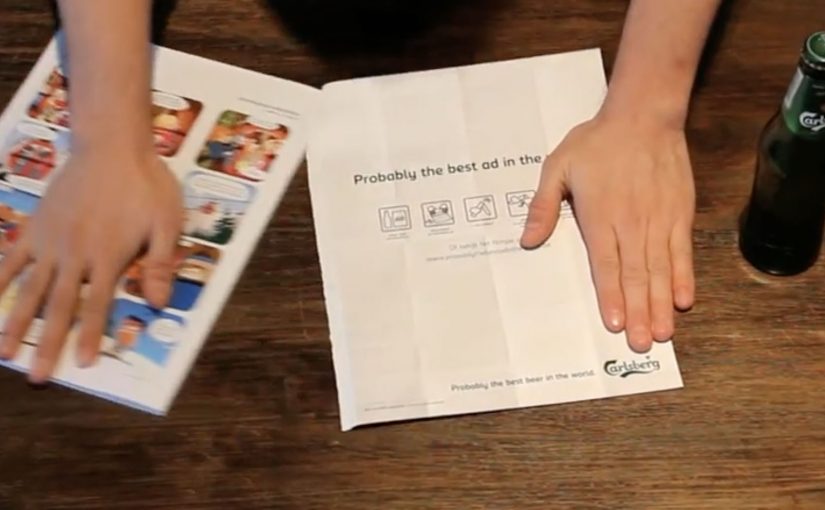
You can debate the effectiveness of magazine advertising all day long, but this Carlsberg ad from Belgian agency Duval Guillaume is undeniably useful. The advertisement reportedly appeared in Men’s magazine Menzo. Follow its instructions and you can use the flimsy piece of paper to open a bottle of Carlsberg.

How the idea is built

The mechanic is the message: the page is not just media. It is a tool. The ad teaches you how to tear and fold it into a working opener, which turns “try the product” into a physical action inside the magazine.

In print-led FMCG marketing, the fastest way to earn attention is to make the medium do something the viewer can immediately test.

The real question is whether your medium can deliver proof, not promises.

Why it lands

It turns a claim into proof. There is no argument to win and no feature list to remember. You either open the bottle, or you do not.

Extractable takeaway: Interactive print works when the action is the demonstration. Here, “interactive print” means the paper itself triggers a physical action, not just reading or looking. If the audience can do the product benefit with their hands in under a minute, the ad becomes memorable because it turns attention into a small personal “win”.

It forces participation. The reader cannot stay passive. The ad only completes itself when someone follows the instructions.

It earns a second look. Utility creates curiosity. People keep it, show it, and try it, which is the opposite of how most print gets treated.

Try it out yourself by downloading the advertisement from: www.probablythebestadintheworld.be.

But does it make this “probably the best ad in the world”? Not if you consider the likely inspiration below. The video shows someone using a piece of paper to open a bottle of Carlsberg.

Steal this: make the page a tool

  • Make the medium carry the benefit. If the product is about a moment. Build an execution that creates that moment.
  • Keep the instruction set frictionless. Fewer steps. Clear folds. Obvious success condition.
  • Design for sharing in the real world. The best print innovations get passed around physically before they get shared digitally.

A few fast answers before you act

What makes this print ad “interactive”?

It is not just read. It is folded into a functional bottle opener, so the reader completes the ad by doing something.

Why is a bottle-opener mechanic effective for beer?

It links the ad directly to the consumption moment. The ad becomes part of opening the product, not just talking about it.

Does utility automatically make a print ad effective?

It improves attention and memorability, but effectiveness still depends on distribution and whether people actually try it.

What is the biggest risk with “useful” print ideas?

If the build is fiddly or fails, the novelty collapses. The interaction must work reliably with minimal effort.

What is the most transferable lesson for advertisers?

When possible, replace messaging with demonstration. If the audience can experience the benefit through a simple action, persuasion gets easier.