
Norwegian Airlines: Red Cab Remote Taxi

A shopper in an Oslo mall steps up to a big screen and “hails” a cab in New York City. Seconds later, they are effectively riding along in real time, steering what they see and getting a guided tour from someone inside the taxi.

Remote sightseeing as a route launch

Norwegian Airlines creates an interactive experience that lets visitors in an Oslo shopping mall control a New York City taxi in real time. A tour guide inside the cab helps participants discover New York while building awareness of Norwegian’s direct long-haul destinations from Oslo to New York, Miami, LA, San Francisco, and Bangkok.

The mechanism: viewer control, live feed, human guide

The activation is built like a two-way window. A live camera setup in the taxi transmits the streets of New York back to the mall installation, and mall visitors can influence what they are seeing while talking with the person in the cab who keeps the “tour” moving. Here, viewer control means the participant can steer the camera’s attention and request what the cab shows next. That matters because even light control makes the experience feel personal, which turns passive watching into active participation.

It is also described as an M&C Saatchi Stockholm idea with production support from Stopp, using a 360-degree style camera approach to make the feed feel explorable rather than like a fixed livestream.

In European airline marketing, real-time remote experiences can make new long-haul routes feel tangible before anyone commits to a flight.

Why this lands

This works because it turns a schedule update into a lived moment. People do not just hear “we fly direct.” They experience the destination, live, in a way that creates an instant story to tell. The red cab visual also keeps the brand present throughout the interaction without needing heavy-handed messaging.

Extractable takeaway: When you are launching access (routes, coverage, delivery zones, service areas), design a live, controllable preview that lets people feel the place or outcome, then attach the brand benefit as the enabler of that experience.

What Norwegian is really buying

The stunt earns attention like an event, but it is strategically a conversion tool. It reduces psychological distance to long-haul travel by giving people a low-friction “trial,” and it reframes the airline as a bridge between cities rather than as a price-and-seat product.

The real question is whether a route launch can make distance feel emotionally short before the first booking happens.

What to steal from Red Cab

  • Turn claims into access. If your promise is reach, let people sample the reach.
  • Use a human guide. A live host makes the experience coherent, warm, and watchable.
  • Design for the crowd. Make the installation entertaining for bystanders, not just the participant.
  • Make the brand a prop. The red cab functions as an always-on brand cue without interrupting the experience.

A few fast answers before you act

What is Norwegian Red Cab?

It is a mall-based interactive installation where people in Oslo can explore New York City through a live taxi connection, with a guide inside the cab.

What does “control the taxi” mean here?

It refers to viewer control over the live viewing experience, such as directing the camera perspective and interacting with the person in the cab, rather than physically driving the vehicle.

Why is real-time important to the idea?

Because “live” removes doubt. It makes the destination feel present, which strengthens the message that direct long-haul routes bring far-away places closer.

What makes this more than a livestream?

The combination of viewer control and a human tour guide turns passive watching into an experience people can participate in and retell.

What’s the main operational risk with this pattern?

Reliability. If latency, audio, or camera control fails, the magic breaks quickly, so technical robustness matters as much as the creative concept.
Quilmes: Mitigol

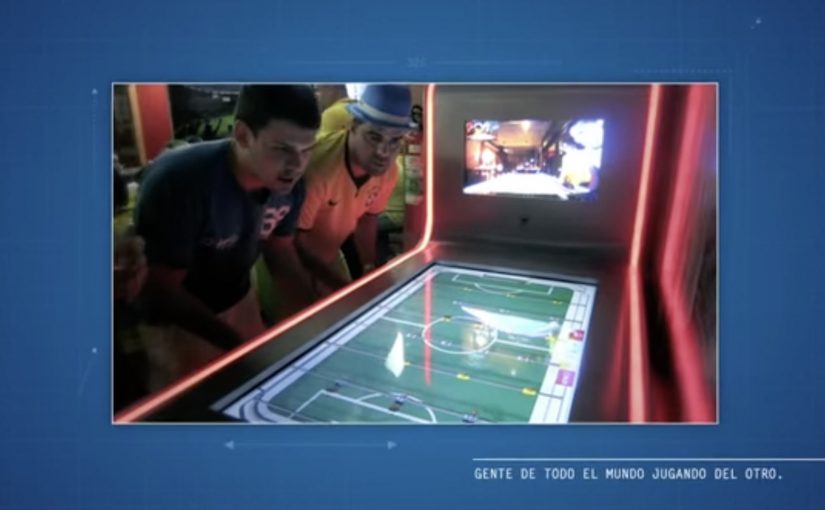
Quilmes and their agency +Castro reinvented the classic game of foosball. In its new version they enabled Argentinians and Brazilians to play each other in real time through a custom made digital foosball table.

Dubbed “Mitigol”, the activation turns foosball into a cross-border live match. One half of the table was placed in Argentina and the other half in Brazil. During the game, players could see their opponent via special in-built video cameras that further enhanced the real time experience of the game. As a prize, Quilmes gave away free beer.

How Mitigol works

The mechanism is a physical game with a digital bridge. A custom table syncs the ball and player movement across distance, while embedded cameras add face-to-face presence so it feels like a real match rather than a remote demo.

In sports and event-led marketing, shared-play installations can turn rivalry into participation because they give fans something to do together, not just something to watch.

Why it lands

This works because it makes a national rivalry tangible without needing a screen-first experience. Foosball already has competitive tension built in, so the cross-border connection raises the stakes instantly. The cameras then do the emotional work by proving the opponent is real, right now, reacting in real time.

Extractable takeaway: When you want “real time” to feel meaningful, do not rely on the word. Add one physical interaction that people already understand, then layer in live presence so the distance becomes the headline.

What Quilmes is really buying

The real question is how to turn passive rivalry into a shared act people want to join.

Beyond novelty, Mitigol is a closeness story. It borrows the energy of an event moment and converts it into a branded experience where the fan is the performer, not the spectator. The prize is just the nudge that keeps the line moving and the competition sharp.

What to steal from Mitigol

  • Start with a familiar game. If the rules are known, participation spikes.
  • Make distance visible. The split-table concept is the idea. Do not hide it.
  • Add live presence. Cameras or live feedback make “remote” feel human.
  • Reward the behavior you want. Small, immediate prizes keep throughput high.

A few fast answers before you act

What is Mitigol?

It is a custom foosball table experience that connects two locations so players in different countries can play the same match in real time.

Why split the table across Argentina and Brazil?

Because the physical split makes the cross-border rivalry concrete. It is instantly legible as “we are playing each other right now”.

What role do the built-in cameras play?

They add live presence and reaction, which makes the experience feel like a real opponent rather than a remote simulation.

What is the simplest way to copy the principle?

Take a familiar physical activity, connect it across distance with tight synchronization, then add a live human layer so the interaction feels personal.

What should you measure for an activation like this?

Participation volume, repeat play, dwell time, and how often spectators convert into players once they see it in action.

Giraffas: The Goal Screen

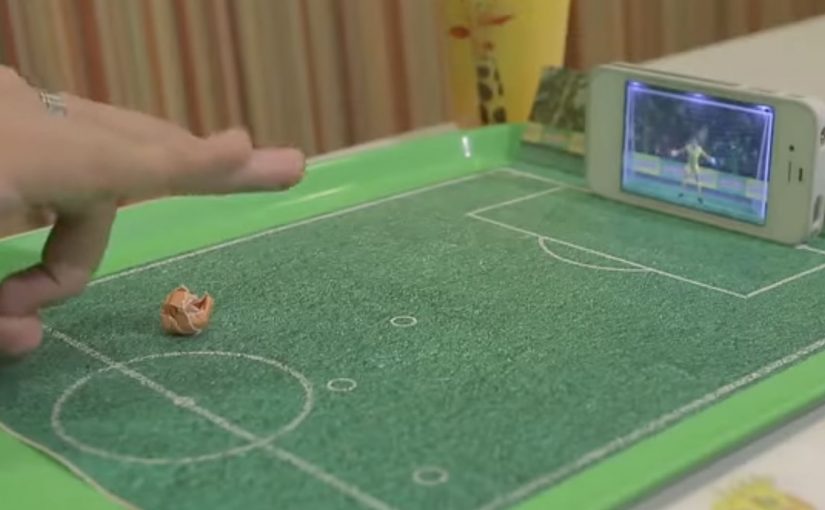
To capitalize on the lead up to the 2014 FIFA World Cup, Brazilian fast food chain Giraffas creates a mobile game that turns their tray papers into a virtual soccer field. To play, consumers rip the side of the paper tray, make a paper ball, and flick it into their mobile screens.

7 million tray papers are printed, and the game is made possible by using the smartphone camera to recognize the ball distance, the accelerometer to identify the trajectory of the kick, and the microphone to recognize the area of impact.

A game that bridges paper and screen

The mechanism is a simple physical ritual, meaning a repeatable action with objects already on the tray, that unlocks a digital experience. The tray liner provides the “pitch”. The paper ball provides the input. The phone turns sensors into a referee, translating distance, direction, and contact into gameplay.

That matters because the tray liner and paper ball remove setup friction, so the leap from noticing the idea to trying it stays almost instant.

In quick-service restaurants, the strongest interactive ideas add value during the waiting and eating moment, without requiring staff training or extra hardware at the counter.

The real question is how little effort a brand can ask of people before play feels easier than ignoring it.

Why it lands

The strongest part of the idea is not the World Cup tie-in. It is the packaging mechanic that makes play feel native to the meal. This works because it turns a disposable surface into a reason to play, and it makes participation feel immediate. It is not “download an app for later”. It is “play right now, with what you already have, while you are here”. The World Cup context supplies motivation, but the in-store simplicity supplies repeatability.

Extractable takeaway: When you want in-the-moment engagement, design a physical trigger that is already in the customer’s hands, then use the phone only as the translator. The fewer steps between curiosity and action, the more people actually try it.

What to borrow from this tray-to-screen mechanic

  • Use packaging as the interface. If your brand owns a surface (tray liners, cups, wrappers), it can become the entry point.
  • Make the first attempt effortless. Rip, roll, flick. Three verbs. No instructions wall required.
  • Exploit phone sensors, not novelty tech. Camera, accelerometer, and microphone are scalable because they are already everywhere.
  • Anchor to a cultural moment, but keep it evergreen. The event creates urgency, the mechanic creates habit.

A few fast answers before you act

What is “The Goal Screen” for Giraffas?

It is an in-store mobile game that turns Giraffas tray papers into a virtual soccer field, using a paper ball that customers flick into their phone screen.

Why does the paper tray matter to the experience?

The tray paper acts as the physical “pitch” and the trigger for play, making the game feel native to the restaurant moment.

How does the phone detect the kick?

The setup is described as using the camera for distance, the accelerometer for trajectory, and the microphone for impact area.

What is the marketing objective behind this kind of mechanic?

To make the in-store visit more entertaining and memorable, and to create a reason to interact with the brand during the meal.

What is the transferable lesson for other brands?

Turn a ubiquitous brand touchpoint into a play surface, then use the phone as a lightweight sensor hub that makes the interaction feel “magical” without added hardware.