
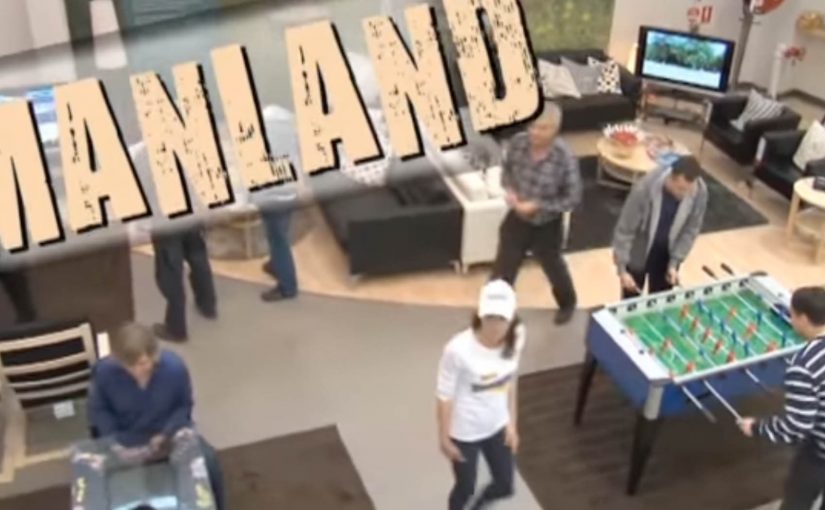
IKEA Manland

Last month IKEA in Sydney, Australia ran a four-day trial of Manland. They created a dedicated area in the store which men with short retail attention spans could use to escape the pains of weekend shopping at IKEA. In simple words, it was day-care for husbands and boyfriends who wanted to take a break from the shopping.

The store offered free hot dogs, Xbox consoles, pinball machines and nonstop sports action on TV. IKEA even handed out buzzers so women would get reminded to come back and pick up their men after a short session.

Turning “waiting time” into a branded service

Manland works because it is not pretending men suddenly love shopping. It acknowledges the reality. Some people will be there for the relationship, not the retail. So IKEA reframes the pain point as a service, the same way Småland turns “kids are restless” into a solved problem.

The mechanism is deliberately low-effort. You do not need an app, a QR code, or an explanation. You just drop in, decompress, and rejoin the trip with less friction and fewer arguments.

In big-box retail, weekend shopping is often a couple activity, and boredom is a conversion killer for the accompanying partner.

Why this becomes press, not just a gimmick

It is instantly legible. A “day-care for men” is a headline. The imagery does the distribution work. Consoles, sports, hot dogs, and a buzzer are all recognisable symbols, so the concept travels across cultures even if you have never been to an IKEA.

Extractable takeaway: If you want earned media from an in-store experience, design one idea that reads in a single photo and a single sentence.

It is also slightly provocative, which helps. People argue about whether it is funny, patronising, or brilliant. That debate is oxygen for earned media.

The business intent: protect dwell time and reduce walk-outs

The practical goal is simple. Keep groups in-store longer, reduce the urge for someone to storm out, and make the trip feel easier, especially on peak weekend traffic. The PR upside is a bonus. But the operational benefit is the real value.

The real question is whether you can remove that boredom without turning the idea into a stereotype.

If your store relies on group shopping, design for the bored companion as deliberately as you design for the primary buyer.

Steal the companion-lounge playbook

  • Solve a real friction. If it does not remove pain, it will not spread.
  • Make the rules obvious. The best retail ideas need zero onboarding.
  • Build a “photo truth”. If the experience photographs well, it earns its own distribution.
  • Use time limits to keep it fair. A short session keeps it accessible and stops it becoming a hangout that blocks capacity.

A few fast answers before you act

What was IKEA Manland?

Manland was a short trial inside an IKEA store in Sydney. It offered a staffed, game-and-sports lounge where men could take a break while their partners shopped.

Why did the buzzer matter?

The buzzer turned “come back later” into a simple timing system. It made pickup predictable and helped manage capacity without complicated queueing.

Is this primarily an ad idea or an operations idea?

Both. It is an operations idea that creates PR. The experience removes friction inside the store, then the simplicity of the concept turns it into a shareable story.

What makes this kind of activation risky?

Stereotypes. If the tone feels insulting or dated, the press flips from amused to critical. The safest version is to frame it as optional decompression, not a judgment.

What should you measure if you do something similar?

Dwell time, drop-off rates, and satisfaction in exit feedback. For comms, track earned pickup and social sharing, but only after the in-store metrics look healthy.
FRANK Oslo: Giuliani 9/11 Tweets

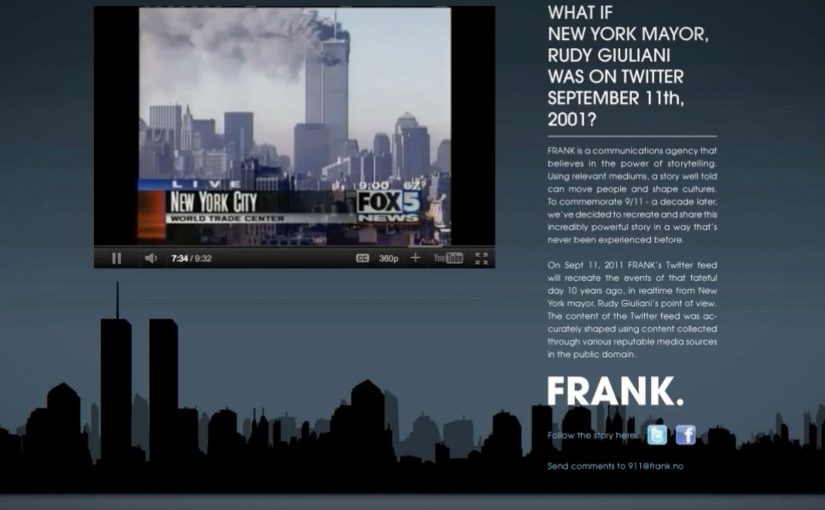
You follow a Twitter feed as if it is happening now. Updates arrive minute by minute, building confusion into urgency, then urgency into shock. The feed is written from New York mayor Rudy Giuliani’s point of view, and it recreates September 11, 2001 in real time.

FRANK is a communications agency from Oslo that wants to demonstrate the power of storytelling through the right medium. To commemorate 9/11 a decade later, they recreate and share the day as a live social stream experience.

On September 11, 2011, FRANK’s Twitter feed recreated the events of that day ten years earlier in real time from Giuliani’s point of view. The feed is described as being shaped using content collected from reputable public-domain media sources.

Real-time remembrance as a platform-native documentary

The mechanism is simple and specific. A single account publishes a paced sequence of posts that map to the original timeline, written in a constrained perspective, so the audience experiences the narrative in the same format they use for breaking news.

Here, platform-native means the story is built for the feed itself, not merely promoted through it.

In crisis and remembrance communications, real-time formats can make historical events feel immediate without changing the facts.

Why it lands

The power is in the temporal constraint. Real-time pacing prevents the viewer from jumping to the ending, which recreates uncertainty and heightens attention. The Giuliani viewpoint acts as a narrative spine, giving the stream a human decision-maker and a consistent voice, rather than a collage of headlines. It is a reminder that storytelling is not only what you tell, but also how you sequence it and where you let people experience it.

Extractable takeaway: If you want audiences to feel the weight of a known story, constrain the format. Pick one viewpoint, match the original timeline, and let pacing do what exposition cannot.

What the campaign is really doing

This is a proof of medium choice. The real question is whether the medium can carry remembrance with the same urgency as the original news cycle. Twitter is not used as a promotion channel. It is used as the container for the story. The campaign demonstrates that a platform-native structure can increase empathy and attention for complex events, while staying grounded in documented reporting.

What to steal from this real-time storytelling pattern

  • Choose one perspective. A single viewpoint makes large events navigable and coherent.
  • Use timing as a creative constraint. Real-time sequencing creates tension and attention without additional production.
  • Build credibility into the sourcing. If you rely on archival material, describe your source discipline clearly.
  • Match story to medium. The most persuasive channel is sometimes the format people already trust for “live” information.

A few fast answers before you act

What is FRANK Oslo’s “Giuliani 9/11” idea?

A real-time Twitter reconstruction of September 11, 2001 from Rudy Giuliani’s viewpoint, published ten years later to let audiences experience the timeline through a live-feed format.

Why use Twitter instead of a film or article?

Because the platform format is the point. A feed is how people experience unfolding events, so the campaign uses that native behavior to recreate pacing and uncertainty.

How does the single viewpoint help?

It creates narrative continuity. Viewers follow one decision-making perspective rather than switching between fragmented sources.

What is the main credibility requirement for this pattern?

Source discipline. If you claim accuracy, you need a clear method for selecting, verifying, and sequencing archival material.

When should you use real-time reconstruction?

When the goal is remembrance, education, or empathy, and when pacing and sequence are essential to understanding the human experience of the event.

Augmented Reality: Hyperlinking the real world

A French company called Capturio turns a t-shirt into a business card. You point your phone at what someone is wearing, and the “link” is the fabric itself. No QR code required.

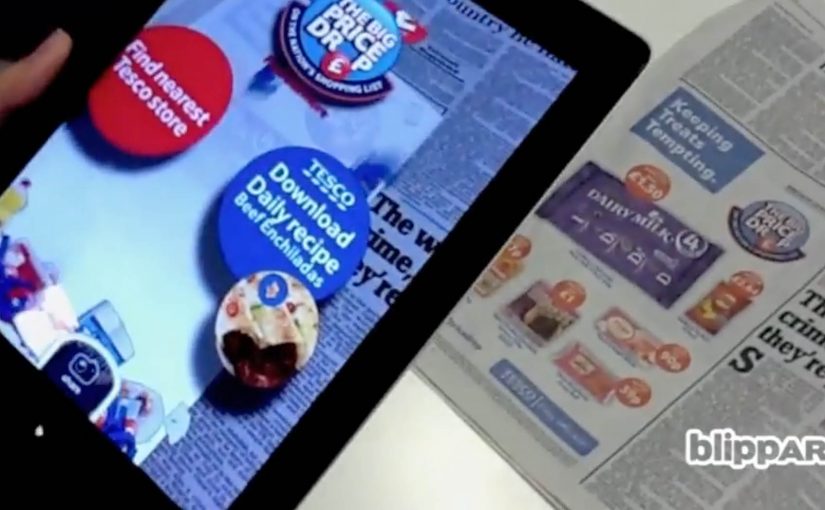
Right after that, Blippar in the UK takes the same idea to printed images. A newspaper page, poster, or pack becomes the trigger. The result is a 3D augmented reality overlay that appears on-screen the moment the image is recognised. Again, no QR code.

From visible codes to recognition triggers

QR codes get put to good use in countless innovative projects. But the drift is towards technology that produces similar results without visible codes. QR codes are not “dead”. Recognition-based triggers win whenever you can control the surface and want the interaction to feel seamless.

How “invisible links” work in practice

Capturio’s concept is simple. The physical object becomes the identifier. A t-shirt behaves like a clickable surface in the real world.

Blippar applies the same pattern to print. Image recognition here means matching what the camera sees to a known reference image so the system can anchor content to that surface.

The interaction is straightforward:

  1. Download a custom app, in this case the Blippar app.
  2. Scan a Blippar-enabled printed image, identifiable by a small Blippar logo, using an iPhone, iPad, or Android device.
  3. Start interacting with the augmented reality 3D overlay on the screen.

In India, Telibrahma uses the same approach to increase experiential engagement for brands via traditional media like newspapers and posters.

In consumer marketing and retail environments, this pattern turns owned surfaces into low-friction entry points for digital experiences.

Why recognition beats visible codes

A visible code is a visual tax. It signals “scan me”, but it also interrupts design and can feel bolted-on. When the surface itself becomes the trigger, the mechanism and the message align. The scan feels like discovery, not compliance. That mechanism is exactly why this pattern tends to spread once teams see it work in the wild.

Extractable takeaway: If you want people to scan, remove the decision point. Make the object itself the identifier, and make the reward immediate.

The bigger idea is not the novelty of 3D overlays. It is that physical surfaces become links. Clothing, posters, newspaper pages, packaging, storefronts. Anything that can be recognised can behave like a gateway to content, commerce, or interaction.

What this unlocks for brands

This is useful when you need a bridge from “attention” to “action” without adding friction. It can turn traditional media into a gateway for:

  • Content. Rich product stories, demos, or tutorials that do not fit on-pack or on-page.
  • Commerce. A route into product detail and purchase flows from packaging or print.
  • Interactivity. Lightweight games, utilities, or experiences that create repeat engagement.

What to steal for your next activation

  • Pick a surface you own. Packaging, print, or wearable assets work best when distribution is in your control.
  • Make the trigger legible. Even without a QR code, users need an affordance like a small mark, instruction, or demo.
  • Design the “first 5 seconds”. Recognition must lead to an immediate payoff, or people will not try twice.
  • Decide what success means. Share, sign-up, repeat use, or store visit. Do not ship without one primary metric.

A few fast answers before you act

What does “hyperlinking the real world” mean here?

It means using image recognition and augmented reality so physical objects like shirts, posters, and print behave like clickable links without QR codes.

Which companies are the concrete examples in this post?

Capturio (France), Blippar (UK), and Telibrahma (India).

How does Blippar work at a high level?

Download the app, scan a Blippar-enabled image marked with a small Blippar logo, then interact with a 3D AR overlay on-screen.

Is this actually “the end” of QR codes?

No. QR codes remain useful. But recognition-based triggers are often preferred when you want the surface to stay clean and the interaction to feel seamless.

What types of media does this apply to?

Newspapers, posters, packaging, and other printed or visual surfaces that can be reliably recognised by a camera.

What should you measure first if you try this?

Start with activation rate, meaning how many people who see the surface actually trigger the experience. Then track the next action, such as shares, sign-ups, or clicks into commerce.