
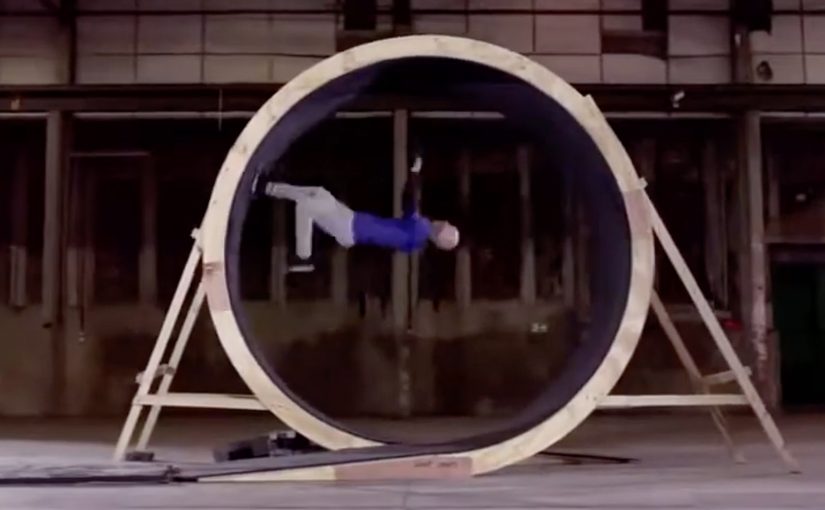
Pepsi Max: Human Loop

Pepsi Max: Human Loop

Last year, Pepsi Max for its ongoing #LiveForNow campaign created an unbelievable bus levitation stunt. Now continuing this “unbelievable feats and experiences” brand positioning, they challenged daredevil stuntman, Damien Walters to do another unbelievable stunt for them. Here, positioning means the single promise the brand wants people to remember and retell.

Pepsi Max provided Damien with a human-sized loop-the-loop in an abandoned warehouse and then got him to defy gravity for them…

In global FMCG marketing, stunts like this earn value when they reinforce an existing brand platform, not when they try to create one from scratch.

Why this stunt fits the brand

The mechanism is simple. A clearly defined physical challenge, executed by credible talent, makes the “unbelievable” promise feel real because the payoff is visible without narration.

Extractable takeaway: If your positioning is a claim, design one repeatable moment that functions as proof, then film it so the viewer can verify it without explanation.

  • It commits to the promise. “Unbelievable” is not a line here. It is the product.
  • It is instantly legible. You understand the challenge in one second, then you watch to see if it is possible.
  • It is built for replay. Stunts invite rewatching, pausing, and sharing because people want to verify what they saw.

How to make the stunt behave like proof

The real question is whether your brand promise can be proven in one obvious moment on camera.

This kind of spectacle earns its keep only when it is a direct proof point for an ongoing platform, not a disconnected attempt at “random viral”.

If your positioning is about experiences, you need executions that behave like proof. This kind of spectacle works when the idea is simple, the talent is credible, and the payoff is visible without explanation.

  • Make the promise behave like proof. If positioning is about experiences, the execution should demonstrate it, not describe it.
  • Keep the idea simple and the payoff visible. The viewer should understand the challenge instantly and see the outcome without explanation.
  • Use credible talent, then shoot for replay. Stunts invite rewatching, pausing, and sharing when people want to verify what they saw.

A few fast answers before you act

What is Pepsi Max “Human Loop”?

It is a Pepsi Max #LiveForNow stunt featuring Damien Walters attempting a human-sized loop-the-loop setup inside an abandoned warehouse.

Why does a loop-the-loop stunt perform so well in video?

The challenge is obvious, the risk feels real, and the outcome is visually conclusive, which makes it highly shareable.

What is the core pattern behind this kind of campaign?

Make the brand promise measurable in one moment, then capture it cleanly so the viewer does not need context to understand it.

How do you keep stunts from feeling like “random viral”?

Anchor them to an ongoing brand platform, use consistent talent and tone, and make each execution feel like a credible next chapter.

When should you avoid a stunt-led proof moment?

Avoid it when the idea cannot be understood instantly, the talent is not credible, or the execution does not ladder up to an ongoing brand platform.

DHL: DHL Is Faster Trojan Parcels

DHL: DHL Is Faster Trojan Parcels

A courier from UPS, TNT or DPD walks through a busy city centre carrying a large, plain-looking parcel. A few minutes later, the same box is effectively doing outdoor advertising for DHL, with a bright message reading: “DHL is Faster.”

Turning competitors into media

DHL’s large network of offices, trucks and employees is a straightforward speed story, but saying it loudly in a traditional ad campaign is expensive. So DHL worked with German trojan campaign specialists Jung von Matt/Neckar to make competitors unknowingly promote DHL as the fastest parcel delivery service. In this context, a trojan campaign hides the brand message inside a neutral object or someone else’s distribution until it reveals itself in public.

The mechanism: temperature reveals the punchline

Large, inconspicuous parcels were created and sealed with a thermo-sensitive foil. When cooled in refrigerators, the parcels appeared black, hiding the message. UPS, TNT and DPD were then asked to deliver these parcels to difficult but central city locations. Exposed to warmer street temperatures during delivery, the parcels shifted colour and revealed the words “DHL is Faster.”

A “trojan” mechanic in marketing is a message that travels inside a neutral object or someone else’s distribution, then reveals itself at the moment of maximum visibility.

In competitive European parcel logistics, a proof-by-demonstration stunt can move “we’re faster” from claim to spectacle without buying classic media.

Why this lands

It works because the reveal happens in public and in motion, exactly where speed matters, and it borrows credibility from the awkward fact that a rival courier is doing the carrying. The stunt also makes the comparison feel earned rather than asserted, because the message appears as a consequence of the journey.

Extractable takeaway: If your advantage is hard to believe as a headline, design a mechanism where the environment exposes the proof, and let the proof show up at the exact point where the audience can “see the claim happen.”

What DHL is really buying

The real question is how to turn a functional speed claim into a public proof people can instantly understand and retell.

This is less about humiliating competitors and more about reframing the category. It turns delivery speed into a street-level moment that people can film, retell, and instantly understand, while the brand pays for production rather than for repeated media placements.

What to steal from DHL’s reveal design

  • Build a reveal. Hide the message until the moment the audience is already watching.
  • Use context as a trigger. Temperature, light, movement, location. Let the world “activate” the story.
  • Put the proof on the distribution. The carrier becomes the billboard, not a separate ad unit.
  • Make the explanation obvious at a glance. If it needs a voiceover, the stunt is too clever.

A few fast answers before you act

What is the “DHL is Faster” stunt?

It’s a trojan-style activation where rival couriers deliver parcels that reveal “DHL is Faster” as they warm up in city conditions.

How does the reveal work?

The parcels are wrapped in a thermo-sensitive foil that looks dark when cooled, then changes to expose bright lettering when the parcel warms during delivery.

Why call it a trojan campaign?

Because the message travels hidden inside a neutral-looking object and is distributed by someone else, then reveals itself at the most visible moment.

What brand point does this communicate?

Speed and network scale, reframed as a live demonstration rather than a paid claim.

What’s the main risk with this kind of idea?

Brand backlash if the stunt feels mean-spirited or deceptive, and operational complexity if the reveal is inconsistent or hard to understand in the wild.

Coca-Cola Turkey: Invisible Vending Machine

Coca-Cola Turkey: Invisible Vending Machine

Since the time I started writing this blog, I have come across many innovative vending machines. Some I featured right here on Ramble.

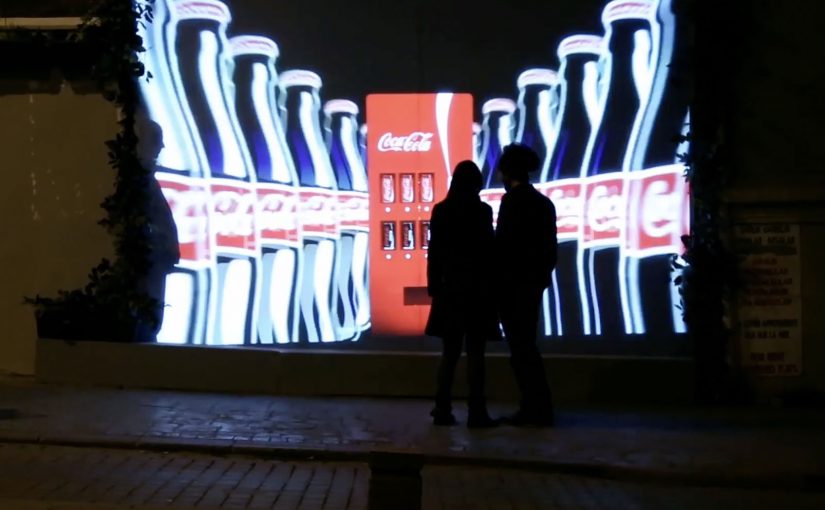
Now to add to this collection, here is an invisible vending machine from Coca-Cola Turkey that becomes visible only when couples walk by. The machine was created specially for Valentine’s Day (last week) and was installed in Istanbul to spread happiness Coca-Cola style.

A vending machine you cannot see until the right moment

The trick is the reveal. What looks like a normal stretch of wall becomes a vending interface only when two people approach together. That instant transformation creates a micro-scene, and the micro-scene pulls in everyone nearby.

In consumer brand activations, public installations work best when the interaction is obvious, fast, and shareable without instruction.

How the interaction is described to play out

  • Invisible by default. The unit blends into the wall and does not present itself as a machine.
  • Couples trigger the reveal. When two people pass together, the interface lights up and becomes visible.
  • Personal moment, not just a dispense. In coverage at the time, the machine asks for names and then produces two personalised cans.

Why it lands

This is not “another vending machine story”. It is a street-level surprise that creates a small, romantic spotlight for a couple, and a quick bit of theatre for everyone else. The invisibility is not a gimmick. It is a pacing device that makes the reveal feel like a reward. The real question is whether the experience creates a transformation that bystanders can explain in one sentence.

Extractable takeaway: If you want people to stop, watch, and retell an activation, build a visible transformation into the experience. A before-and-after moment is easier to share than a static stunt.

What Coca-Cola gets out of the Valentine framing

Valentine’s Day provides the social permission for public sweetness, names, and sentiment. For the brand, it is a clean link back to togetherness and “sharing happiness”, while turning a sample into a story people can repeat without being prompted.

Retail theatre patterns worth borrowing

By “retail theatre” I mean designing a retail moment as a small piece of live, shareable experience, not just a dispense or transaction.

  • Hide the interface until it matters. Visibility can be part of the reward, not just a prerequisite.
  • Keep the trigger legible. People should understand why it happened in one glance, or they will not mimic it.
  • Design for bystanders. The couple is the participant. The crowd is the media channel.
  • Personalise lightly. Names, messages, or small custom outputs feel intimate without needing heavy data.

A few fast answers before you act

What is the “invisible vending machine” concept?

A vending machine that stays hidden until a couple approaches, then reveals itself and delivers a Valentine-themed Coca-Cola moment.

Why make the machine “invisible” at all?

It creates a sharp reveal, and that reveal is the shareable payload. People remember transformations more than static installations.

What is the simplest way to replicate the effect?

Use a clear proximity trigger plus lighting and screen content that turns on instantly, and ensure the “why it appeared” is immediately understandable.

What is the biggest execution risk?

If the trigger is inconsistent or unclear, people will not repeat the behaviour and the crowd will not form. Reliability matters more than complexity.

What should you measure beyond views?

Dwell time, participation rate per hour, bystander clustering, social mentions generated on site, and any lift in nearby sales during the activation window.