

Fiat Street Evo

Fiat Street Evo

Leo Burnett Iberia has launched a new app called Fiat Street Evo, described as a “not-printed” car catalogue. A catalogue that is virtually on every street in your city.

Fiat Street Evo recognises traffic signs as if they were QR codes and associates each sign with a feature of the new Fiat Punto Evo. For example, a STOP sign points you to braking. A curve-ahead sign points you to intelligent lighting that guides you through bends. The list continues across the everyday signage you pass without noticing.

When street furniture becomes a product demo

The mechanism is a neat inversion of the usual brochure logic. Instead of printing a catalogue and hoping people keep it, the city becomes the index. Your camera becomes the browser, and the sign becomes the trigger. Here, “street furniture” means the signs and fixtures already in public space.

In automotive launch marketing, the strongest mobile ideas turn the real world into media without asking people to change their routine.

Why it lands

It reframes “specs and features” as discovery. You do not read a list. You unlock a feature in context, tied to a symbol you already understand. That makes the catalogue feel lighter, and it makes exploration feel like play rather than research. This pattern is stronger than a brochure-style feature list because it earns attention through context, not interruption.

Extractable takeaway: Product education travels further when it is organised around familiar cues in the environment, not around the brand’s feature taxonomy.

What Fiat is really trying to achieve

The real question is whether you can make the phone the first place curiosity goes by attaching product education to cues people already recognise. This kind of execution is doing two jobs at once. It builds attention for a new model, and it makes the phone the first place curiosity goes. That matters because the intent moment is not always at a dealership. It is often on the street, in motion, and in between other tasks.

Patterns to borrow for mobile launch marketing

  • Borrow existing symbols. Traffic signs already carry meaning. Use that meaning as your information architecture.
  • Keep the mapping intuitive. The sign-to-feature link should feel obvious, or people will drop the experience.
  • Design for quick sessions. One sign. One feature. One payoff. Repeat when you feel like it.
  • Make “catalogue” feel like exploration. A sense of discovery beats a long scroll of specifications.
  • Use the city as distribution. When the triggers are everywhere, frequency becomes effortless.

A few fast answers before you act

What is Fiat Street Evo in one sentence?

It is a mobile catalogue concept that recognises traffic signs and uses each sign to reveal a related Fiat Punto Evo feature.

Why call it a “not-printed car catalogue”?

Because the “pages” are distributed across the city as street signs. The phone becomes the reader, and the street becomes the catalogue.

What makes the sign-to-feature mapping important?

The mapping is the comprehension layer. If the association feels natural, users keep going. If it feels random, the idea collapses into novelty.

What is the biggest execution risk?

Recognition reliability. If the app struggles to identify signs in real conditions, people will not persist beyond the first attempt.

What should you measure in a pilot?

Successful recognitions per session, repeat usage, time-to-first-payoff, and whether the experience increases search, dealership visits, or brochure requests.

Volkswagen LinkedUit: A LinkedIn API Campaign

Volkswagen LinkedUit: A LinkedIn API Campaign

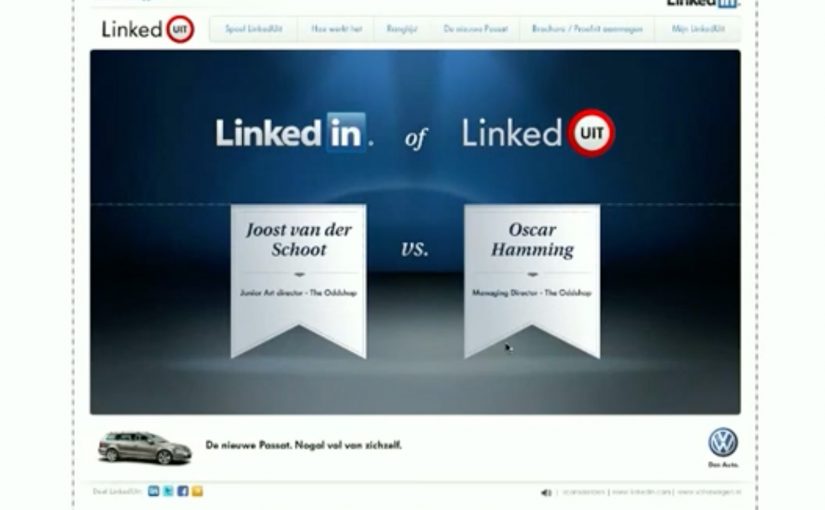
Volkswagen has released a LinkedIn-based campaign which takes full advantage of the new LinkedIn API. Here, “LinkedIn API” simply means the permissioned interface that lets an app read profile information after you sign in.

The campaign is called “LinkedUit” (LinkedOut) and gives anyone who challenges a friend on LinkedIn a chance to win a Volkswagen Passat.

The game is really simple. After signing in using your LinkedIn profile, the app lets you choose others in your network to challenge. A LinkedIn victor and a LinkedOut loser is then chosen based on education, experience, recommendations and connections.

Mechanically, the app pulls profile fields after sign-in and turns them into a score you can compare against someone in your network. This pattern is worth copying when you can explain the scoring in plain language and keep participation clearly opt-in. Because the inputs are already curated, the result feels personal with almost no extra work.

In European automotive marketing, platform-native games like this only stay credible when the data use is explicit and the scoring feels fair.

The real question is whether the value of the interaction outweighs the discomfort of being compared.

Why this is a smart use of platform data

This campaign uses something people already curate and care about. Their professional identity. Instead of asking for attention, it uses existing LinkedIn data as the raw material for the experience.

Extractable takeaway: If you can make a platform’s identity data the mechanic, you lower friction and raise relevance. But you only earn repeat use when people can predict why they won or lost.

  • Low input for users. The profile is already built. The game simply reads it.
  • High personal relevance. Comparisons feel personal because they are based on your own history.
  • Built-in social spread. Challenges create a natural loop through networks.

The Passat benefit: “feature-rich” as a metaphor

The creative link is straightforward. Passat equals feature-rich. LinkedIn profile equals information-rich. The experience makes the metaphor tangible by turning profile depth into a competitive score.

That kind of metaphor works when it is easy to explain in one sentence and easy to experience in one click.

What makes this type of social game succeed or fail

  1. Fair scoring logic. If the rules feel arbitrary, people reject the result.
  2. Fast time-to-result. The payoff must arrive quickly after sign-in.
  3. Friendly rivalry. Challenges should feel playful, not judgmental.
  4. Clear reward. A chance to win a Passat is a simple, memorable incentive.

What to take from this if you are building platform-native campaigns

  • Use the platform’s native data as the experience. The more you rely on what already exists, the lower the friction.
  • Make the mechanic social by default. Challenges, invites, and comparisons drive distribution.
  • Keep the brand connection clean. One strong metaphor beats multiple weak links.
  • Design for credibility. When you use personal data, transparency and perceived fairness matter.

A few fast answers before you act

What is Volkswagen “LinkedUit”?

It is a LinkedIn-based campaign that uses LinkedIn profile data to create a challenge game, giving participants a chance to win a Volkswagen Passat.

How does the game determine a winner?

The app compares elements such as education, experience, recommendations, and connections to choose a “LinkedIn victor” and a “LinkedOut” loser.

Why is the LinkedIn API important here?

Because it enables the experience to pull in profile information automatically, making the game quick to start and personally relevant without extra data entry.

What is the creative link to the Passat?

The campaign uses the idea that the new Passat is full of features, just like a LinkedIn profile is full of information, then turns that into a competitive mechanic.

What is the main lesson for social platform campaigns?

If you build around native identity and data, and make the interaction social by default, you can create an experience that spreads through the network naturally.

Chery M11: Road M11

Chery M11: Road M11

Hundreds of people design their own “dream roads” online. Then one of those roads gets built in the real world, and the person who created it ends up navigating a rally run alongside a professional driver.

That is the core idea behind Chery M11’s “Road M11” project by Voskhod, built to tackle a real market perception problem. In Russia, Chinese cars were widely seen as unreliable and unpleasant to drive, so the campaign had to create proof, not promises.

Instead of leading with specs, the brand launches an internet game where anyone can create roads and drive them using a computer model of the Chery M11. People race against the clock and vote on the best road. After a month and more than 800 submitted roads, a winner is selected. The winning road is then constructed in reality for a rally-style event, journalists are invited, a Russian rally champion is chosen as driver, and the road’s creator becomes the navigator.

Turning “prove it” into a participation loop

The mechanic is not just gamification. It is co-creation with consequences. The audience builds roads, competes, and votes. The brand takes the best idea and commits to building it at full scale, then lets independent observers experience the car on a course the public designed rather than a track the brand curated.

In automotive categories where trust is the main barrier, converting digital participation into a real-world test creates credibility that advertising claims cannot buy.

Why it lands

The campaign reframes skepticism as a challenge the audience can test. That matters because the negative belief is about performance and reliability, and those beliefs tend to change only through experience or trusted proxy experience. The road-building game gives people viewer control over what the car is “asked to do”, and the real rally event creates a clean narrative of proof. If the car cannot handle it, the idea collapses publicly. That risk is what makes the demonstration persuasive.

Extractable takeaway: When a category suffers from “untrusted origin” bias, meaning buyers discount the product because they distrust where it comes from, move the claim from messaging into a public test. Let the audience help define the test, then invite credible witnesses to validate the outcome.

What the business intent really is

The obvious goal is traffic and attention. The deeper goal is to earn test drives and journalist coverage by making the car’s capabilities feel observed rather than asserted. The legacy write-up reports strong site visitation and sales impact, which fits the logic of the mechanism. Participation creates investment, investment creates trial, trial creates conversion.

The real question is whether the brand can turn skepticism into a public proof event that feels harder to dismiss than an ad.

What to borrow from Road M11

  • Design a proof that scales. Digital participation can scale fast, but the proof moment must be simple enough to summarize.
  • Let the public set the challenge. Co-creation increases trust because it reduces suspicion of “staged conditions”.
  • Bridge online to offline. The handoff from game to real-world event is where credibility is minted.
  • Invite credible witnesses. Journalists, experts, or known practitioners make the proof travel beyond your owned channels.

A few fast answers before you act

What is “Road M11” in one sentence?

An online road-building game for the Chery M11 where the winning user-created road is built in real life for a rally-style demonstration with journalists and a pro driver.

Why use a game instead of a traditional test-drive campaign?

Because the barrier is trust. A participatory mechanic creates investment, and the game-to-real-world conversion creates a visible proof story that journalists and viewers can follow.

What perception problem is this designed to solve?

That Chinese cars in the Russian market were seen as unreliable and poor to drive, so performance had to be demonstrated rather than claimed.

What results did the legacy write-up claim?

It reported more than 340,000 visitors in three months, sales exceeding plan by 76%, and annual sales growth of 186% versus market averages. Treat these as campaign-reported figures unless you have primary reporting to validate them.

What is the biggest risk in this approach?

If the real-world build and rally experience does not match the promise, the proof flips into a public counter-proof. The execution has to be operationally strong, not just creatively strong.