

Microsoft: Big Data to Predict Traffic Jams

Big Data is increasingly being used to find solutions to problems around the world. In this latest example, Microsoft partnered with the Federal University of Minas Gerais, one of Brazil’s largest universities, to undertake research that helps predict traffic jams up to an hour in advance.

With access to traffic data, including historical numbers where available, road cameras, Bing traffic maps, and drivers’ social networks, Microsoft and the research team set out to establish patterns that help foresee traffic jams 15 to 60 minutes before they happen.

What “big data” means in this context

Here, “big data” is not a buzzword. It means combining multiple high-volume signals that each describe traffic from a different angle. Flow and speed data. Camera feeds. Map-layer congestion indicators. And sometimes social or incident signals that explain why conditions change.

How the prediction model is positioned

The mechanism is short-horizon forecasting. Aggregate live and historical traffic conditions. Detect repeating patterns and transitions. Then output a probability that a segment will shift from free-flowing to congested within the next 15 to 60 minutes. The goal is not perfect certainty. It is an early warning that is useful enough to reroute, rebalance signals, or advise drivers.

In urban mobility programs, 15 to 60 minute congestion prediction is a practical layer between raw telemetry and real-world operational decisions.

Why it lands

This works because it targets a time window people actually feel. Short-horizon forecasting matters because it aligns the prediction with the moment when routes, signals, and departures can still change. The real question is whether earlier warning is reliable enough to trigger better decisions before congestion locks in. Useful prediction beats perfect prediction in operational systems.

Extractable takeaway: When a prediction is delivered inside the decision window, it creates value even if it is not perfect. The win is earlier choices, not flawless foresight.

What to steal for traffic prediction

  • Design for actionability: pick a forecast horizon that matches real decisions, not academic elegance.
  • Blend signals carefully: combine steady signals, like flow data, with explanatory signals, like incidents or events, when available.
  • Communicate confidence: a probability and a time window often beats a single definitive “will happen” claim.
  • Validate across cities: portability matters, because traffic behaviors vary by road network and culture.
  • Measure the right outcome: accuracy matters, but reduced delay and better routing outcomes are the real business KPIs.

A few fast answers before you act

What is Microsoft trying to do here?

The project aims to predict traffic jams 15 to 60 minutes ahead by combining traffic flow data, map signals, cameras, and other contextual inputs to spot patterns before congestion forms.

Why is 15 to 60 minutes the useful range?

It is long enough to change routes, adjust signal timing, or delay a departure. It is short enough that conditions have not completely changed since the forecast was generated.

What data sources matter most?

Traffic flow and speed data usually provide the core signal. Cameras, incidents, events, and social signals can add context that improves timing and explains sudden changes.

What does “80% accuracy” actually mean?

It is typically reported as the share of correct predictions under a defined test setup. The real value depends on how accuracy is measured, what baseline is used, and how the prediction is turned into driver or city actions.

Where does this approach fit in a smart-city stack?

It sits between sensing and intervention. Sensors and maps detect current conditions. Prediction estimates near-future conditions. Then routing, signaling, and traveler information systems act on that forecast.
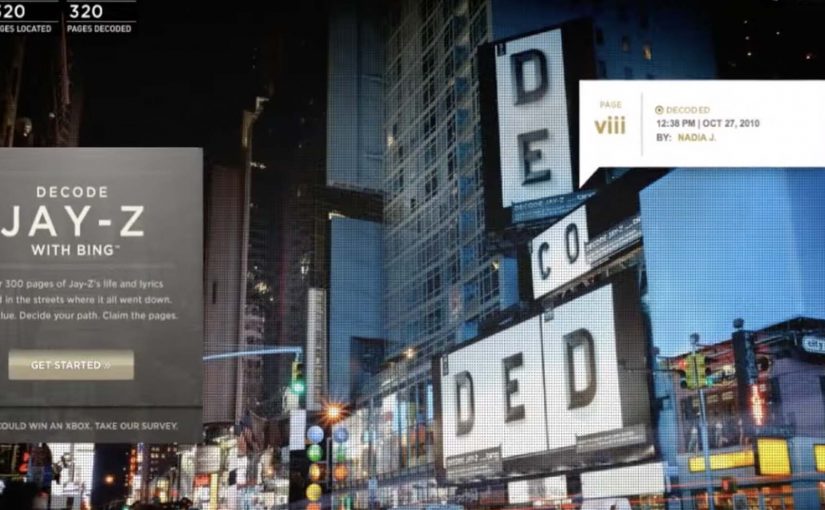

Bing: Decode JAY-Z

In a market dominated by Google, Bing wants to feel like a modern choice, and a younger audience is the fastest route to relevance. So it partners with JAY-Z for the launch of his book Decoded.

A book launch that shows up in the real world first

Instead of revealing the book in one place, pages are unveiled in locations referenced on those pages: a Gucci jacket, a restaurant, a hotel pool, a pool table, a car, a bus stop, and a subway. The stunt turns reading into a hunt, and turns “promotion” into something you can physically stumble into.

How the decode game works

Bing ties the physical reveals to an integrated game where fans assemble the book digitally using Bing Search and Bing Maps. Clues to page locations are released daily across Facebook, Twitter, and radio, pushing fans back into search behavior and map-based navigation as part of the entertainment.

In consumer search platforms, discovery mechanics that bridge real-world locations and digital navigation can turn a launch into participation.

Why it lands with a younger audience

The mechanics reward curiosity, speed, collaboration, and social proof. Finding a page is a story you can post. Decoding a clue is a micro-win. Watching the book come together feels like progress you helped create, not content that was simply handed to you. That works because each clue forces a Search and Maps action, so the product becomes the route to the reward.

Extractable takeaway: If you want a younger audience to adopt a utility product, tie progress to repeatable micro-wins that are easy to share.

The business intent hiding in plain sight

For Bing, the goal is not only buzz around Decoded. It is repeated usage of Search and Maps in a context where using the tools feels like play, not a utility task. The partnership borrows cultural gravity from JAY-Z, then converts it into product interaction.

The real question is whether your launch can force repeat product actions, not just cultural attention.

This is stronger than a celebrity endorsement, because it makes Search and Maps the game board instead of the backdrop.

Steal the decode launch mechanics

  • Make the “content” unlockable. People value what they have to discover, not what they are merely shown.
  • Anchor digital behavior to a physical trigger. Real locations make clues feel concrete and worth chasing.
  • Ship a daily cadence. Drip-fed clues keep attention warm without demanding long sessions.
  • Design for sharing as proof-of-work. Proof-of-work here means a visible signal that you did the effort, not just consumed the content.

A few fast answers before you act

What is “Decode JAY-Z” in one line?

A scavenger-hunt book launch where pages appear in real places, and fans use Bing Search and Bing Maps to find and assemble the book digitally.

What are the key mechanics?

Location-based page reveals, daily clues distributed through social and radio, and a digital assembly experience built around search and maps.

Why does this work better than a standard launch?

It converts passive awareness into repeat actions, and each action produces a shareable win that keeps the loop going.

What is the transferable takeaway for product marketing?

If your product is a tool (search, maps, utility apps), embed it inside a game where using the tool is the fun, not the homework.

What should you measure to know it worked?

Track repeat usage of the specific features you embedded in the game (search queries, map actions, and return visits), not only reach or mentions.

Magnum Pleasure Hunt 2: bigger, bolder sequel

Last year, to launch the all new Magnum Temptation Hazelnut ice-cream, Swedish agencies Lowe Brindfors and B-Reel created an advergame, a branded game built to promote a product, called “Magnum Pleasure Hunt Across The Internet”. In the game, players are taken across 20 well known websites as they collect Bon Bons, the special ingredient of the Magnum Temptation Hazelnut ice-cream.

Since the game did exceedingly well, Magnum and team came up with round 2, enhanced with 3D graphics. This time players were taken on a run in New York, made to fly over Paris, and surf the waves in Rio De Janeiro, using a map and street-view style interface as the playground.

What changes from round 1 to round 2

The first game is a browser-bending sprint that treats the wider internet as a set of levels. The sequel shifts the same chase mechanic into city environments, with more depth, more spectacle, and clearer “set pieces” you can remember after one play.

In global FMCG brand launches, advergames like this work when they turn “a product promise” into a simple, replayable challenge people can explain in one sentence.

The real question is whether your sequel escalates the world without changing the one rule people already learned.

  • Round 1: web-hopping levels and Bon Bons as the core collectible.
  • Round 2: city-based runs plus a stronger 3D feel for movement, obstacles, and momentum.

Why it lands: it feels like discovery, not advertising

This is not a microsite you click once and forget. It is designed as a time-and-score loop. You play again to improve your route, your timing, and your collection count, and that repeat play is where the brand association gets built. It also matches Magnum’s “pleasure seeking” positioning with a mechanic that is literally a hunt. Because the loop rewards replay with visible improvement, the hunt association gets reinforced without asking the player to read a product pitch.

Extractable takeaway: When the brand promise is an action verb, make that verb the gameplay loop, and make replay the fastest way to feel the promise again.

The smart brand logic behind the Bon Bons

Bon Bons are a neat choice because they let the product story travel inside the gameplay. You are not only collecting points. You are collecting the “ingredient” that makes the new variant feel specific, even if you never read a product description.

I think it is a great follow up to the first version. Magnum Pleasure Hunt 2 could be experienced at www.pleasurehunt2.mymagnum.com.

Sequel campaign rules worth copying

  • Keep the core rule the same. Sequel energy comes from familiarity, then escalation.
  • Upgrade the world, not the instructions. New environments create novelty without re-teaching the game.
  • Build signature moments. New York, Paris, and Rio act like memorable chapters, not just backgrounds.
  • Make it easy to share a result. If the outcome is a score or time, people instantly understand what “good” looks like.

A few fast answers before you act

What is Magnum Pleasure Hunt?

It is a branded advergame where players chase and collect Magnum Bon Bons, originally by racing across well known websites as game levels.

What is different about Magnum Pleasure Hunt 2?

The sequel moves the action into city environments, adds a more cinematic 3D feel, and turns New York, Paris, and Rio into distinct stages of the chase.

Why does the “hunt” mechanic fit the Magnum brand?

Because it translates the idea of “pleasure seeking” into a simple action loop. Keep moving, keep collecting, keep chasing the next reward.

What makes an advergame replayable enough to matter?

Clear scoring, short rounds, and visible improvement. If players can beat their own time or score, they come back.

What is one practical takeaway for marketers?

If you plan a sequel, keep the rules familiar and escalate the world. That is how you get “new” without losing the audience you already earned.