
KLM: Disney’s Planes Pre-Screening on a Plane

KLM: Disney’s Planes Pre-Screening on a Plane

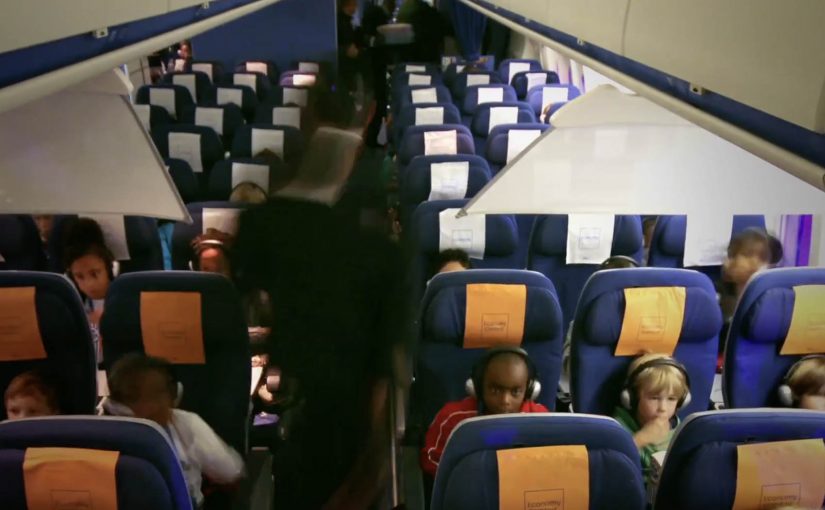
On October 2, KLM gave 300 kids an experience of a lifetime. The lucky kids were invited to a spectacular pre-screening of the new Disney film Planes.

To make the event unforgettable, KLM held the pre-screening on an actual airplane, then used timed special effects to recreate the world of Planes in a live setting around the aircraft. KLM described it as the world’s first movie experience in and around a plane.

A movie theatre that already has wings

The clever bit is not “screening a film on a plane”. That is normal. The clever bit is synchronizing the environment with the story so the audience feels like the film has leaked into real life.

In airline and travel brands, immersive launches work best when the setting is native to the promise you sell.

The real question is whether your launch idea could only happen in the world your brand already owns.

This is worth copying because it makes the brand story feel inevitable rather than advertised.

The most memorable launches turn passive viewing into a physical moment that people can retell in one sentence.

Why it sticks

It sticks because the story, the setting, and the timed effects all reinforce the same feeling, and the audience experiences it rather than just watching it.

Extractable takeaway: Immersive brand experiences land when the environment is part of the content. If you can make the setting behave like the story, you create a memory people repeat for you.

It collapses brand and story into one setting. An airline is already a stage for travel narratives. Parking a film about aircraft inside a real aircraft makes the connection immediate.

It treats immersion as service, not spectacle. The effects are not there to show off production budget. They are there to make the kids feel looked after and included in something that cannot be repeated at home.

It earns conversation because the headline is simple. “They screened Planes on a plane” is a line anyone can pass on. The live effects turn that line into a story worth sharing.

Steal the sync-moment playbook

  • Pick a venue that makes your message inevitable. The location should do half the explaining before a single word is said.
  • Design “sync moments”. By “sync moments” I mean timed physical cues that match a few key beats so people feel the story, not just watch it.
  • Optimize for retellability. If the concept cannot be summarized in one sentence, it will not travel as earned media.
  • Make the audience the hero. For kids especially, the emotional memory is the product. The brand benefit follows.

A few fast answers before you act

What did KLM actually do here?

They hosted a pre-screening of Disney’s Planes for 300 kids inside a real aircraft and staged timed effects around the plane to mirror moments from the film.

Why is the airplane venue more than a gimmick?

Because it is native to both the brand and the story. It makes the experience feel “only possible with KLM”, which is the point of experiential work.

What makes this different from a normal premiere?

The environment is synchronized to the content, creating immersion. It is closer to live theatre than to a standard screening.

What is the business intent behind an event like this?

To build brand affinity and memorability, especially with families, by creating a high-emotion story people associate with the airline.

What is the most transferable lesson?

Choose a setting that embodies the message, then add a few well-timed sensory cues that turn viewing into a felt experience.
Heineken Departure Roulette En Route

Heineken Departure Roulette En Route

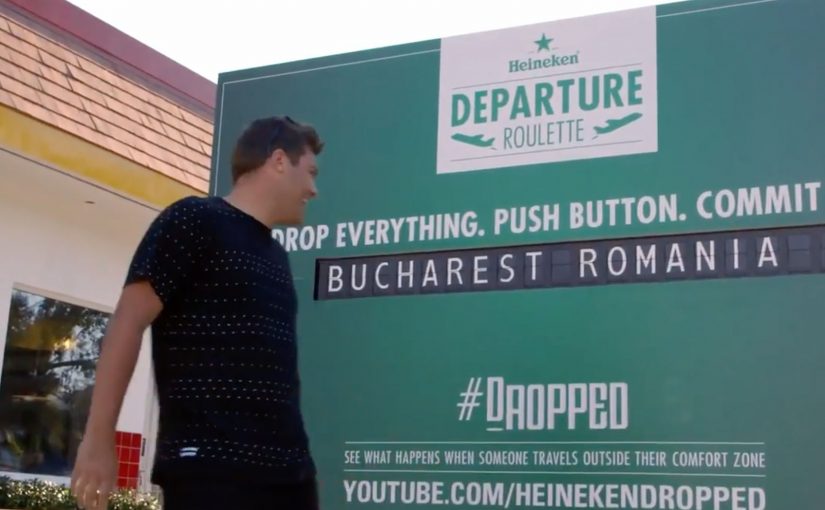
Heineken spots the tweets. Then they make them real. People watch the original Departure Roulette stunt and post the inevitable line on Twitter: “I’d press the button.” Heineken takes that public intent seriously. They track down a few of the people who tweet about wanting to play. Then they offer them the chance to play Departure Roulette on the spot. Real time, real commitment, no rehearsal.

If you want the backstory first, the original Departure Roulette activation sets the frame: a physical roulette board at JFK Terminal 8. One red button. Press it and you accept a new destination immediately. Read about the original here.

What “En Route” gets right: it turns social intent into action

The smartest part of this follow-up is not the surprise. It is the mechanism. Heineken treats social conversation as a live signal of willingness, not just commentary. Here, “social intent” means an explicit public statement like “I’d press the button,” not passive engagement. By acting on that signal fast enough to feel connected, the brand turns curiosity into a credible story of commitment.

Extractable takeaway: When people declare intent in public, treat it as an opt-in trigger. Respond fast with a real commitment moment, and make the decision itself the content.

The real question is whether you can turn “I’d do that” intent into a real commitment fast enough to feel causal, while keeping consent and safety airtight.

If you cannot deliver the commitment reliably in real time, you should not run this pattern.

It rewards declared intent in public

A tweet is a lightweight commitment. Heineken upgrades it into a real decision. The gap between “I would” and “I did” becomes the content.

It closes the loop from earned media to owned experience

The original stunt earns attention. The follow-up re-enters the stream where that attention lives. Social becomes a trigger for a real-world activation, not just a distribution channel.

It stays consistent with the campaign’s core promise

Departure Roulette is about spontaneity and courage. The follow-up keeps the same proposition, just delivered to a different moment and audience.

In global consumer brands running real-time social and experience programs, the advantage comes from turning explicit public intent into a safe, opt-in moment of commitment.

What to measure beyond views

  • Intent volume. How many people explicitly say they would do it.
  • Conversion rate. Percentage of selected participants who actually commit when approached.
  • Time-to-response. How quickly you move from trigger to activation.
  • Amplification quality. Replies and quote-posts that debate “would you do it,” not just “nice video.”
  • Brand linkage. Whether the audience repeats the core idea (spontaneity, adventure), not just the prank.

Risks and guardrails that matter

  • Consent and privacy. Do not approach people in a way that feels extractive. Keep it clearly opt-in.
  • Safety and duty of care. High-stakes travel stunts need hard boundaries, support, and contingencies.
  • Credibility. The offer must be unquestionably real, or the story collapses into suspicion.
  • Operational readiness. The logistics are the product. If ops fail, the story turns.

How to reuse this pattern without copying the stunt

  1. Define the “press the button” moment. Pick one unmistakable action that proves intent.
  2. Listen for explicit triggers, not vague sentiment. Look for “I would,” “I want,” or “If you did this I’d…” rather than likes alone.
  3. Respond fast enough that it feels connected. If the follow-up arrives too late, it reads like a promotion, not a story.
  4. Make the commitment real, but safe. Build constraints on timing, eligibility, logistics, and consent.
  5. Capture the decision, not just the reward. The moment of choice is the asset. The prize is the justification.

A few fast answers before you act

What is Departure Roulette En Route in one line?

It is a social-powered follow-up where Heineken turns “I’d press the button” tweets into a real-world chance to do exactly that.

Why does it spread?

Because it stages a high-stakes, relatable decision in public: keep your plan, or choose the unknown.

What is the reusable strategy?

Treat public intent as a trigger for action. Then deliver a real experience that proves the brand promise.

What is the minimum viable version for a brand without travel budgets?

Reward declared intent with an immediate upgrade: surprise access, exclusive drop, instant appointment, or fast-track service.

Where does this go wrong fastest?

When it feels like surveillance, or when the logistics do not deliver on the promise.

MINI: Salutes You in London

MINI: Salutes You in London

In August I wrote about how Coca-Cola Israel used technology to personalise billboards for people who drove by.

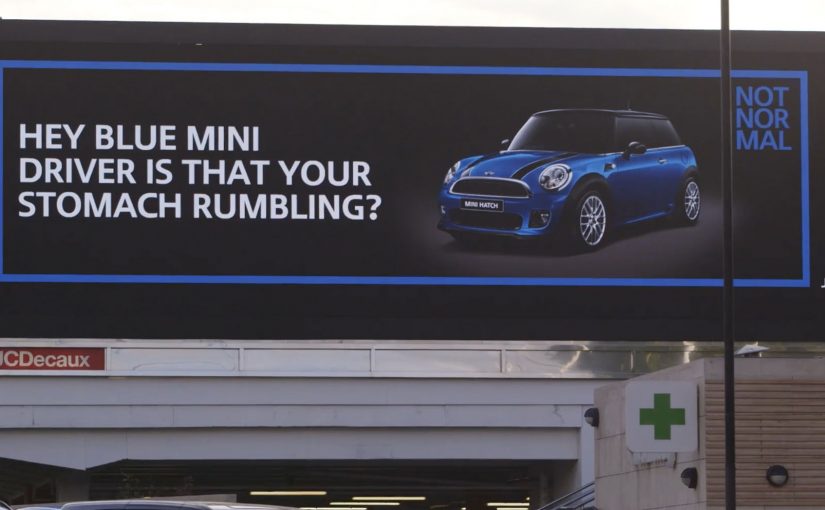
Now, as part of its ongoing Not Normal campaign, MINI decides to give MINI drivers in London a custom message by taking over a run of giant billboards along a fast-paced road for a two-week period. “Not Normal” is the positioning line for celebrating owners over product claims.

Reportedly, the campaign reached out to 1,941 MINI drivers in London during the run.

How the billboards “recognise” drivers

The mechanism is deliberately human. Spotters use iPads to identify approaching MINIs and trigger the right creative. Each message is sent with pictures of the make and model of the MINI it relates to, so the driver sees something that feels directed, not generic.

In urban out-of-home advertising, combining live triggers with personalised creative can make a brand message feel like a service moment, not just media.

A human-triggered approach is the right call on a fast road, because it keeps the moment specific without pretending you have perfect recognition tech.

Why this lands on a road, not in a feed

Most personalised media is private and one-to-one. This flips it into a public setting. The driver gets a direct salute, and everyone else sees a brand that appears to be paying attention to its community in real time. That publicness is the multiplier, because it turns a personal moment into shared talk value, meaning people retell it.

Extractable takeaway: Public personalisation works when the proof cue is instantly legible to bystanders, not just meaningful to the target.

What the campaign is really doing for MINI

The work reinforces the Not Normal positioning by celebrating owners rather than pushing product claims. It also turns “existing drivers” into the hero audience, which is a neat way to build loyalty and social proof at the same time.

The real question is whether the salute feels like a genuine community nod, not a clever stunt.

Transferable moves from MINI Salutes You

  • Use a simple trigger and a clear payoff. Recognition plus a tailored line is enough if the timing is perfect.
  • Keep it brand-native. A salute fits a community brand. A hard sell would break the spell.
  • Make personalisation visibly specific. Showing the make and model is the proof cue that prevents it feeling random.
  • Design for safety and readability. Short messages, high contrast, instant comprehension.

A few fast answers before you act

What is “MINI Salutes You” in one line?

A digital out-of-home activation that displays personalised messages to MINI drivers as they pass selected London billboards.

How are the personalised messages triggered?

Human spotters using iPads identify approaching MINIs and trigger the relevant creative, including make and model visuals.

Why use billboards for personalisation?

Because it makes recognition public. The driver feels noticed, and bystanders see a brand visibly celebrating its community.

What do you need to make this work without advanced tech?

A small set of tightly written messages, clear proof cues (like make and model), and a reliable human trigger that can fire the right creative at the right moment.

What is the main transferable lesson?

If you can time a simple personalised moment perfectly, you do not need complex tech to create a campaign people retell.