
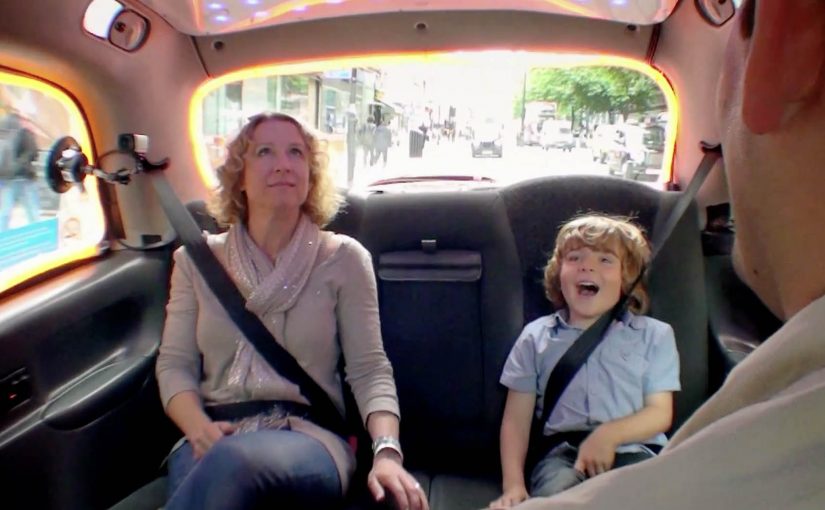
LivingSocial: Roll the Dice Taxi

Taxis are becoming a great media for unexpected advertising. In London, LivingSocial takes over an everyday cab and turns it into a surprising, delightful experience.

The objective is simple. Create buzz around the LivingSocial website and showcase the variety of discounts in a way that feels like a story, not a sales pitch.

A taxi ride with a fork in the road

When unsuspecting passengers hail this special taxi and get inside, they are offered a choice. Carry on to their original destination, or “roll the dice” and go for an experience instead.

The decision is the hook. The passenger stays in control, but the brand turns that control into a game, and the game turns a normal ride into a memorable narrative.

In urban commuter cities, a taxi ride is one of the few time-boxed moments where a brand can own the environment end-to-end.

Why the gamble is more persuasive than the pitch

This works because it reframes discount discovery as adventure. The “roll the dice” option creates a moment of suspense, and suspense buys attention better than any list of offers ever will.

Extractable takeaway: If you sell a broad catalogue of offers, do not lead with the catalogue. Lead with a simple, voluntary choice that creates emotional momentum, then let the catalogue appear as the natural payoff for choosing to play.

While the ride plays out, the experience is described as feeding contestants a long stream of sales information. The trick is that the information arrives while the passenger is already invested in what happens next, so it feels like part of the ride rather than an interruption.

The real business intent behind the stunt

At the surface, this is “surprise and delight.” The real question is whether you can turn an everyday ride into a voluntary choice people want to retell. Underneath, it is a conversion engine. It demonstrates the breadth of deals, pushes people into trying something they would not normally consider, and gives them a story they want to retell.

Steal this pattern for city-scale activations

  • Offer two paths. A safe default and a bold option. The contrast makes the bold option irresistible.
  • Make the choice voluntary. Consent turns skepticism into curiosity.
  • Let the content ride shotgun. Teach benefits during the experience, not before it.
  • Design for retellability. Make the twist easy to repeat in one sentence, like “a taxi that lets you roll the dice for a surprise destination.”

A few fast answers before you act

What is the LivingSocial Taxi Experiment?

It is a branded taxi experience where passengers can either continue to their original destination or roll the dice and be taken to a surprise experience that showcases LivingSocial deals.

Why does the “roll the dice” mechanic work?

It creates suspense and a sense of ownership. The passenger chooses the gamble, which makes the experience feel like their story, not the brand’s stunt.

What is the key mechanism that makes this shareable?

A clear, explainable twist on a familiar behavior. Taking a taxi becomes a game with a surprising payoff, which people naturally want to describe to friends.

How do you adapt this pattern without a taxi fleet?

Find a time-boxed environment you can fully control, introduce a simple forked choice, and make the “bold” path deliver a visible, memorable payoff that naturally carries your product story.

What is the simplest way to judge if it worked?

If people can retell the twist in one sentence and explain why they chose the bold path, you built something that travels beyond the ride.

Mercedes-Benz: Tweet-Fueled Road Trip Race

In February this year four two-person teams left four cities, Chicago, Los Angeles, New York City, and Tampa Bay, to goto Dallas, Texas in a custom-designed Mercedes-Benz car that was fuelled by Twitter.

Of course the cars were not physically running on tweets, but virtually they were. The reason for Mercedes-Benz saying that the race was “Tweet-Fueled” was because each of the four teams had to get the support of their home cities to drum up enough support on Twitter to get them to the finish line in Dallas.

In the end the campaign had almost 30,000 active participants with over 72,000 Facebook Fans and 77,000 Twitter Followers who generated over 150,000+ tweets to power the cars. The campaign videos generated about 2 million views, while the twitter reach pushed over the 25 million mark.

Why “tweet-fueled” is more than a gimmick

The smart move is that social support is not commentary. It is the engine of progress. That turns spectators into participants, because every tweet has a clear meaning. It helps your team move. In large consumer brands, this kind of real-time mechanic works best when the audience action maps to a visible outcome.

Extractable takeaway: When the audience can see their social action move a scoreboard, participation scales beyond one-off commenting.

  • Clear cause and effect. Tweets translate into distance and momentum.
  • City pride as a driver. Chicago vs LA vs NYC vs Tampa gives the story a natural rivalry.
  • Built-in recruiting. Teams need their cities, so they recruit friends to contribute.

How the campaign design created scale

The structure is simple. Four teams. One destination. A visible race. But it is the social mechanics that create the volume.

The real question is whether your campaign turns audience action into trackable progress that people can influence in real time.

  1. Teams need advocates. Supporters feel like they are part of the outcome.
  2. Progress is trackable. People return when they can see movement and standings.
  3. Video extends the narrative. Moments from the road give the audience something to share beyond the scoreboard.

In real-time social entertainment, participation scales when the audience can visibly change the outcome, not just comment on it.

What to take from this if you build real-time social campaigns

  1. Make participation meaningful. If the social action changes the outcome, people care more.
  2. Create teams and identity. Groups recruit. Individuals browse.
  3. Design a visible progress loop. Standings and milestones keep engagement alive.
  4. Use content to refresh attention. Videos give people new reasons to re-share and re-engage.

A few fast answers before you act

What was the Mercedes-Benz Tweet-Fueled race?

It was a social-powered race where four teams drove from Chicago, Los Angeles, New York City, and Tampa Bay to Dallas, and their progress was powered virtually by Twitter support from their home cities.

Why were the cars called “tweet-fueled”?

Not because tweets powered engines physically, but because tweets served as the mechanism that enabled teams to accumulate the support needed to reach the finish line.

What were the reported results?

Almost 30,000 active participants, over 72,000 Facebook fans, 77,000 Twitter followers, more than 150,000 tweets, about 2 million video views, and Twitter reach exceeding 25 million.

Why does the city-based structure matter?

It creates rivalry and pride, which motivates supporters to participate and recruit others to help their team advance.

What is the transferable lesson?

If you can turn social activity into measurable progress toward a clear goal, you can convert audience attention into sustained participation.

Tipp-Ex: A Hunter Shoots a Bear

If you have ever wanted to hijack a storyline mid-play, Tipp-Ex delivers a brilliant “wait, what?” moment. A hunter is about to shoot a bear. Then the video breaks its own frame. The hunter reaches out, grabs Tipp-Ex, whites out the word “shoots” in the title, and invites you to write your own verb instead.

One verb becomes the remote control

This is an interactive YouTube takeover ad where the headline is the interface. You type a command into the title, and the story branches into a matching outcome. It is simple enough to explain in one line. It is also instantly rewarding, because you see the consequence of your input right away.

The real question is whether your audience can understand the control in one glance and feel the payoff in one click.

In European FMCG marketing, few products have a built-in metaphor as literal as correction tape: white it out, then rewrite.

This is interactive video done right: it hands the viewer a single, obvious control. Replace one verb in the title, and the story instantly branches into a matching ending. That mechanism makes the product demonstration inseparable from the entertainment.

Why it lands: you are not watching, you are steering

The psychological hook is viewer control with near-zero friction. You are not asked to learn a UI, register, or navigate a microsite. You do one small thing (type a verb), and you get a big payoff (a fresh scene). That combination of viewer control and immediacy turns curiosity into repeat plays, because every new verb feels like another door.

Extractable takeaway: One obvious input plus an immediate, visible change is the fastest way to turn curiosity into repeat plays.

The business goal hidden inside the gag

Tipp-Ex is not just sponsoring a funny clip. The brand behavior is the plot device. “White and rewrite” is demonstrated, not stated. The longer you experiment, the longer you stay with the brand idea, and the more likely you are to share it as “you have to try this.”

Steal the one-verb control pattern

  • Make the control obvious. One input. One immediate, visible change.
  • Fuse product truth with interaction. The mechanic should only make sense for this brand.
  • Reward experimentation. Curiosity loops need fast feedback, not a slow reveal.
  • Design for retelling. People share experiences they can describe in one sentence.

A few fast answers before you act

What is “A Hunter Shoots a Bear” for Tipp-Ex?

An interactive video campaign where the viewer changes the story by editing a single word in the video title, turning the headline into the control surface.

What is the core mechanism that makes it interactive?

The campaign asks the viewer to replace the verb in the title and then routes them to a matching video outcome, so the typed command becomes the next scene.

Why did this format spread so widely?

It gives immediate viewer control and fast feedback. People share it because they can describe the interaction in one line and friends can instantly try their own outcomes.

What brand intent does this serve beyond “being clever”?

It makes Tipp-Ex (a correction tool) inseparable from the interaction. The product truth is the mechanic, so the brand is not optional to the idea.

What is the most transferable takeaway?

When the interaction is one obvious input with one visible change, curiosity turns into repeat play, and repeat play turns into distribution.