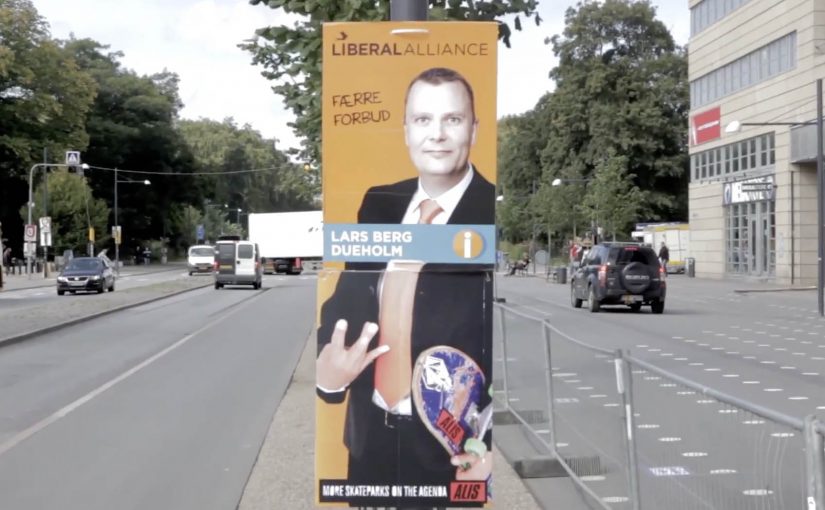
Original Danish election posters go up as usual. Then ALIS adds a few new visual elements that flip the meaning, ending with a simple line: “more skateboards on the agenda.”
“Take action in your life and reALISe your dreams” is the intention behind ALIS, established by Albert Hatchwell and Isabelle Hammerich and grown from an underground movement in Christiania into a company that creates opportunities and inspiration.
In a fun and well-thought guerrilla activity in Denmark, ALIS takes existing election posters and extends them with a skateboarding twist. The result sits right on the boundary between civic campaigning and street culture, using the familiarity of political posters to smuggle in a different agenda.
A guerrilla twist on election season
The mechanic is simple. Start with something everyone recognizes, a candidate poster. Add just enough to reframe it. Then leave it in the wild so people discover it, photograph it, and spread it for you.
In Nordic youth-culture marketing, repurposing civic symbols can earn disproportionate attention when the tone stays playful rather than destructive.
Why it works as shareable street media
It is instantly legible. You do not need to know the brand, the candidate, or the backstory. The “before and after” reads in a second, and the idea feels like a wink rather than a lecture. Because the “before and after” reads in a second, a single photo carries the whole story, which is why it spreads.
Extractable takeaway: Treat this as an ambient execution, meaning you reuse existing public poster inventory as your first distribution layer, then let photography and sharing do the rest.
What ALIS is really buying
This is identity reinforcement. ALIS signals what it stands for, skateboarding and youth culture, by inserting itself into a mainstream moment and making it feel slightly more “theirs”. The real question is whether your reframing is clear enough that strangers do the distribution for you. This kind of remix works best when the intervention reads as playful and reversible. The budget stays low because the distribution is social. The street provides the first audience. Cameras and sharing provide the second.
How to remix a familiar format cheaply
- Borrow a familiar format. Start with something people already read without thinking.
- Change one thing that changes the meaning. The smallest edit with the biggest reframe wins.
- Design for photos. If it does not capture clearly, it will not travel.
- Keep it non-destructive. Playful add-ons land better than anything that looks like vandalism.
A few fast answers before you act
What is “Election Poster Skate Attack”?
A guerrilla-style ALIS action that adds skateboard-themed elements to existing Danish election posters, ending with the message “more skateboards on the agenda.”
Why use election posters as the canvas?
Because they are already designed to grab attention in public space. A small twist on a familiar political format becomes instantly noticeable.
What makes this feel “earned” rather than “paid”?
The distribution comes from discovery and sharing. People see it, smile, photograph it, and pass it on without needing media spend.
What is the main risk with poster hacks like this?
Being perceived as vandalism. The execution needs to read as a light, non-destructive add-on, not damage.
How can a brand apply the pattern safely?
Borrow a recognizable public format, alter it with a single clear reframe, and ensure the intervention is reversible and legally defensible.