
Norwegian Airlines: Red Cab Remote Taxi

A shopper in an Oslo mall steps up to a big screen and “hails” a cab in New York City. Seconds later, they are effectively riding along in real time, steering what they see and getting a guided tour from someone inside the taxi.

Remote sightseeing as a route launch

Norwegian Airlines creates an interactive experience that lets visitors in an Oslo shopping mall control a New York City taxi in real time. A tour guide inside the cab helps participants discover New York while building awareness of Norwegian’s direct long-haul destinations from Oslo to New York, Miami, LA, San Francisco, and Bangkok.

The mechanism: viewer control, live feed, human guide

The activation is built like a two-way window. A live camera setup in the taxi transmits the streets of New York back to the mall installation, and mall visitors can influence what they are seeing while talking with the person in the cab who keeps the “tour” moving. Here, viewer control means the participant can steer the camera’s attention and request what the cab shows next. That matters because even light control makes the experience feel personal, which turns passive watching into active participation.

It is also described as an M&C Saatchi Stockholm idea with production support from Stopp, using a 360-degree style camera approach to make the feed feel explorable rather than like a fixed livestream.

In European airline marketing, real-time remote experiences can make new long-haul routes feel tangible before anyone commits to a flight.

Why this lands

This works because it turns a schedule update into a lived moment. People do not just hear “we fly direct.” They experience the destination, live, in a way that creates an instant story to tell. The red cab visual also keeps the brand present throughout the interaction without needing heavy-handed messaging.

Extractable takeaway: When you are launching access (routes, coverage, delivery zones, service areas), design a live, controllable preview that lets people feel the place or outcome, then attach the brand benefit as the enabler of that experience.

What Norwegian is really buying

The stunt earns attention like an event, but it is strategically a conversion tool. It reduces psychological distance to long-haul travel by giving people a low-friction “trial,” and it reframes the airline as a bridge between cities rather than as a price-and-seat product.

The real question is whether a route launch can make distance feel emotionally short before the first booking happens.

What to steal from Red Cab

  • Turn claims into access. If your promise is reach, let people sample the reach.
  • Use a human guide. A live host makes the experience coherent, warm, and watchable.
  • Design for the crowd. Make the installation entertaining for bystanders, not just the participant.
  • Make the brand a prop. The red cab functions as an always-on brand cue without interrupting the experience.

A few fast answers before you act

What is Norwegian Red Cab?

It is a mall-based interactive installation where people in Oslo can explore New York City through a live taxi connection, with a guide inside the cab.

What does “control the taxi” mean here?

It refers to viewer control over the live viewing experience, such as directing the camera perspective and interacting with the person in the cab, rather than physically driving the vehicle.

Why is real-time important to the idea?

Because “live” removes doubt. It makes the destination feel present, which strengthens the message that direct long-haul routes bring far-away places closer.

What makes this more than a livestream?

The combination of viewer control and a human tour guide turns passive watching into an experience people can participate in and retell.

What’s the main operational risk with this pattern?

Reliability. If latency, audio, or camera control fails, the magic breaks quickly, so technical robustness matters as much as the creative concept.
MINI: Salutes You in London

In August I wrote about how Coca-Cola Israel used technology to personalise billboards for people who drove by.

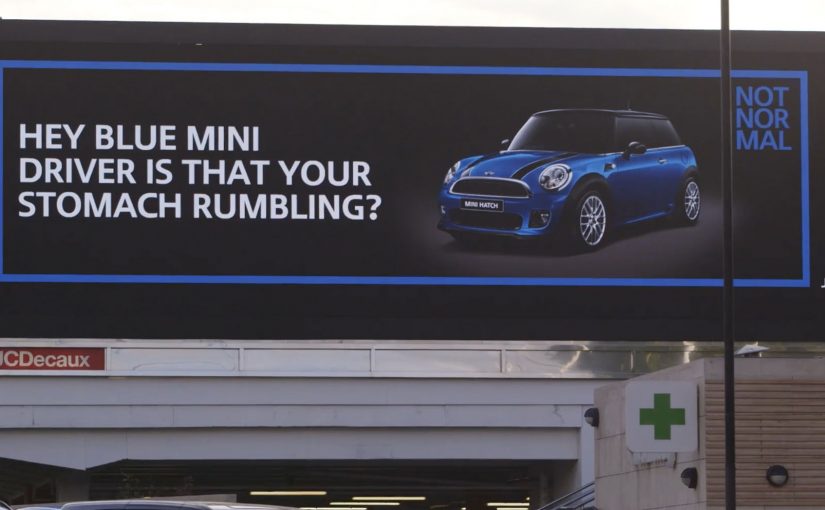
Now, as part of its ongoing Not Normal campaign, MINI decides to give MINI drivers in London a custom message by taking over a run of giant billboards along a fast-paced road for a two-week period. “Not Normal” is the positioning line for celebrating owners over product claims.

Reportedly, the campaign reached out to 1,941 MINI drivers in London during the run.

How the billboards “recognise” drivers

The mechanism is deliberately human. Spotters use iPads to identify approaching MINIs and trigger the right creative. Each message is sent with pictures of the make and model of the MINI it relates to, so the driver sees something that feels directed, not generic.

In urban out-of-home advertising, combining live triggers with personalised creative can make a brand message feel like a service moment, not just media.

A human-triggered approach is the right call on a fast road, because it keeps the moment specific without pretending you have perfect recognition tech.

Why this lands on a road, not in a feed

Most personalised media is private and one-to-one. This flips it into a public setting. The driver gets a direct salute, and everyone else sees a brand that appears to be paying attention to its community in real time. That publicness is the multiplier, because it turns a personal moment into shared talk value, meaning people retell it.

Extractable takeaway: Public personalisation works when the proof cue is instantly legible to bystanders, not just meaningful to the target.

What the campaign is really doing for MINI

The work reinforces the Not Normal positioning by celebrating owners rather than pushing product claims. It also turns “existing drivers” into the hero audience, which is a neat way to build loyalty and social proof at the same time.

The real question is whether the salute feels like a genuine community nod, not a clever stunt.

Transferable moves from MINI Salutes You

  • Use a simple trigger and a clear payoff. Recognition plus a tailored line is enough if the timing is perfect.
  • Keep it brand-native. A salute fits a community brand. A hard sell would break the spell.
  • Make personalisation visibly specific. Showing the make and model is the proof cue that prevents it feeling random.
  • Design for safety and readability. Short messages, high contrast, instant comprehension.

A few fast answers before you act

What is “MINI Salutes You” in one line?

A digital out-of-home activation that displays personalised messages to MINI drivers as they pass selected London billboards.

How are the personalised messages triggered?

Human spotters using iPads identify approaching MINIs and trigger the relevant creative, including make and model visuals.

Why use billboards for personalisation?

Because it makes recognition public. The driver feels noticed, and bystanders see a brand visibly celebrating its community.

What do you need to make this work without advanced tech?

A small set of tightly written messages, clear proof cues (like make and model), and a reliable human trigger that can fire the right creative at the right moment.

What is the main transferable lesson?

If you can time a simple personalised moment perfectly, you do not need complex tech to create a campaign people retell.

Prigat: Smile Stations

Publicis Israel and e-dologic are back with a new campaign for Prigat, a leading company in the Israeli fruit juice market.

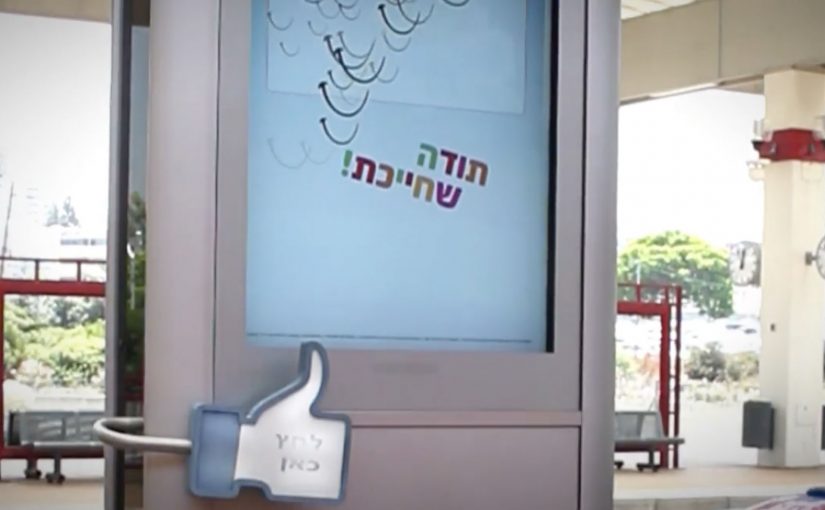
This time they use innovative digital billboards called “Smile Stations” to send real-time messages at various train stations. The aim is to get passers-by to smile, and “like” the moment.

The mechanic: turn a Facebook message into a station moment

It starts on the Prigat Facebook Page. People send messages that are pushed to screens at train stations. Commuters walking by can approach the screen and press a physical “Like” button.

That button press triggers a simple payoff. The billboard captures the moment, then broadcasts the video back to the person who sent the message. Users who generate the most smiles win a prize.

In busy public transit environments, interactive out-of-home works best when the action is obvious, the feedback is immediate, and the reward is shareable.

Why it lands: it makes public emotion measurable

Most out-of-home asks for attention. Smile Stations asks for a reaction, then turns that reaction into proof you can send back to the originator.

Extractable takeaway: If you want participation at scale, close the loop. Let a remote user trigger a real-world moment, let a passer-by respond with one physical action, then send that response back as a personal artifact the originator can keep and share.

Reported figures put this at over 10,000 messages sent to station screens, with thousands of people responding by hitting the Like button.

What the brand gets from this

The real question is whether a public display can turn a remote social prompt into a personal moment worth sharing.

This is stronger than passive digital out-of-home because the physical Like button reduces effort and the returned video turns a fleeting reaction into a personal memory both sides can own.

The campaign does not just generate impressions. It creates a two-sided interaction where both parties feel like they caused something to happen. That is a stronger memory structure than “I saw an ad”, especially in a context as repetitive as commuting.

What to steal for your own social-plus-out-of-home activation

  • Design a one-step physical interaction: one big button beats a complicated interface in public space.
  • Make the response visible: the passer-by should understand instantly that their action “counts”.
  • Return a personal artifact: sending the video back is what turns participation into sharing.
  • Gamify without friction: “most smiles wins” is a clean mechanic with no explanation overhead.
  • Pick locations with dwell time: stations work because people pause, look up, and wait.

A few fast answers before you act

What is a “Smile Station”?

It is an interactive digital billboard at a train station that displays user-submitted messages and invites passers-by to respond by smiling and pressing a physical Like button.

What makes this different from a normal digital billboard?

It is two-way. Remote users trigger messages, commuters respond physically, and the response is captured and sent back as video, creating a closed feedback loop.

Why include a physical Like button?

Because it removes friction. A single, tangible action is faster and more intuitive than asking people to pull out a phone, scan, or type.

How do you measure success for an activation like this?

Message volume, unique senders, Like-button presses, response rate per message, video shares by originators, and dwell time around the screen locations.

What is the main execution risk?

Latency and unclear feedback. If the system feels slow or people are unsure what their button press did, participation drops quickly in a commuter setting.