Durex: Baby App

Making the consequence tangible, not the lecture louder

In consumer health marketing, the hardest problems are rarely about information. They are about motivation in the moment. This Durex idea is a clean example of turning a behavior barrier into an experience.

Condoms are a downer. So how does one convince guys to put it on, and make Durex the favored choice.

Using the iPhone, Nicolai Villads, Peter Ammentorp and Raul Montenegro created what is called the Durex Baby application for the iPhone.

How the Durex Baby app worked as a behavioral nudge

The mechanism was simple. If the barrier is that protection feels like a mood killer, shift attention to what happens without it.

The app simulated the realities of having a baby, using the phone as a constant companion device. It turned an abstract risk into a persistent, personal experience that could be felt rather than explained.

Why simulation can change decisions faster than persuasion

Most messaging about safe sex competes with optimism bias. People assume consequences happen to someone else.

A simulation reduces that distance. It makes “later” feel like “now,” and it reframes the trade-off. Short-term inconvenience versus long-term responsibility. When the consequence feels immediate and specific, the decision calculus changes.

The intent behind building it for Future Lions

The app was created for the Future Lions 2010 competition organized by digital agency AKQA and the Cannes Lions Advertising festival.

The business intent is clear. Use mobile to translate a sensitive topic into a playful but pointed interaction that can travel socially and be discussed without heavy moralizing, while keeping the brand associated with the responsible choice.

What to steal from this idea

  • Turn abstract risk into felt experience. Simulation can outperform warnings when the audience tunes out lectures.
  • Use the device people always carry. Mobile is effective when the behavior change depends on everyday moments.
  • Reframe the trade-off. Move attention from short-term friction to long-term consequence in a way people can grasp instantly.
  • Make it discussable. Playful interaction can open conversation on topics people avoid in direct language.

A few fast answers before you act

What is the Durex Baby app?

An iPhone app concept that simulates the realities of having a baby to encourage safer choices and reduce resistance to using condoms.

What was the core mechanism?

Behavioral reframing through simulation. The phone delivers an ongoing experience that makes the consequence of not using protection feel immediate.

Why does this approach work better than a warning for some audiences?

Because it reduces optimism bias. People are more likely to change behavior when the consequence feels personal and present, not distant and theoretical.

What business goal does it serve for Durex?

Positioning the brand as the responsible default choice by shifting the decision from mood-based resistance to consequence-based clarity.

What is the main takeaway for marketers?

If persuasion is failing, design an experience that makes the outcome feel real, then let the audience reach the conclusion themselves.

Vodafone NZ: 1000 phones, 53 ringtones, 1 song

When “viral” requires real engineering

To create a viral video these days, you need to do something great and unique. Vodafone NZ hired a production team to orchestrate cellphones into “playing” Tchaikovsky’s 1812 Overture.

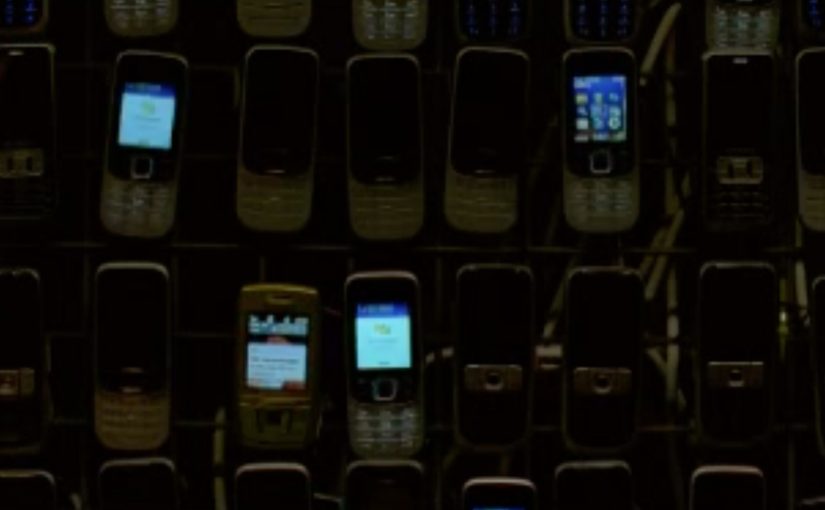
This was done using 1000 phones and 53 different ringtone alerts, synchronized to recreate the classical piece.

How 1000 phones became an orchestra

The mechanism was constraint-driven composition.

Instead of instruments, the “sound palette” was a fixed set of ringtone alerts. The team then arranged phones like sections in an orchestra and synchronized their playback so the combined output recreated the music.

What makes this work on camera is that you can see the system. Rows of devices. Repetition at scale. A human-built machine producing a familiar piece.

In global telecom marketing, the most shareable films often work because the effort is visible. Vodafone NZ’s Symphonia-style execution is a clean example of spectacle built from real craft.

Why the idea lands with viewers

It lands because it is both absurd and precise.

Absurd in the best way. A classical overture performed by ringtone alerts should not work. Precision is what makes it impressive. The viewer can sense the complexity without needing to understand the full production process.

It also bridges cultures. Highbrow music meets everyday tech, creating an unexpected contrast that feels fresh instead of forced.

The business intent behind the ringtone orchestra

The intent was to associate Vodafone with coordination, scale, and modern connectivity, without having to say those words.

Thousands of connected devices acting as one is a visual metaphor for a telco’s promise, and the film makes that metaphor entertaining rather than technical.

What to steal for your next “impossible” content idea

  • Make effort visible. When the craft can be seen, viewers reward it with attention and sharing.
  • Use a constraint as the hook. “Only ringtones” creates a clear challenge people instantly understand.
  • Engineer a spectacle that reads in one frame. Scale should be obvious without explanation.
  • Let the metaphor do the branding. Show coordination and connectivity instead of claiming it.

If you like the resulting tune, you can download it to your computer, as well as the 53 ringtones used to create it, from www.vodafone.co.nz/symphonia.


A few fast answers before you act

What did Vodafone NZ create?

A film where 1000 mobile phones, using 53 different ringtone alerts, were synchronized to perform Tchaikovsky’s 1812 Overture.

What is the core mechanism?

Constraint-driven composition. A fixed set of ringtone sounds becomes the “instrument set”, and synchronization plus physical arrangement makes the system readable on camera.

Why does it work as shareable content?

The effort is visible. The scale reads instantly, and the contrast between classical music and ringtones creates a surprising but coherent hook.

What business goal does this support for a telco brand?

It turns “connectivity at scale” into a watchable metaphor. Many devices acting as one becomes an entertaining proof of coordination and network promise.

What is the most transferable takeaway?

If you can make the constraint and the craft legible in one frame, the build itself becomes the reason people share.

Social Media Happiness

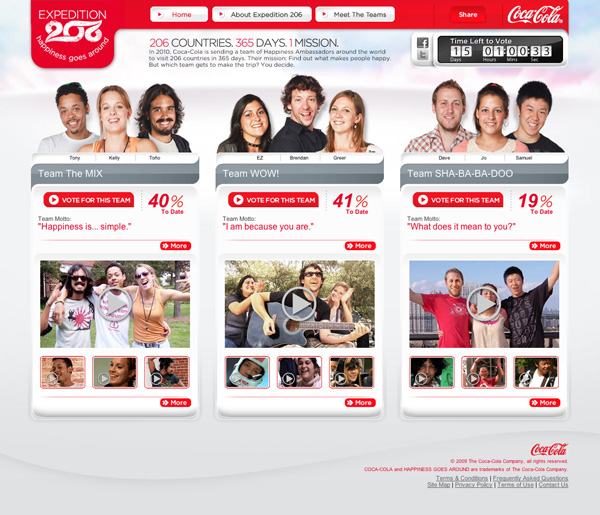
In a first of it’s kind undertaking, we are seeing Coca Cola using social media marketing and a travel campaign to tap into regular people to be their “Happiness Ambassadors” and travel the world for the whole of 2010 and document their entire quest via blog posts, tweets, YouTube videos, TwitPics, and other social media mentions.

Currently their is a contest in progress to shortlist the brand ambassadors whose mission will be to find happiness in the 206 different countries that sell Coca-Cola products across the world.

Expedition-206

The winning three-person team will begin their journey on January 1, 2010 and attempt to travel more than 150,000 miles in 365 days, visiting each of the 206 countries where Coca-Cola is sold. Their duty will be to engage with local denizens and uncover what makes them happy. After which they are to share their experiences online, and complete tasks in each country as determined by online voters.