
ROM: The American Takeover wrapper switch

ROM: The American Takeover wrapper switch

ROM, made by Kandia Dulce, is the traditional Romanian chocolate bar wrapped in the national flag. It has a nostalgic consumer base. But with younger Romanians it was losing ground to cooler American brands.

So McCann Erickson Bucharest launched “The American Takeover.” ROM’s familiar wrapper was replaced with an American-flag version to provoke the country’s ego and force a reaction. It is a risky deception, because the packaging is the product’s identity.

The trick was not the wrapper, it was the public reflex

The campaign doesn’t try to persuade with copy. It creates a cultural irritant and then lets people do the storytelling for it. By “cultural irritant,” I mean a small, unmistakable provocation that triggers public commentary. The outrage, debate, and defensiveness are the mechanism that “refreshes” ROM back into relevance for the people who had stopped paying attention.

In heritage FMCG categories, packaging is a symbol people feel they own.

The reveal is what makes the stunt more than trolling. The brand flips the wrapper back and turns the backlash into a point about identity, pride, and what it means when local icons try to imitate foreign cool.

The real question is whether you can trigger that reflex and still earn forgiveness when the reveal lands.

This approach is worth attempting only when the reversal is pre-planned and the reveal carries a clear meaning.

Why it worked: it made “cool” feel like betrayal

Younger audiences often default to global brands because the signals are easy. ROM makes that default choice emotionally expensive for a moment. When you see a national icon wearing another flag, you are forced to pick a side, even if you didn’t plan to care.

Extractable takeaway: If you want to revive a heritage brand with youth, you can borrow attention from the culture war around it. But you must do it with a clear reversal and a clear message, otherwise you just burn trust.

What McCann actually engineered

  • A single visual change that could be understood instantly.
  • A provocation that invited discussion beyond advertising channels.
  • A redemption arc that lets the audience feel proud again, and lets the brand look clever rather than cynical.

A legacy-brand refresh playbook

  • Change one symbol, not everything. One sharp deviation creates clarity and talkability.
  • Build a reversible stunt. You need a planned way back to safety once the reaction peaks.
  • Let people carry the message. When the audience argues for you, the brand feels revalidated.
  • Respect the sacred bits. If the brand has a national or cultural role, treat it like identity, not aesthetics.
  • Make the reveal the moral. The stunt is the hook. The reveal is the brand meaning.

A few fast answers before you act

What is “The American Takeover” for ROM?

It is a campaign where ROM replaced its Romanian-flag wrapper with an American-flag version to provoke public backlash, then used the reaction to reassert Romanian pride and renew interest in the brand.

Why was the wrapper switch so risky?

Because ROM’s wrapper is a national symbol as much as a pack design. When you touch that symbol, people react emotionally, not rationally.

What did the campaign win?

It is reported to have won top honours at Cannes Lions, including the Grand Prix in Promo & Activation, and it is also credited with winning the Direct Grand Prix.

What is the core lesson for consumer brands?

If your brand is culturally owned, you can regain relevance by staging a public argument about what it stands for. But the argument must end in a respectful reaffirmation, not a cheap shock.

When should you not copy this approach?

If you cannot control the reversal, if the symbol you are provoking is too sensitive, or if your brand does not have enough goodwill to survive a week of anger.

Coca-Cola: Santa’s Forgotten Letters

Coca-Cola: Santa’s Forgotten Letters

When childhood letters get answered years later

The city of Santa Claus is situated in the state of Indiana, USA. The museum in the city brings together different objects related to Santa Claus and has long received letters from people around the world, described as doing so for more than 70 years.

Coca-Cola with its ad agency Ogilvy Brazil selected 75 forgotten letters, meaning letters written to Santa as children that sat unanswered for years, and set out on an impossible task to find the writers and give them exactly what they asked for. The result was a touching movie that reinforces the magic of Christmas.

The impossible brief behind the film

The mechanism is straightforward and brutal in effort. Find a place where old letters to Santa were kept. Read through decades of messages that never got a reply. Select a small set of letters. Then track down the original writers and recreate the exact gifts they once requested.

In global FMCG holiday marketing, the fastest route to belief is to make generosity observable in the real world, not just promised in a tagline.

Santa’s Forgotten Letters is a Coca-Cola Christmas campaign by Ogilvy Brazil that turns archival letters into real deliveries, using the act of fulfilment as the proof of the story.

Why it lands: belief becomes physical

This works because it reverses the usual Christmas-ad formula. Instead of asking the audience to feel something while watching a film, it shows a real-world action first. The emotion is earned by the logistics.

Extractable takeaway: If you want “magic” to read as real, put the proof in the world first, then let the film simply document the effort.

The letters also do the writing for the brand. Each request is specific, personal, and time-stamped by childhood. That specificity makes the surprise feel less like marketing and more like closure.

The business intent hiding inside the sentiment

Coca-Cola is reinforcing a familiar role in the season. It wants to be the brand that protects the “magic” adults quietly miss, and it does that by staging a story people retell without needing to mention product features.

The real question is whether you can prove the sentiment with a concrete act, not just narrate it.

Done well, this is the right kind of sentiment-led brand work because it earns emotion through effort the audience can verify.

This is brand meaning built through a single, high-signal act that generates a long tail of earned conversation.

Steal this structure for earned emotion

  • Start with an artifact, not an insight. Real letters, real handwriting, real specificity.
  • Make the work visible. Show the searching, the tracking, the making, the delivery.
  • Let the recipients carry the truth. The reactions are the credibility layer.
  • Limit the scope to protect authenticity. A small number of deliveries can feel more believable than a mass stunt.

A few fast answers before you act

What is Coca-Cola’s Santa’s Forgotten Letters campaign?

It is a Christmas film built around a real-world fulfilment stunt. Coca-Cola and Ogilvy Brazil selected 75 old letters to Santa from Santa Claus, Indiana, tracked down the writers, and delivered the gifts they once asked for.

Where did the letters come from?

The letters were kept in Santa Claus, Indiana, where a local Santa-related museum had reportedly received letters for decades.

What is the mechanism, step by step?

Locate an archive of unanswered letters. Select a small set. Identify the original writers years later. Recreate the exact requested gifts. Deliver them, and film the search and the moment of fulfilment.

Why does the “old letters” device work so well?

Because it carries built-in specificity and credibility. A handwritten childhood request feels personal and time-stamped, so the fulfilment reads as earned rather than manufactured.

What should brands learn from this execution?

If you want belief, let the action do the persuading. Make the work visible. Keep the claim simple. Let real reactions carry the credibility.

What is the main risk with this kind of sentiment-led work?

If the fulfilment feels staged, scaled too broadly, or too polished, it can lose authenticity. Limiting scope and showing real effort helps protect trust.

The Swedish Post: The Sound of Green

The Swedish Post: The Sound of Green

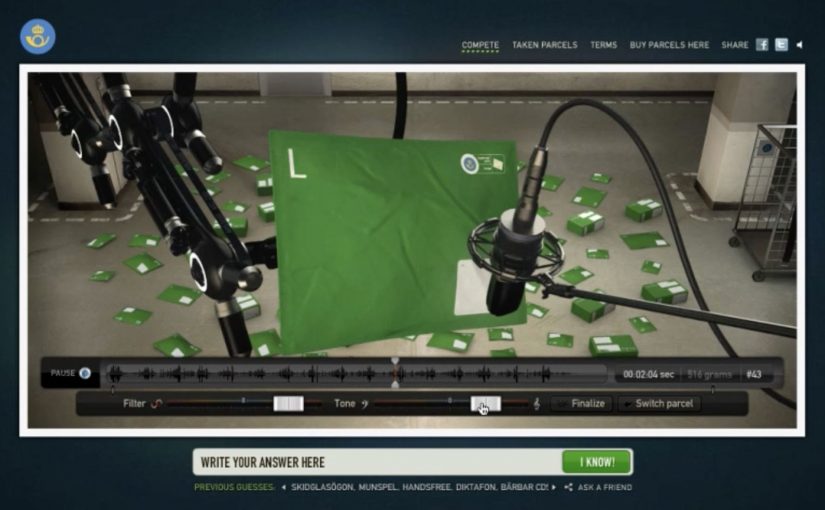
The Swedish Post has a collection of pre-stamped parcels that makes it easy to send things. The task for ad agency Åkestam Holst was to tell people that it was possible to send almost anything overnight with these pre-stamped parcels.

So they packed 80 parcels with all sorts of stuff and recorded 80 specific sounds. Those sounds powered “The Sound of Green” competition. Users picked a parcel, listened closely, and guessed what was inside. If they got it right, the Swedish Post sent the same parcel to the winner the very same day.

After a reported 140,240 guesses, the competition finally came to an end.

When proof beats promise

The mechanism is a neat translation of capability into play. Instead of listing what you can ship, you create 80 mystery parcels, record what they sound like, and let the public test their attention. The prize is not a voucher or a discount. The prize is the actual thing, delivered fast, which quietly demonstrates the core promise.

In consumer postal markets where “overnight delivery” sounds like a commodity claim, capability stories land better when they are demonstrated through a simple, repeatable experience.

The real question is whether the brand can make overnight delivery felt before someone ever ships a parcel.

Why it lands

This works because it turns logistics into curiosity. Sound is intimate and surprisingly hard to fake, so the listener leans in. The guessing format also creates a low-friction reason to spend time with the brand, and the same-day fulfilment makes the payoff feel real, not promotional.

Extractable takeaway: If you are selling an invisible service, build a public game that forces the benefit to show up as evidence, not copy.

What service brands can borrow

  • Demonstrate the promise. Replace “we can do anything” with proof people can experience.
  • Use a constraint to create focus. 80 sounds is large enough to feel rich, small enough to feel curated.
  • Make the prize the product. Shipping the parcel is the cleanest way to validate shipping.
  • Design for repeat attempts. A guessing mechanic naturally invites “one more try”.

A few fast answers before you act

What is “The Sound of Green”?

An online competition by the Swedish Post and Åkestam Holst where people listen to recorded parcel sounds, guess the contents, and winners receive the same parcel delivered the same day.

What is the core mechanism?

Pack real parcels, record the sounds they make, then let users choose a parcel sound and submit a guess. Correct guesses trigger real fulfilment.

Why use sound instead of photos?

Sound forces attention. It is less immediately obvious than visuals, and it creates a stronger sense of discovery when you finally figure it out.

What does this teach about marketing service businesses?

Claims are easy to ignore. Demonstrations are harder to dismiss, especially when the demonstration is interactive and ends in real delivery.

How do you keep a contest like this from feeling gimmicky?

Make the payoff identical to the promise. In this case, the reward is the service itself, delivered fast.