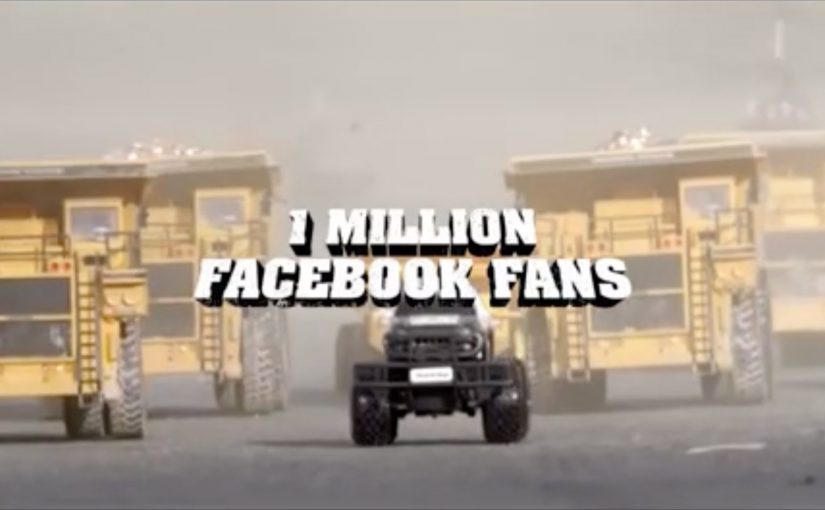
A security team clears the street in a quiet neighborhood. Neighbors step outside. Then a tiny convoy rolls in. 193 miniature “money trucks”, each loaded with 1-cent coins, drives up to the winner’s home and unloads one million cents into a growing pile in the driveway. It is a cash delivery staged like a movie scene, except the payoff is real.
The idea in one line
Celebrate a social milestone by turning “one million” into a physical spectacle people can watch, share, and retell.
What Media Markt does to mark 1 million Facebook fans
Over the last couple of years I have seen a handful of brands reach the 1 million fans milestone. To celebrate, most of them create really nice and innovative thank-you videos. A good example is Tic Tac “Likes” Matt. Media Markt hits the same milestone, but takes a very different route. It turns the number into a physical stunt people can watch, share, and retell.
Media Markt on reaching 1 million fans on Facebook launched a contest: “How many small trucks do you need to transport 1,000,000 cents?” The activation was created by Ogilvy & Mather Frankfurt.
The business intent is simple: turn a fan milestone into participatory attention that travels beyond the Facebook page itself.
How the campaign plays out
Step 1. Start with a guess that feels simple and sticky
The mechanic is deliberately basic: one question, one number, one prize framed as a million small units. It is easy to participate, and easy to share.
Step 2. Make the prize physically absurd
The winner does not receive a bank transfer. She receives €10,000 as 1-cent coins, delivered using the exact number of miniature trucks the contest asks people to estimate.
Step 3. Turn delivery into content
The delivery is filmed as a “cash-in-transit” moment: security clearing streets, convoy arriving, coins dumped into a heap. The documentation becomes the story asset that travels beyond Facebook.
In retail and mass-market marketing, milestone campaigns travel further when the audience can see the scale in the real world, not just read the number on a screen.
The numbers that make it feel “earned”
- The correct answer is 193 trucks.
- The winner is in Saßmicke (western Germany), and the stunt is played as a neighborhood event, not a private handover.
Why it works
This works because the mechanic turns an abstract fan count into a visible, countable spectacle people can grasp in seconds.
Extractable takeaway: If a brand milestone matters to you, convert it into a physical event with one simple unit people can instantly understand and retell.
It converts an online number into a physical reality
“One million fans” is abstract. One million coins is instantly legible, and the convoy makes the number feel even bigger.
The stunt is engineered for repeatable media beats
Announcement. Guessing phase. Winner selection. Convoy “journey” updates. Final delivery video. The campaign creates multiple moments people can follow, not one single post.
It is brand-consistent in one glance
Electronics retail competes in a world of deals and hype. This behaves like a deal, but acts like a story. The spectacle fits the loud, “big gesture” brand posture without needing product claims.
The deeper point
The real question is how to turn a passive social milestone into a public event people want to witness and retell.
This is a better move than another thank-you video because it makes participation and spectacle do the distribution work.
If you want people to care about a community milestone, do not announce the number. Stage the number. Make it participatory, then make the payoff visual enough that the community wants to distribute it for you.
How to stage a milestone people retell
- Turn a milestone into a game: “1 million fans” becomes a concrete challenge with one guessable number.
- Make the prize a proof object: Delivering “1 million cents” as physical trucks makes the claim visual and press-friendly.
- Use a single, memorable unit: “Cents” is simple. People instantly understand the scale without explanation.
- Let the reveal be the content: The answer plus the delivery moment is the story, not a brand speech.
- Design for retelling: If someone can summarize it in one sentence, it will travel.
A few fast answers before you act
What is the campaign mechanic?
A Facebook contest asks fans to guess how many miniature trucks are needed to transport one million cents.
What is the actual prize?
€10,000 delivered as 1,000,000 one-cent coins, transported by 193 miniature trucks.
Why does the “193 trucks” detail matter?
Because it closes the loop. The answer is not just “correct”. It becomes the logistics and the spectacle of the payout.
Who creates the campaign?
Ogilvy & Mather Frankfurt.
What is the reusable pattern?
Turn a social milestone into a simple prediction game, then make the reward delivery so visual that it becomes the main distribution asset.