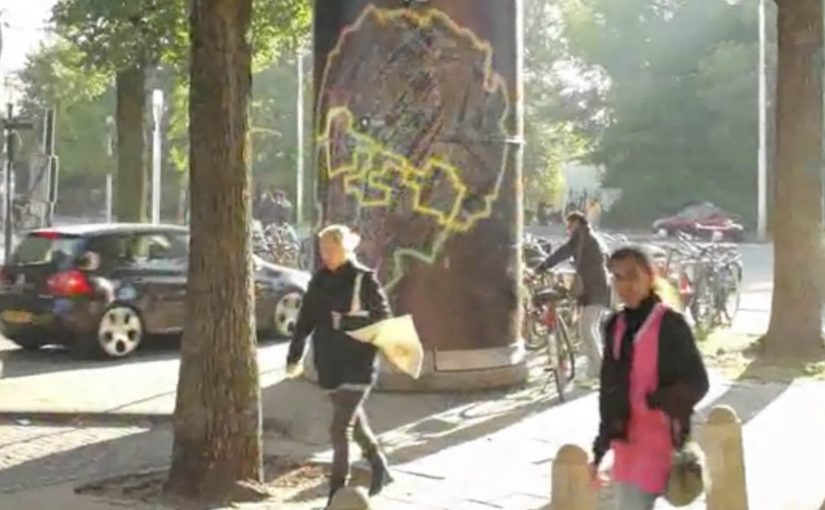
Nike Take Mokum: graffiti you paint by running

Boondoggle Amsterdam came up with a campaign for Nike that made running less serious. They distracted youngsters from their boring running schedules and challenged them to release their creativity on Amsterdam by using their feet as paint instead.

A Facebook app called “Take Mokum” (Amsterdam’s local nickname) was developed that allowed runners to make digital graffiti on the map of Amsterdam. All they had to do was actually run the route and upload their KMs with Nike+. The app would then paint the graffiti for them. These graffiti pieces could then be shared, and liked fanatically.

Running as a creative tool, not a discipline

The mechanism is beautifully simple: convert effort into expression. The runner designs a “tag” by choosing a route. The city becomes the canvas. Nike+ becomes the proof that the route was actually run. Then the app visualises the path as graffiti, so the output feels like art rather than exercise data.

That flips the motivation model. You are not running to hit a number. You are running to create something worth showing.

Why it lands with youngsters

This campaign taps into identity and visibility. Graffiti culture is about leaving a mark. Take Mokum lets people do that in a digital layer without vandalising anything. The “like” loop adds social reward. The route becomes content, not just a workout.

It also removes the seriousness that can make running feel like punishment. The challenge is playful. The accomplishment is shareable.

The intent: make Nike’s running promise felt, not claimed

The business intent is aligned with Nike’s broader mission to change running. Instead of telling young people that running is cool, the campaign makes running a means to do something else: create, compete for attention, and express style. The product story is embedded in the behaviour.

The result: young Amsterdam started running, and Nike’s mission to change running was actually experienced by youngsters.

What to steal from Take Mokum

  • Turn effort into an artefact. People stick with habits when the output feels worth keeping or sharing.
  • Let users design the challenge. The route is the creative input. That increases ownership.
  • Use data as validation, not as the headline. Nike+ proves the run. The graffiti is the reward.
  • Build a social loop. Sharing and liking are not add-ons. They are the motivation engine.
  • Match the culture. The campaign borrows from street expression rather than “fitness discipline”.

A few fast answers before you act

What is Nike Take Mokum?

It is a Facebook app that lets runners create digital graffiti on an Amsterdam map by running a route and uploading the kilometres through Nike+.

How does the app turn a run into graffiti?

The runner’s route becomes the “drawing”. After the Nike+ upload, the app visualises the path as a graffiti-like mark on the city map.

Why is this motivating compared to a normal running plan?

Because the reward is creative and social. You produce something you can share and get reactions to, not just a time and distance record.

What audience behaviour did this campaign aim to create?

To get young people running by making the activity feel playful, expressive, and socially visible, rather than structured and serious.

What is the key takeaway for behaviour-change campaigns?

Motivation improves when you convert effort into identity. Give people a way to express themselves, then let the community reinforce it.

Mercedes-Benz: Tweet-Fueled Road Trip Race

In February this year four two-person teams left four cities, Chicago, Los Angeles, New York City, and Tampa Bay, to goto Dallas, Texas in a custom-designed Mercedes-Benz car that was fuelled by Twitter.

Of course the cars were not physically running on tweets, but virtually they were. The reason for Mercedes-Benz saying that the race was “Tweet-Fueled” was because each of the four teams had to get the support of their home cities to drum up enough support on Twitter to get them to the finish line in Dallas.

In the end the campaign had almost 30,000 active participants with over 72,000 Facebook Fans and 77,000 Twitter Followers who generated over 150,000+ tweets to power the cars. The campaign videos generated about 2 million views, while the twitter reach pushed over the 25 million mark.

Why “tweet-fueled” is more than a gimmick

The smart move is that social support is not commentary. It is the engine of progress. That turns spectators into participants, because every tweet has a clear meaning. It helps your team move.

  • Clear cause and effect. Tweets translate into distance and momentum.
  • City pride as a driver. Chicago vs LA vs NYC vs Tampa gives the story a natural rivalry.
  • Built-in recruiting. Teams need their cities, so they recruit friends to contribute.

How the campaign design created scale

The structure is simple. Four teams. One destination. A visible race. But it is the social mechanics that create the volume.

  1. Teams need advocates. Supporters feel like they are part of the outcome.
  2. Progress is trackable. People return when they can see movement and standings.
  3. Video extends the narrative. Moments from the road give the audience something to share beyond the scoreboard.

In real-time social entertainment, participation scales when the audience can visibly change the outcome, not just comment on it.

What to take from this if you build real-time social campaigns

  1. Make participation meaningful. If the social action changes the outcome, people care more.
  2. Create teams and identity. Groups recruit. Individuals browse.
  3. Design a visible progress loop. Standings and milestones keep engagement alive.
  4. Use content to refresh attention. Videos give people new reasons to re-share and re-engage.

A few fast answers before you act

What was the Mercedes-Benz Tweet-Fueled race?

It was a social-powered race where four teams drove from Chicago, Los Angeles, New York City, and Tampa Bay to Dallas, and their progress was powered virtually by Twitter support from their home cities.

Why were the cars called “tweet-fueled”?

Not because tweets powered engines physically, but because tweets served as the mechanism that enabled teams to accumulate the support needed to reach the finish line.

What were the reported results?

Almost 30,000 active participants, over 72,000 Facebook fans, 77,000 Twitter followers, more than 150,000 tweets, about 2 million video views, and Twitter reach exceeding 25 million.

Why does the city-based structure matter?

It creates rivalry and pride, which motivates supporters to participate and recruit others to help their team advance.

What is the transferable lesson?

If you can turn social activity into measurable progress toward a clear goal, you can convert audience attention into sustained participation.