
Slide to Unlock: Audi and Amnesty iAds

Audi “Slide to Unlock”

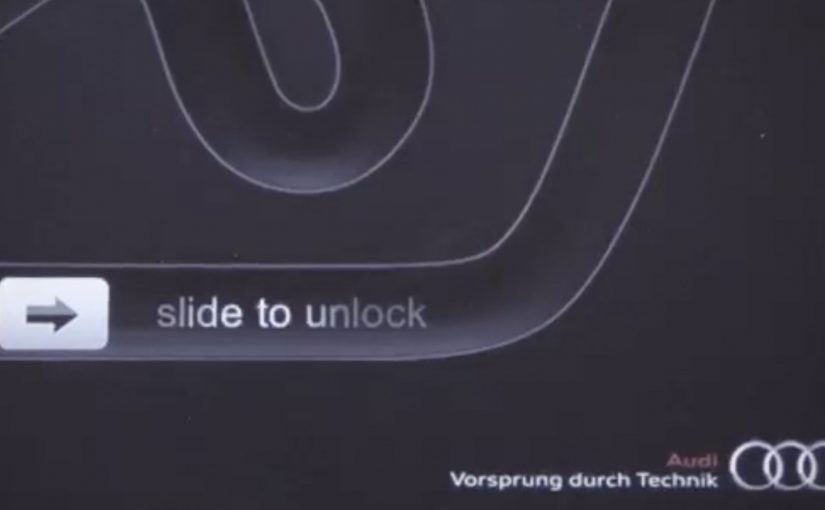
AlmapBBDO Brazil developed a distinctive iAd for the Brazilian Audi Magazine iPad app. Here, “iAd” refers to an interactive in-app ad unit built for iPad publications. The ad appeared in iPad publications and played with Apple’s familiar “Slide to Unlock” gesture to pull people into the experience.

Users instantly recognised the swipe interaction used to unlock Apple devices. After racing their finger around the track, they were rewarded with a free download of the first Audi Magazine issue from the App Store.

Amnesty International “Slide to Unlock the Truth”

Amnesty International ran an iAd in one of Sweden’s largest newspapers, DN, presenting readers with an image of a prison cell and a prisoner inside. The same “Slide to Unlock” gesture opened the cell and revealed a strong invitation to join Amnesty International as an activist.

Mechanic: borrow muscle memory, then repay it with value

Both executions use the same trick. They take an interaction people already know, then remap it to a brand action. In Audi’s case, the swipe becomes a playful mini-game. In Amnesty’s case, the swipe becomes a literal unlock that reveals a call to action.

In iPad-era rich media placements, the fastest engagement comes from interactions that feel native to the device instead of invented for the ad.

The real question is whether the gesture is already learned, so the first second goes to the message instead of the UI.

This approach is worth using when you can deliver a clear payoff within one gesture and one reveal.

Why it lands

The shared win is immediacy. There is no learning curve. The interface is already familiar, so attention goes straight to the message. Audi uses that familiarity to reduce friction on a content reward. Amnesty uses it to make the metaphor physical and emotionally legible.

Extractable takeaway: If you want interaction inside an ad to feel effortless, borrow a gesture people already trust, then make the outcome either instantly rewarding or instantly meaningful.

What to steal from gesture-first iAds

  • Start with a native gesture. Familiar interaction reduces drop-off in the first seconds.
  • Make the mapping obvious. Swipe-to-race and swipe-to-open both explain themselves.
  • Reward immediately. Audi pays the user back with a free issue. Amnesty pays back with a clear reveal and a direct next step.
  • Keep the loop short. One gesture, one transformation, one outcome.
  • Let metaphor do the work. Amnesty’s “unlock” is not decoration. It is the message.

A few fast answers before you act

What is the core idea behind “Slide to Unlock” iAds?

They repurpose a familiar device gesture to trigger a brand action, reducing friction and making interaction feel instinctive.

Why does borrowing a system gesture increase engagement?

Because users already know what to do. That removes instruction time and makes the first interaction feel safe and predictable.

What is the key difference between the Audi and Amnesty uses of the gesture?

Audi uses it for playful interactivity and a content reward. Amnesty uses it as a literal metaphor that reveals a persuasive call to action.

What is the biggest risk when using familiar UI patterns in ads?

If the gesture mapping feels unclear or gimmicky, people feel tricked. The interaction must lead to a payoff that justifies the borrowed familiarity.

What should you measure if you run an interaction-led ad?

Interaction start rate, completion rate, time-to-first-payoff, post-interaction clicks, and whether the interaction improves recall of the message.

VGT: Fur iAd that bleeds when you swipe

VGT (an association combating animal factories), working with Austrian agency Demner, Merlicek & Bergmann, created an iAd, an interactive tablet ad unit, for the iPad edition of DATUM magazine.

The iAd shows a young woman wearing a fur coat. When the iPad user tries to continue browsing with the familiar finger-wipe movement, each swipe leaves a blood stain on the fur. The more you try, the more blood appears, turning a simple “next page” gesture into the message.

A navigation gesture that becomes the accusation

The clever part is that nothing “extra” is required from the user. No quiz. No mini game. No new behaviour. The iAd hijacks the most natural behaviour on the device. Swiping to move on. That is why it feels so sticky. The ad does not ask for attention. It punishes avoidance.

The mechanism: friction by design

Most advertising tries to reduce friction. This does the opposite. It introduces deliberate friction at the exact moment the audience normally exits. That choice forces a small pause, and that pause is where the ethical point lands. For tablet units, this kind of purposeful friction beats bolt-on interactivity that can be ignored.

In tablet-first media environments, gesture-based interactivity can turn a standard placement into a moral confrontation.

The real question is whether your interaction makes the viewer complicit, or merely entertained.

Why it lands even if you dislike shock tactics

This is not shock for spectacle. It is shock attached to an action the viewer chooses. You create the stains. That’s what makes the experience uncomfortable in a more personal way than a static image could. It also matches the medium. The iPad is intimate. It’s held close.

Extractable takeaway: When touch is the medium, tie consequence to a habitual gesture so the argument is felt in the hand, not just read on the screen.

How to borrow this for tablet units

  • Exploit a native gesture. Swipe, pinch, tap, drag. If the gesture is already habitual, the learning curve disappears.
  • Make the interaction mean something. The response should be the argument, not just a visual flourish.
  • Use friction sparingly and intentionally. Only add resistance when the resistance is the point.
  • Design for instant comprehension. The first swipe should explain the whole idea.
  • Earn the discomfort. If you push people emotionally, the payoff must be clarity, not confusion.

A few fast answers before you act

What is the VGT iAd concept in one sentence?

An iPad iAd that prevents an easy page swipe by leaving blood stains on a fur coat every time you try to move on.

Why use the swipe gesture instead of a video or a static image?

Because swiping is an action the user performs. When the consequence appears immediately, the viewer feels involved rather than merely informed.

Is this an example of “interactive storytelling” or “interactive persuasion”?

Both. The story is minimal, but the persuasion is embodied. The interaction itself carries the moral logic.

When does this kind of tactic backfire?

When the shock feels disconnected from the cause, when the friction blocks people without a clear point, or when the execution reads as manipulation rather than meaning.

What is the simplest way to apply this pattern ethically?

Use a familiar gesture, create an immediate consequence tied to the message, and ensure the user can still exit once the point is delivered.

AXA: iPhone App for Car Accidents

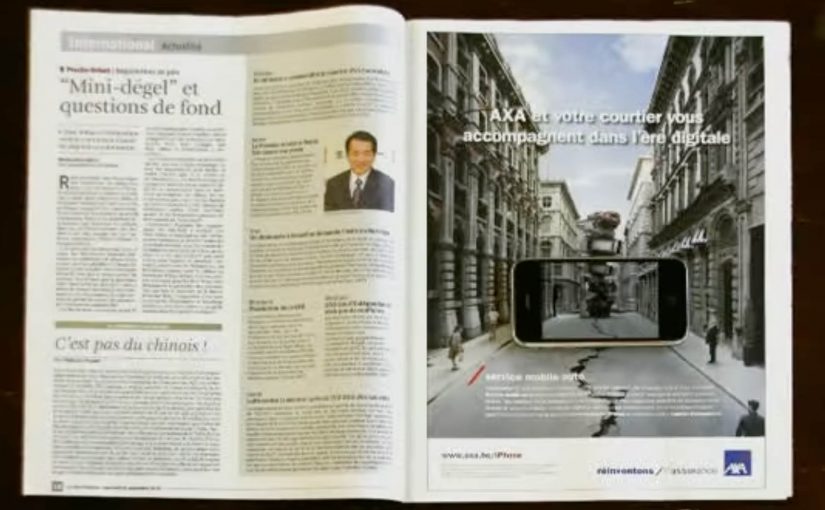
AXA is Belgium’s first insurance company to launch an iPhone app. Their free application helps and guides you through some basic steps when you have a car accident.

To launch this new app Duval Guillaume Antwerp / Modem from Belgium created an innovative print ad that required your iPhone to complete the message.

Why the print idea is a smart match

The product promise is practical. Help me when I am stressed and do not know what to do next. The launch mirrors that by making the iPhone essential to “finishing” the ad, so the viewer experiences the role of the phone immediately. Because the viewer has to use their own device to complete the message, the concept is remembered as help in the moment, not a feature claim. In European insurance marketing, the first interaction needs to make crisis guidance feel tangible.

Extractable takeaway: If your product is built for high-stress moments, design the launch so people experience the first step, not a promise about steps.

  • Device as the missing piece. The iPhone is not just where the app lives. It is how the message becomes complete.
  • Low barrier to understanding. You do one simple action and the concept clicks.
  • Print-to-mobile bridge. The campaign uses print to trigger a mobile behavior, instead of treating print as a dead end.

What to reuse from this approach

The real question is whether your launch makes someone feel guided before they have to believe you.

If the utility of your app is “guidance in a critical moment”, your launch should demonstrate guidance, not describe it. By “guidance”, I mean a few clear, step-by-step prompts that reduce decision load when people are stressed. A small, tangible interaction can do that faster than any list of features.

  • Start with one action. Give people a single, low-friction step that mirrors the moment your app is built for.
  • Make the device essential. Let the phone complete the story so the product role is experienced, not inferred.
  • Bridge media into behavior. Use the channel to trigger the next step, not just to carry copy.

A few fast answers before you act

What does the AXA Belgium iPhone app do?

It helps guide drivers through basic steps after a car accident, providing practical assistance when they need it most.

Who created the print launch ad?

Duval Guillaume Antwerp / Modem (Belgium) created the print execution to launch the app.

What made the print launch ad innovative?

The print execution required the viewer’s iPhone to complete the message, turning the phone into an active part of the ad rather than a separate channel.

Why is this a strong launch mechanic for an insurance app?

It demonstrates the phone’s role as a helper in-the-moment, which aligns directly with the app’s accident-assistance promise.

What is the transferable pattern?

Design a simple physical or media trigger that forces a first interaction with the device. Then let that interaction explain the product in seconds.