
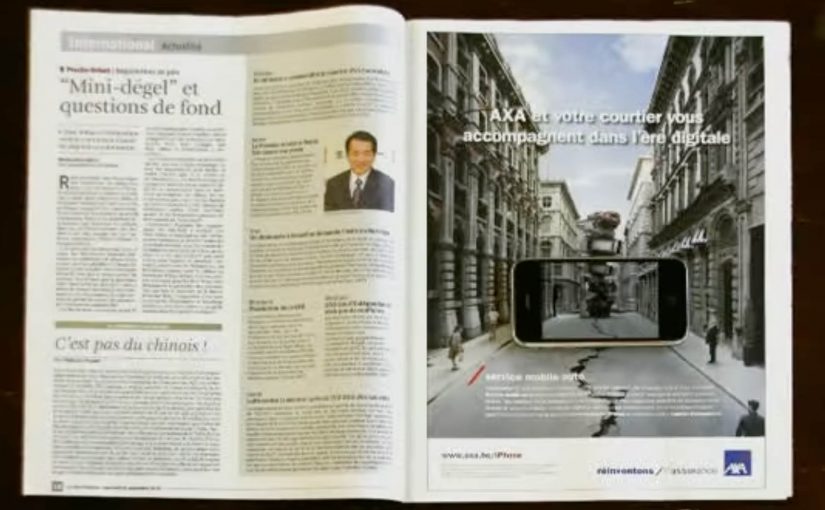
AXA: iPhone App for Car Accidents

AXA is Belgium’s first insurance company to launch an iPhone app. Their free application helps and guides you through some basic steps when you have a car accident.

To launch this new app Duval Guillaume Antwerp / Modem from Belgium created an innovative print ad that required your iPhone to complete the message.

Why the print idea is a smart match

The product promise is practical. Help me when I am stressed and do not know what to do next. The launch mirrors that by making the iPhone essential to “finishing” the ad, so the viewer experiences the role of the phone immediately. Because the viewer has to use their own device to complete the message, the concept is remembered as help in the moment, not a feature claim. In European insurance marketing, the first interaction needs to make crisis guidance feel tangible.

Extractable takeaway: If your product is built for high-stress moments, design the launch so people experience the first step, not a promise about steps.

  • Device as the missing piece. The iPhone is not just where the app lives. It is how the message becomes complete.
  • Low barrier to understanding. You do one simple action and the concept clicks.
  • Print-to-mobile bridge. The campaign uses print to trigger a mobile behavior, instead of treating print as a dead end.

What to reuse from this approach

The real question is whether your launch makes someone feel guided before they have to believe you.

If the utility of your app is “guidance in a critical moment”, your launch should demonstrate guidance, not describe it. By “guidance”, I mean a few clear, step-by-step prompts that reduce decision load when people are stressed. A small, tangible interaction can do that faster than any list of features.

  • Start with one action. Give people a single, low-friction step that mirrors the moment your app is built for.
  • Make the device essential. Let the phone complete the story so the product role is experienced, not inferred.
  • Bridge media into behavior. Use the channel to trigger the next step, not just to carry copy.

A few fast answers before you act

What does the AXA Belgium iPhone app do?

It helps guide drivers through basic steps after a car accident, providing practical assistance when they need it most.

Who created the print launch ad?

Duval Guillaume Antwerp / Modem (Belgium) created the print execution to launch the app.

What made the print launch ad innovative?

The print execution required the viewer’s iPhone to complete the message, turning the phone into an active part of the ad rather than a separate channel.

Why is this a strong launch mechanic for an insurance app?

It demonstrates the phone’s role as a helper in-the-moment, which aligns directly with the app’s accident-assistance promise.

What is the transferable pattern?

Design a simple physical or media trigger that forces a first interaction with the device. Then let that interaction explain the product in seconds.

Durex: Baby App

Making the consequence tangible, not the lecture louder

In consumer health marketing, the hardest problems are rarely about information. They are about motivation in the moment. This Durex idea is a clean example of turning a behavior barrier into an experience.

Condoms can feel like a downer. So how do you convince guys to put one on, and make Durex the favored choice?

This is the right move when information is not the problem. Make the consequence tangible, not the lecture louder.

Using the iPhone, Nicolai Villads, Peter Ammentorp and Raul Montenegro created what is called the Durex Baby application for the iPhone.

How the Durex Baby app worked as a behavioral nudge

The mechanism was simple. If the barrier is that protection feels like a mood killer, shift attention to what happens without it.

The app simulated the realities of having a baby, using the phone as a constant companion device. It turned an abstract risk into a persistent, personal experience that could be felt rather than explained. Because the phone stays close, the simulation can interrupt everyday moments, which is why it lands as a nudge instead of a lecture.

In consumer health marketing, consequence simulation works best when the audience already knows the facts but needs a visceral prompt.

The real question is how you make “responsible” feel like the easiest choice in the moment.

Why simulation can change decisions faster than persuasion

Most messaging about safe sex competes with optimism bias, the tendency to assume consequences happen to someone else. A simulation reduces that distance by making “later” feel like “now,” reframing the trade-off from short-term inconvenience to long-term responsibility.

Extractable takeaway: When persuasion stalls, build a simulation that collapses time and personal distance so the audience feels the outcome and re-evaluates the trade-off on their own.

The intent behind building it for Future Lions

The app was created for the Future Lions 2010 competition organized by digital agency AKQA and the Cannes Lions Advertising festival.

The business intent is clear. Use mobile to translate a sensitive topic into a playful but pointed interaction that can travel socially and be discussed without heavy moralizing, while keeping the brand associated with the responsible choice.

What to borrow from Durex Baby

  • Turn abstract risk into felt experience. Simulation can outperform warnings when the audience tunes out lectures.
  • Use the device people always carry. Mobile is effective when the behavior change depends on everyday moments.
  • Reframe the trade-off. Move attention from short-term friction to long-term consequence in a way people can grasp instantly.
  • Make it discussable. Playful interaction can open conversation on topics people avoid in direct language.

A few fast answers before you act

What is the Durex Baby app?

An iPhone app concept that simulates the realities of having a baby to encourage safer choices and reduce resistance to using condoms.

What was the core mechanism?

Behavioral reframing through simulation. The phone delivers an ongoing experience that makes the consequence of not using protection feel immediate.

Why does this approach work better than a warning for some audiences?

Because it reduces optimism bias. People are more likely to change behavior when the consequence feels personal and present, not distant and theoretical.

What business goal does it serve for Durex?

Positioning the brand as the responsible default choice by shifting the decision from mood-based resistance to consequence-based clarity.

What is the main takeaway for marketers?

If persuasion is failing, design an experience that makes the outcome feel real, then let the audience reach the conclusion themselves.

Apple: 12 Days of Christmas

Is it just me or is Christmas this year turning out to be very Apple.

Here is Apple making Christmas news again. This time with their new TV ad.

The ad reworks the standard Christmas carol of the same name to feature twelve iPhone applications related in some way to the holiday season.

  • 12 cookies cooking: The Betty Crocker Mobile Cookbook (Free)
  • 11 cards a’ sending: Postman ($2.99)
  • 10 gifts for giving: My Christmas Gift List ($0.99)
  • 9 songs for singing: TabToolkit ($9.99)
  • 8 bells for ringing: Holiday Bells ($0.99)
  • 7 slopes a’ skiing: Snow Reports ($1.99)
  • 6 games for playing: Christmas Fever ($0.99)
  • 5 gold rings: Anna Sheffield Jewelry (Free)
  • 4 hot lattes: myStarbucks (Free)
  • 3 flights home: Flight Search (Free)
  • 2 feet of snow: Weather Pro ($3.99)
  • And an app that can light up the tree: Schlage LiNK (Free but hardware required)

What the spot is really doing

The mechanism is a catalog disguised as a carol. Each lyric is a micro use case, and each use case quietly argues that “apps” are the reason the device feels personal in December, not just powerful on paper.

In consumer technology categories where feature lists blur quickly, showing everyday use cases beats claiming capability.

The real question is how to make an ecosystem feel instantly useful without falling back on a feature list.

Why it lands

It is lightweight, instantly recognisable, and structured for memory. You already know the song, so the ad can spend its time on the parade of utility and novelty instead of on explanation.

Extractable takeaway: If you want to sell a platform, turn your ecosystem into a familiar format people can hum, then make each beat a concrete “I can use that” moment.

What platform marketers can borrow

  • Use a cultural template. Borrow structure from something the audience already carries.
  • Keep each benefit bite-sized. One line per use case is enough when the rhythm does the glue work.
  • Let variety do the persuasion. A spread of small moments can outperform one big claim.

A few fast answers before you act

What is this Apple “12 Days of Christmas” ad?

A holiday TV spot that rewrites the classic carol to showcase twelve iPhone apps tied to seasonal moments.

What is the core mechanism?

A familiar song structure becomes a rapid-fire list of app use cases, turning the App Store into the product story.

Why does the format work so well for apps?

Because apps are easiest to understand as situations, not specs. The carol format delivers situations at speed while staying coherent.

What is Apple really selling here?

The ad sells the iPhone as an entry point to a seasonal ecosystem of useful apps, not just as a piece of hardware.

What should I copy if I am marketing a platform?

Package the ecosystem as a set of quick, concrete jobs-to-be-done, then anchor them in a structure the audience already recognises.