
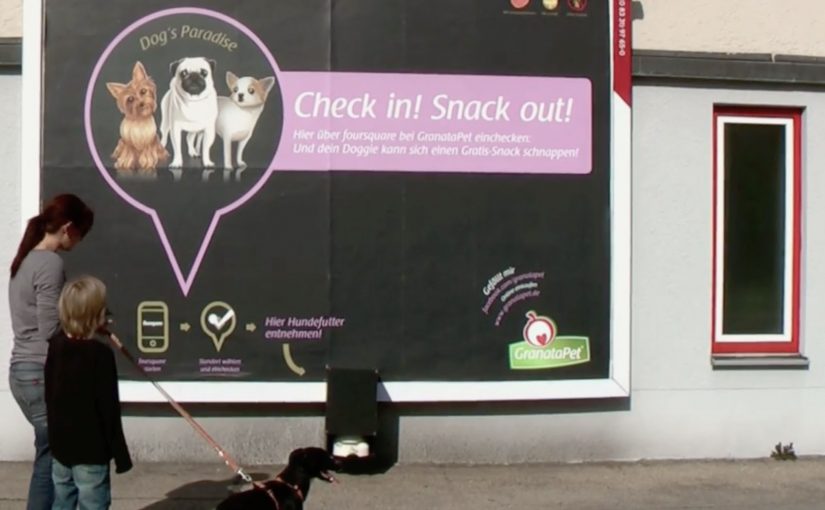
GranataPet: Check In, Snack Out

GranataPet is one of the innovative leaders of high premium pet food in Germany. Their agency, agenta, was given the challenge to create awareness for GranataPet dog food on a slim budget.

The idea targets dog owners at the exact moment they are most open to noticing pet-related messages. While walking their best friend. Socially activated installations are placed on key walking routes. Dogs catch the scent of treats, stop, and pull their owners toward a billboard that simply says “Check in. Snack out”.

A sampling demo that your dog starts for you

This is a classic trial mechanic with a smart trigger. Instead of asking humans to approach a promoter, the dog does the targeting. The owner follows the leash. Then the message becomes self-evident. Check in with Foursquare to activate a free bowl of dog food.

How the mechanism works

The billboard combines three parts. A location check-in prompt, a connected dispenser and bowl, and a social echo via the check-in behavior, meaning each check-in can create additional visibility beyond the street placement itself. When a user checks in at the billboard’s location, the system releases a portion of food into the bowl. The owner watches the dog’s reaction in real time, which functions as the product demo.

In pet food sampling, the highest-converting trial moments are the ones where the animal can deliver an immediate preference signal in front of the owner.

The real question is whether the brand can turn a routine walk into a low-friction proof moment that the owner trusts more than advertising copy. The stronger move here is to let the dog, not the promoter, make the case.

Why it lands

It is easy to trigger, well-timed, and emotionally loaded. The owner does not have to imagine whether the dog will like the food. They see it. That works because a visible reaction from the dog removes guesswork faster than any product claim can. The social layer then turns one local poster into distributed impressions, because check-ins can surface to friends depending on settings. The most important part is that the “proof” is not the copy on the billboard. It is the dog’s behavior.

Extractable takeaway: If your product decision depends on a third party’s preference, build a live demo where that third party delivers the verdict on the spot, and use a simple location trigger to scale it.

What the brand is really buying

This is awareness, trial, and measurable demand in one loop. The execution creates talk value, it generates trackable interactions per location, and it pushes owners toward retail purchase after a positive in-the-moment test. Trade coverage at the time also described increased local demand following the activation.

What pet food marketers can steal from this

  • Target the moment, not the demographic. Dog-walking routes beat broad reach when the category is specific.
  • Let behavior be the headline. A happy dog is more persuasive than any claim line.
  • Make the trigger simple. One action. One reward. No explanation tax.
  • Use the environment as your interface. The billboard is the call-to-action and the proof point.
  • Instrument the activation. Location check-ins can double as measurement, not just distribution.

A few fast answers before you act

What is “Check in, snack out” in one sentence?

An interactive billboard that dispenses free dog food when a nearby owner checks in using a location service.

Why does this outperform a normal sampling stand?

The dog initiates the interaction, and the product proves itself immediately through the dog’s reaction, which reduces hesitation for the owner.

What makes the social layer valuable here?

Check-ins can create secondary reach beyond the physical location, and they can be used to track which placements generate the most interactions.

What is the biggest operational risk?

Reliability. If the dispenser jams or the trigger fails, the experience collapses and the brand takes the blame.

How would you adapt this without Foursquare?

Keep the same structure. A location trigger plus instant physical reward. Use whatever mobile mechanism your audience already uses for quick opt-in and confirmation.


Dentsu: iButterfly Location-Based Coupons

Coupons with wings: iButterfly turns deals into a mobile hunt

Here is a great example of Online, Mobile and Shopper Marketing converging with Augmented Reality (AR), where the phone camera view becomes the backdrop while digital objects are overlaid and tied to location signals like GPS. Integrated Marketing literally put into the hands of the people.

Japanese ad agency Dentsu has started this experimental coupon download platform called iButterfly on the iPhone. The free iPhone app transforms the habit of collecting coupons into a fun little game using AR and the device’s GPS.

The mechanic: catch a butterfly, unlock a coupon

The app tasks its users with catching virtual butterflies that are flying around, each representing one or more coupons. You can even share “butterflies” with your friends via Bluetooth.

In this context, the phone camera view becomes the backdrop, while digital objects, here butterflies, are overlaid and tied to location signals like GPS.

In retail and FMCG shopper marketing, the value of this approach is that promotions become a location-linked experience, not a passive download.

Why this format works for targeted promotions

The key shift is motivation. People are not “clipping” coupons. They are playing a simple collecting game, and the reward is a deal that feels earned. That feeling is why the offer holds attention long enough to drive action.

Extractable takeaway: When an offer is packaged as a collectible tied to place and moment, it feels context-aware rather than generic. Treat location as part of the experience, and keep the capture-to-redemption path short so the “find” turns into a real reward.

What Dentsu is really prototyping here

This is less about novelty AR and more about a new distribution behavior. Turning offers into collectible objects changes how often users open the app, how long they stay in it, and how naturally they talk about it with friends.

The real question is whether your promotion can create a repeat habit, not just a one-time redemption.

This format is worth copying when you can tie the reward to a real place and keep redemption friction near zero.

It is also a rare example where “share with a friend” is not a marketing CTA. It is a gameplay action that carries the promotion with it.

Shopper activation moves to copy from iButterfly

  • Make the reward immediate. Catch. Unlock. Redeem. Long funnels kill the game loop, the simple repeat cycle of catch, unlock, redeem.
  • Use location as a story, not a filter. Place rewards where people already go, so the map feels meaningful.
  • Let sharing be part of the mechanic. A tradable object beats a generic “share this” button.
  • Keep the collection simple. If users need a manual, they will not hunt.

A few fast answers before you act

What is iButterfly?

iButterfly is a mobile coupon platform that turns deal collection into a location-based AR game. Users catch virtual butterflies on their phone and unlock coupons as rewards.

How does the AR coupon mechanic work?

Users view the real world through the phone camera. Virtual butterflies appear and can be “caught”. Each butterfly contains one or more offers, which unlock after capture.

Why is this relevant for shopper marketing?

It shifts promotions from passive browsing to active discovery. Location and gameplay increase attention, repeat usage, and the likelihood of in-the-moment redemption.

What makes it feel targeted rather than random?

Butterflies can be tied to locations and contexts via GPS. That links the offer to where the shopper is, not just who they are.

What is the biggest execution risk?

If redemption is hard or the rewards feel weak, the novelty wears off fast. The game loop only survives when the payoff is clear and friction stays low.

The North Face: Red Flags in China

The North Face in China turns a simple outdoor ritual into a phone-powered race. You “plant” a virtual red flag to claim a location. You get the bragging rights of being first. Then you try to out-plant everyone else.

A modern take on the oldest explorer move in the book

Planting a flag is a universally understood symbol. It’s the shorthand for “I was here first.” This campaign borrows that instinct and digitizes it, so the only equipment you need is a mobile phone.

The mechanic: claim a place, then defend your status

At the heart of the idea is a competitive map. Participants place virtual red flags on locations they discover, and the campaign keeps score so “firsts” become collectible. It’s a light-touch way to make exploration feel like a game you can win, not just a virtue you should aspire to.

In fast-growing outdoor markets where many people are still taking their first steps into hiking culture, this kind of social competition is an effective on-ramp.

Why it lands: it converts curiosity into a scoreboard

Outdoor positioning often sounds lofty. “Explore more.” “Get outside.” The problem is that those ideas are hard to act on today, especially in cities where “nature” is not a default habit.

Extractable takeaway: If you want behavior change, give people a visible “progress signal” they can earn quickly. A simple status marker (first, top 10, streak, champion) turns vague aspiration into a repeatable loop.

Red flags work because they’re instantly legible. You don’t need instructions to understand what it means to claim something, and you don’t need a long explanation to feel the urge to beat someone else to the next spot.

The real question is how do you turn exploration from a brand line into a repeatable action people want to perform?

The business intent: make “Never Stop Exploring” measurable

This is a smart brand move because it makes “Never Stop Exploring” visible as behavior instead of leaving it as a slogan.

Case-study write-ups describe this as an integrated push that blends mobile participation with on-ground visibility and retail activation. The core goal is to move the brand from “admired” to “acted on”, by making exploration something people can start immediately, then repeat.

What brand teams can steal from Red Flags

  • Use a symbol people already understand: flags, stamps, passports, badges. Familiar metaphors reduce friction.
  • Turn progress into a public artifact: a claimed location or visible marker is more motivating than a private point total.
  • Design for repeat loops: one action should naturally suggest the next one.
  • Make competition optional but obvious: the scoreboard should be there for people who want it, without blocking casual participation.
  • Reward “first steps”: the earliest wins matter most when you’re trying to create a new habit.

A few fast answers before you act

What is the Red Flags idea in one sentence?

The Red Flags idea is a mobile competition where people plant virtual red flags to claim places and earn status for being first, encouraging more exploration through a simple scoreboard.

Why does “claiming a location” work so well?

Claiming a location works because it makes exploration feel personal and scarce. Once a place is “yours”, you feel ownership, and ownership increases repeat behavior.

Is this gamification or location-based marketing?

Red Flags is both gamification and location-based marketing. The location is the proof of action, and the game layer, claims, status, and competition, supplies motivation and repeatability.

What’s the main risk in copying this mechanic?

The main risk in copying this mechanic is overcomplicating it. If placing the first marker takes too long or requires too many steps, you lose the impulse that makes the idea work.

What’s a modern equivalent if you don’t want maps?

A modern equivalent without maps is any “claimable” unit: completing a route, checking in at partner venues, finishing a micro-challenge, or earning a time-bound “first” in a shared feed.